









It was just on 1 April that Donald Trump thundered yet again, threatening to “bomb Iran to the Stone Age”. He caught those by surprise who were hoping that he would announce the end of the war, accompanied by a declaration of some vague victory. Trump’s message to the world suffering from the results of his war was that those interested in opening the Strait of Hormuz should make their own efforts.
Besides leaving the world more confused and worried, Trump has made people wonder about the possibilities of ending the war. There are three problems regarding this difficult question: on what terms will the war end, how will the warring parties agree to end the conflict, and who will negotiate the cessation of hostilities?
All these issues are difficult, especially when one cannot assume with certainty what would make Trump happy—is it to force Iran to surrender its nuclear or missile technology, change the regime, or destroy it to pieces? And it is not even clear when he will feel satisfied about attaining either of his objectives. What should also be clear is that Trump may often give the impression that he is about to announce the end of the war, but he has no intention to do so.
Trump’s list of desires, on the other hand, tends to make the Iranian regime persistently belligerent. It is not left with an air force or navy, but has battle-hardened soldiers and Revolutionary Guards, and, thus far, an intent to go down fighting, especially if its destruction is its enemy’s intent. Unfortunately, all of this is happening at a time when the global geopolitical system established after the end of the Second World War has collapsed. Trump has practically killed the United Nations, and there is no power structure around to help negotiate between the warring parties. This is what makes the role of anyone who may appear non-partisan and exchange messages critical.
A dearth of messengers
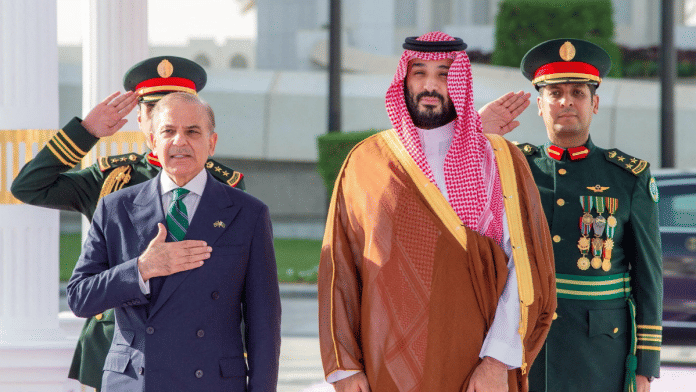
In an environment where countries of the Middle East are partisan and have an interest in seeing the US dominate Iran, there is no one in the region who could carry messages. It seems that countries such as Turkey and Oman have withdrawn from facilitating talks, which leaves Pakistan as the only one still able to do so. This is despite the fact that Pakistan is not entirely neutral—especially by virtue of signing the ‘mutual strategic defence agreement’ with Saudi Arabia in September 2025, which binds Islamabad in a commitment to fight with Riyadh in case the latter opts to actively jump into the conflict.
There are no two opinions or divisions among Pakistan’s ruling elite regarding which side they would take if there were a war between Tehran and Riyadh. But this is also what makes Islamabad active in making efforts to facilitate talks—it is conscious of the high cost of conflict if it expands to Saudi Arabia and Pakistan. Its role as a facilitator is what is helping Pakistan avoid getting involved in the war. This is the one option it has to convince Riyadh not to jump to its side in a conflict.
It is important to note that despite Iran continuing to bomb Saudi Arabia, which has American bases, Riyadh has still held back and not jumped into the war. The Saudis would rather Washington complete the job it started rather than contribute its own forces. This particular shade of Pakistan’s neutrality is appreciated by Tehran, which is not just conscious of the fact that Islamabad has condemned attacks on Iran but that it continues to strategically fence-sit. And this is precisely where Iran would like to see Pakistan sit and not get directly involved. If it did, Iran would activate Shia militancy in Pakistan, which would then result in a response. This is opening a front that both Iran and Pakistan are interested in remaining shut.
Over the last year, Pakistan has also acquired the advantage of establishing dialogue with the Trump administration. Prime Minister Shahbaz Sharif and Field Marshal Asim Munir’s pampering of Trump by nominating him for the Nobel Prize, constantly appreciating his role in ending the India-Pakistan conflict in 2025, and offering rare earth minerals may appear sycophantic. However, it gives Islamabad a limited advantage, especially as a carrier of messages pertaining to the ongoing conflict.
This is not to suggest that either party will necessarily listen to Pakistan. In fact, Foreign Minister Ishaq Dar’s recent visit to China, asking it to play a mediatory role, shows that mediation is beyond its power. The problem is that China itself is interested in the war ending, as it is one of the countries most affected, but it is not willing to jump into the conflict. This is really the problem of the global geopolitical system, where no state has enough political clout to get heard in Washington or even Tehran. According to sources in Islamabad I spoke with, the gathering of foreign ministers of Pakistan, Egypt, Turkey, and Saudi Arabia for a short meeting was a brainstorming session to find ways to convince Tehran to get to the table with the US, even for technical-level talks. However, the sources also said that Tehran refuses to engage until there is some indication of concession by Washington. It is said that Iran wants to begin with war reparations to be paid by the US, which is thus far a non-starter in the American capital.
Also read: The real risk in a ground operation in Iran. It’s not about US capability
No easy end to war
Clearly, Pakistan’s earnestness in ending the war is so that it doesn’t have to get directly involved and so it can bring relief to its economy, which will only come with relief to the world economy. In fact, the entire world is looking at Islamabad’s admittedly limited role as a facilitator due to the dearth of any other geopolitical player. The negative impact on the world economy, especially due to restrictions on passage through the Strait of Hormuz, will become more severe as the war is prolonged.
The Gulf countries and Israel have begun to talk about finding an alternative route through the Red Sea for the safe passage of oil and gas cargo. However, Iran’s continued ability to bomb its Arab neighbours and its proxies, such as the Houthis, can make even that project difficult. In any case, the alternative route is a long-term idea, not something that would provide immediate relief.
The world is indeed watching Pakistan as possibly the place where, if the warring parties agree to talk, a conversation of some kind could take place. Not surprisingly, ordinary folk, even in places such as the UK, have begun to ask what Pakistan is doing in bringing Iran and the US to the table. They may not realise the complexity of the matter or Pakistan’s limitations, but the space Islamabad has carved for itself as a facilitator is getting recognised.
It is, of course, no secret that sitting down and talking or agreeing to stop the war depends on Trump and Benjamin Netanyahu’s temper and capacity to keep pushing for gains. This is certainly not a war that is about to end easily. One could argue that the more important factor here is how much Trump feels affected by the impact of his decisions on his domestic political popularity, which has plunged. However, he is still not as unpopular as President Richard Nixon became during the Vietnam War, which eventually led to the US’s withdrawal from that conflict.
Ayesha Siddiqa is a senior fellow at the Department of War Studies at King’s College, London. She tweets @iamthedrifter. Views are personal.
(Edited by Prasanna Bachchhav)