






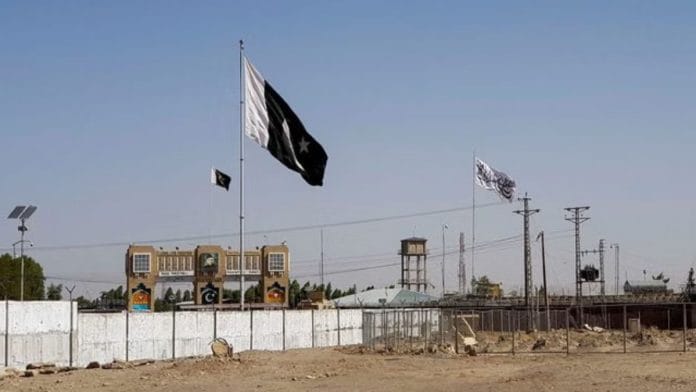



If you nurture snakes in your backyard, they will sooner or later bite you. It’s one of my favourite and oft-repeated lines. Hillary Clinton used it in 2011, in reference to Pakistan’s sponsorship of cross-border terrorism. This metaphor so aptly captures the flavour of the structural dilemma that Islamabad now faces.
Since Independence, military proxies served as instruments of strategic depth, shaping outcomes beyond Pakistan’s borders in neighbouring countries. Today, however, the shoe is on the other foot. Groups such as the Tehrik-i-Taliban Pakistan (TTP) now operate from Afghan soil and strike targets within Pakistan. At the same time, Kabul is resistant to Islamabad’s border enforcement measures.
Tensions between the two Islamic neighbours have been rising since 2021, when the Taliban came to power and took over the reins in Kabul. Once calibrated external leverage, the metaphorical snakes have mutated into a source of Pakistan’s internal vulnerability.
The lesson is not merely tactical but geopolitical: states that instrumentalise loose canons to manage disturbed frontiers end up with eroded borders and compromised domestic security landscapes.
Pakistan’s long-standing habit of disputing external boundaries while pushing for internal sanctity is now rebounding. For India, this presents an opportunity for strategic clarity and an opportunity to reassess a regional geopolitical landscape.
Durand line discord
The current conflict between Pakistan and Afghanistan is the result of long-simmering tensions over the international border between the two erstwhile regimes. The Durand Line came about through the agreement between the Emirate of Afghanistan and the British Empire in 1893 to improve diplomatic relations and trade, and fix the relative spheres of influence.
It is a 2,640 km long border that runs between Iran in the west and China in the East. It was inherited by Pakistan at the time of Independence in 1947 and skirts Pakistan-Occupied Kashmir, a territory that belongs to India.
Afghanistan was positioned as a buffer zone between Russia and Pakistan as a result of this line and is considered one of the most dangerous borders of the modern world from a geopolitical and geostrategic viewpoint.
Afghanistan has never formally accepted this border and insists that it is a colonial demarcation thrust upon them by imperialists who broke up ethnic Pashtun communities illegitimately.
Pakistan, however, treats the Duran Line as a border settled by international law and has repeatedly made attempts to fence the porous border from where drugs and arms (and terrorism) are transported freely. These fencing attempts have been resisted by successive Afghan governments. Even though over 95 per cent of the border has been fenced, dividing ethnic Pashtun communities on both sides, the border remains the source of tension between the two Islamic nations and is the immediate cause of the latest flare-up, as the Pashtun population doesn’t accept the interference or division of their land.
Those who forget history are condemned to revisit it. Decades of mutual interference have tested the Pakistan-Afghanistan relations. During the Soviet-Afghan War, Pakistan—with US backing—supported the mujahideen, the predecessors of the current-day Taliban, by arming them with American weaponry via this porous border.
In a post 9/11 world, Afghan refugees entered Pakistan and were hosted by Islamabad, which also accused Kabul of supporting Baloch separatists and other extremist groups. On the other hand, Afghanistan has accused Pakistan of assisting the Taliban and similar militants as proxies.
When the Taliban took over in 2021, they were initially welcomed by Pakistan, which hoped for support against the TTP, a Taliban splinter group that had become a major security threat and was responsible for thousands of deaths in Pakistan.
However, between 2023 and 2025, militant attacks surged, resulting in more than 500 deaths of Pakistani civilians and security personnel in Islamabad, Bajaur and Bannu. The Afghan Taliban has been accused of harbouring anti-Pakistan groups in Nangarhar, Khost and other regions.
At the same time, Pakistan has evicted over 1.7million Afgnan refugees by pushing them back over the border, leading to instability and uncertainty in the border regions of Afghanistan.
In February 2026, tensions escalated as border skirmishes intensified. Pakistan attacked Afghanistan on 21-22 February, claiming strategic and targeted victories. Afghan retaliation was swift, with ground and aerial attacks on Pakistan’s border areas like Khyber, Bajuar etc.
Pakistan launched Operation Ghazab Lil-Haq, Arabic for “Wrath for the truth” or “Righteous Fury” on 27 February. Pakistan, with its nefarious designs, has engaged in violence and deceit, which is contrary to anything righteous.
Double standards on POK
On the western front, Pakistan insists that the Durand Line be implemented as the international border. On its eastern front, however, Islamabad refuses to accept the legal finality of the accession of the erstwhile princely state of Jammu & Kashmir to India, an accession executed on 26 October 1947 through a formal Instrument of Accession signed by Maharaja Hari Singh and accepted the following day by Governor-General Lord Mountbatten.
Under the legal framework established by the Indian Independence Act 1947, princely states were legally empowered to accede to either dominion, and J &K’s accession followed the same constitutional mechanism as that of over 560 other princely states.
The constitutional validity of this accession has been consistently defended by eminent jurists, including former CJI Justice Mehr Chand Mahajan, who was the PM of J&K at the time. In his memoir Looking Back, he records the circumstances leading to the accession amid armed incursions from Pakistan’s side.
After the 1971 war and the Simla Agreement between India and Pakistan, the LoC was considered the de facto International border pending a final settlement. Even this arrangement was not accepted by Pakistan as a temporary stopgap, with successive Pakistani leaders making constant efforts to internationalise a bilateral issue, keeping the fire burning on this issue to date.
Pakistan’s position, therefore, rests on a paradox. On one hand, it demands the sanctity of colonial-era territorial arrangements in the west, while disputing a legally executed and internationally communicated act of accession in the east. Borders, thus, are permanent when inherited from the imperial colonisers, but unacceptable when derived from the constitutional process.
Also read: Rafale deal, AI summit, Sewa Teerth have something in common. See Verse 13.13 of the Gita
A strategic lesson for Pakistan
For decades, Islamabad played politics on border disputes. But geography cannot be moulded to suit the narrative of convenience. By investing in cross-border terrorism as an instrument to prove geographical supremacy, Pakistan now faces threats to its own territorial sovereignty from the very groups it has created. By contesting India’s border and constitutional frameworks, it weakened the normative principles of territorial finality. That principle is now being invoked against it. Snakes in the backyard and all that.
India can leverage a measured but intellectually firm response through a three pronged-approach.
- Establishing normative consistency: India should strongly reiterate the permanence of settled borders, whether through history, war, or constitutionally valid accession. These require bilateral respect.
- Diplomatic subtlety with Kabul: India can cautiously expand engagement with Kabul, with immediate focus on development and connectivity. The MEA has stated that it “strongly condemns Pakistan’s airstrikes on Afghan territory that have resulted in civilian casualties, including women and children, during the holy month of Ramadan”.
- Global narrative framing: India can grab this opportunity to emphasise the principle of territorial integrity as universal, not selective. Accepting the Durand Line as an international border and fencing it means there is no reason why Pakistan can claim PoK as its own territory and it must immediately give up all claims to the sovereign state of Jammu and Kashmir, which is and shall always remain an integral part of India.
Islamabad, with immediate effect, must give up all claims to Indian territories illegally occupied since 1947. This is the only way it can justify the morality of Operation Ghazab Lil-Haq.
The Pakistan-Afghanistan tensions are likely to mark a broad transition in South Asian geopolitics. Pakistan’s traditional anxiety has always been India-centric. Now that it faces friction on the western front, from once-allied Afghanistan, with another front opening up in Balochistan, Islamabad can safely take a stand against the snakes that are coming home to roost.
With China now being deflected to watching a war unfold with bigger stakes, this little neighbourhood skirmish may teach Pakistan a much-needed lesson in geostrategic warfare.
Meenakashi Lekhi is a BJP leader, lawyer and social activist. Her X handle is @M_Lekhi. Views are personal.
(Edited by Ratan Priya)