




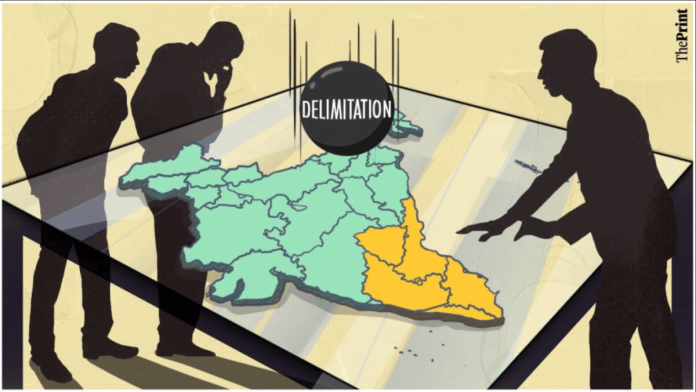

On the 135th birth anniversary of BR Ambedkar, Chairman of the Constituent Assembly’s crucial Drafting Committee, the government announced its proposed legislation to the Constitution. The three Bills seek to create a 33 per cent reservation for women in the Lok Sabha and the Legislative Assemblies of states and Union Territories (UTs).
The Constitution (131st Amendment) Bill, 2026 proposes to expand the strength of the Lok Sabha from 550 to 850 members (815 from states and 35 from Union Territories). This is to be done by amending Article 81 to allow for the increase and Article 82 to decouple delimitation from the mandatory “latest census” requirement, potentially allowing the use of 2011 Census data.
The Delimitation Bill, 2026 provides for the establishment of a new Delimitation Commission to readjust constituency boundaries and seat allocations. This will be the first major redrawing of boundaries proposed since 2002.
The Union Territories Laws (Amendment) Bill, 2026 seeks to apply similar electoral reforms and seat expansions to Union Territories, including Delhi, Puducherry, and Jammu & Kashmir.
The three Bills were reportedly made available on the MPs’ portal 48 hours before the Parliament’s upcoming session, which began Thursday.
Delimitation is course correction
From the time of freeze on Parliamentary representation based on the 1971 Census to the post-2011 Census, Indian states and Union Territories have seen a demographic metamorphosis. For over five decades since 1971, Parliament has remained under-represented in relation to the increase in population and demographic changes.
Many metropolitan cities have outgrown their original size and have added several satellite cities and townships. Massive urbanisation and migration have resulted in some constituencies—such as Malkajgiri in Telangana, Ghaziabad in Uttar Pradesh, and Bangalore North in Karnataka—having more than 20 lakh voters, making representation a mere formality. Issues such as constituency development, managing financial packages, and central schemes have become mere statistics with no effect on the ground. Delimitation of these constituencies should be seen more as creating a better administrative process than seat arithmetic.
The arithmetic of representation in democracy is based on people and not geography. The argument that the freeze of 1971 has protected the interests of states that managed population growth by reducing the birth rate is understandable. Distribution of seats based solely on the number of voters would amount to penalising some of the southern states for doing good work in social indices. At the same time, denying the people of some northern states their right to be represented adequately is a democratic compromise. The delimitation process will have to address these issues of democratic rights, population density, geography-voter imbalance, and the federal structure of constitutional governance.
The structural imbalance in the present system of representation must be clinically examined, understood with an open mind, and corrected. Delimitation is the only constitutionally available process to carry out this correction. This is precisely the reason why a new Delimitation Committee is the need of the hour. Shouting it down as a conspiracy of the BJP government, reducing it to a “North-South divide”, and burning copies of the Bill in public are good political gimmicks, but not sane, responsible governance. Avoiding healthy debate, politicising the issue, and staging a walkout in Parliament will not resolve the problem. All political parties have a responsibility toward the people of India to reconcile the anomalies of population-based representation and federal equity.
Also read: The Delimitation Dilemma—What Southern politicians should be bargaining for
Shortsighted Opposition
The task before the proposed Delimitation Committee is enormous, with far-reaching consequences for the nation’s economic and political federalism as well as democratic trajectory. While the government needs to avoid a quick-fix band-aid solution, the Opposition should work with the government to determine the framework of the new formula and its effective implementation. For a country of India’s size and complexity, representation cannot be a mere technicality—it must be the lifeline.
Opposition to the three proposed Bills is growing from expected quarters. Congress, having lost a series of elections since 2014, is probably looking at every move of the Narendra Modi government with the intent of stymying its electoral fortunes. To assume malice in every legislative exercise of the government, especially regarding reservations for women in the legislative arena—which the Congress claims to have championed for decades—is shortsighted, to say the least. Increasing the number of seats, thus increasing representation, could also facilitate better micro governance if the legislative responsibilities are listed clearly in the Bill.
The three Bills seek to update a genuine democratic process that was delayed and denied to the people for decades. It is important for the government to allow wider debate inside and outside Parliament, and to avoid the temptation to pass the Bills without wider conversation. But it is equally important for the Opposition to behave responsibly and improve the content of the Bills rather than question the government’s intent.
Seshadri Chari is the former editor of ‘Organiser’. He tweets @seshadrichari. Views are personal.
(Edited by Prasanna Bachchhav)
Sir, when has the opposition been responsible for their actions ? They will oppose anything and everything even if in the past they might have been in favor.
I blame mainly Congress for it but unfortunately some journalists like Vir sanghavi will never be able to criticize the principal opposition on their stances.