






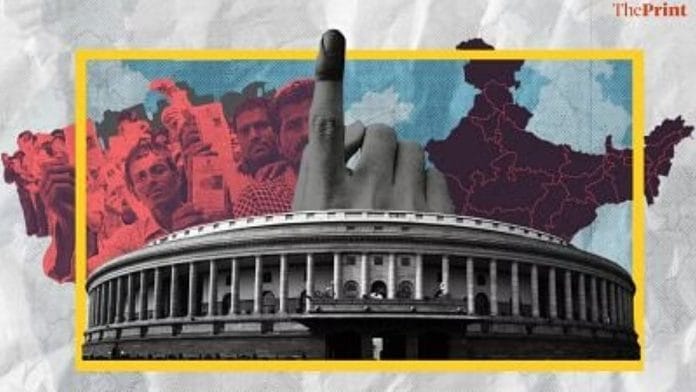


The debate on ‘One Nation One Election’, perhaps the most consequential electoral reform contemplated since Independence, was rekindled last week by Prime Minister Narendra Modi.
Addressing Bharatiya Janata Party workers on the party’s 47th Foundation Day, the PM remarked that “serious discussions are taking place in the country today on all such topics, such as Uniform Civil Code and One Nation One Election and significant progress is being made in this direction”.
It is pertinent to note that PM Modi bracketed the issue of One Nation One Election (ONOE) alongside the BJP’s core ideological issues of Uniform Civil Code (UCC), Citizenship Amendment Act (CAA), the construction of Ram Mandir, the banning of triple talaq, etc. A cursory reading of these remarks suggests that while the BJP government will remain steadfast in its commitment to core ideological issues, other issues of governance and reform will go alongside them.
Also Read: One Nation, One Election could free 26 lakh teachers from poll duty—PM advisory council paper
Combining ideology with reforms
By integrating the agenda of big-ticket national reforms alongside ideology into its repertoire, PM Modi understands that while a political party survives on ideology, for it to thrive, it has to be nourished by ideas that place national interest above pure ideological compulsions.
The PM’s recent mention of ONOE follows a lull after the ball was set rolling with the setting up of the Ram Nath Kovind-led committee in September 2023, and the consequent introduction of the Constitution (One Hundred and Twenty-Ninth Amendment) Bill, 2024, and the Union Territories Laws (Amendment) Bill, 2024, in the Lok Sabha in December 2024, both of which were referred to a Joint Parliamentary Committee.
Some sceptics of ONOE argue that the initiative is like a ‘trial balloon’ and will disappear due to the onerous requirements of constitutional amendments, the lack of political consensus, its linking with the census and delimitation, and the proposed roll-out only in 2034.
However, such sceptics appear to miss the mark on at least two counts. First, a comprehension of the underlying reasons why ONOE is crucial to the Modi government, and second, such assessments underestimate the ability of the Modi government to blend political resolve and ruthless determination in fulfilling its core agendas.
Correcting history
To begin with, the ONOE proposal comes with a historical baggage which the BJP government sees as a natural opportunity to correct.
Contrary to popular belief, the idea of simultaneous elections in India is not novel. When the architects of independent India blended the system of parliamentary government with federalism, the feature of simultaneous elections was entrenched by default. This explains how the early general elections of 1951-1952, 1957, 1962, and 1967 were held in parallel with state assembly elections in almost all states.
However, this design feature was punctuated by an anomaly — neither the Lok Sabha nor the state assemblies have fixed five-year tenures, as both can be dissolved earlier.
The pattern started changing in 1967, when the Congress Party was defeated in several assembly elections. Following these electoral reversals, a stream of party defections, combined with the indiscriminate invocation of President’s Rule in many states, led to variations in the timeline of state assemblies on the one hand, and Parliament on the other.
Indira Gandhi’s call for early national elections in 1971, and the period of Emergency imposed between 1975 and 1977 — when the Lok Sabha’s term was extended beyond its natural five-year span — became the last straw in the decoupling of state and national elections.
Whatever relic remains of simultaneous national elections with some state elections, such as in Arunachal Pradesh, Sikkim, Andhra Pradesh, and Odisha, is by coincidence and not by design. Thus, simultaneous elections remain an exception and not the norm. Consequently, we have a staggered electoral system that persists today.
In this backdrop, by pursuing ONOE, PM Modi seeks to restore the original constitutional design of simultaneous elections, which was vitiated by the Congress through the Emergency and the wanton application of President’s Rule through the years.
Also Read: SIR aside, why BJP is not counting its chickens for a non-vegetarian CM in Bengal
Appetite for big-bang decisions
Over the years, the idea of resuscitating simultaneous elections has been mooted by various institutions: the Election Commission of India in 1982, Law Commission of India in 1999 and 2018, Parliamentary Standing Committee Report in 2015, NITI Aayog in 2017, and, most recently, the Ram Nath Kovind-led High-Level Committee in September 2023. Atal Bihari Vajpayee pursued it with the Opposition till 2003, and LK Advani followed it up till 2010.
All these efforts underlined the concern that India’s ‘continuous election mode’ disrupts governance, places an undue burden on government resources, and creates other inefficiencies. A central motif of the Modi government has been its appetite for ‘big-bang’ decisions on issues which previous governments either chose not to tread upon or could not resolve despite repeated efforts. So, ONOE fits the maxim, ‘Modi Hai Toh Mumkin Hai’.
As a Carnegie Endowment paper pointed out last year, a distinctive pattern discernible under PM Modi has been the enactment of policies that seek to apply homogeneous solutions to a myriad governance problems. The umbrella of ‘One Nation’ policies aims to unify India’s economic and administrative structures to foster integration and efficiency as an impetus for building a Viksit Bharat by 2047.
Such policies include ‘One Nation One Tax’, formally known as the Goods and Services Tax (GST), for a unified tax structure; ‘One Nation One Subscription’ for open access to international journals; and ‘One Nation, One Ration Card’ for access to subsidised food grains. They are designed to eliminate the existing patchwork of regimes and represent a promising start. ONOE arguably represents the ‘crown jewel’ of these one-nation policies, for which the government will go full throttle.
As the pitch is expected to grow louder in the time to come, a reform of this magnitude ought to be driven by robust public engagement and consensus-building, in a spirit grounded in constitutional ethos, especially as it entails questions of federal balance, autonomy, and the trajectory of India’s democracy.
The writer is a former Vice-Chancellor, Aligarh Muslim University and nominated Member of the Uttar Pradesh Legislative Council. He posts on X @ProfTariqManso1. Views are personal.
(Edited by Asavari Singh)