






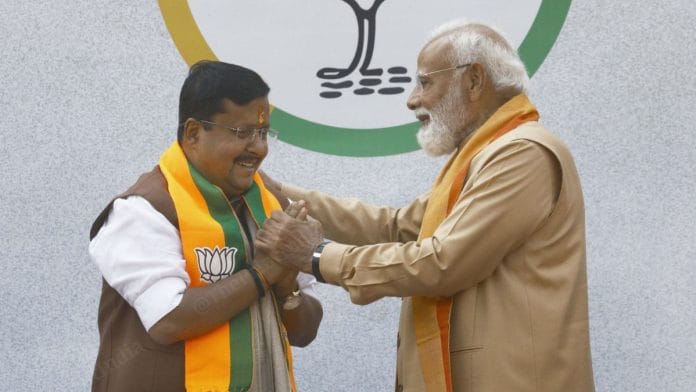



Nitin Nabin has been formally appointed as the president of the BJP. This move has been celebrated because he will be the youngest president who will steer the generational transition within the party in the future. Using this occasion, Prime Minister Narendra Modi has tried to reiterate the old brand of the BJP as the ‘party of difference’.
It is important to determine whether the appointment of Nabin really signifies the BJP as the party of difference vis-à-vis other parties. Is it especially true in the context of its principal challenger, the Congress, which now has its president from non-dynasties background?
I argue that the process of appointing the party head is similar between the BJP and the Congress party, but the crucial difference is the outcome of the process, which is unpredictability in the BJP but not in the Congress. The element of unpredictability in the BJP creates huge hope among its cadres, who tend to believe and hope that any worker can reach any position in the party.
Method of appointment
One of the USPs of the BJP has been that it appoints party presidents beyond non-dynasty background. Its former presidents, such as Atal Bihari Vajpayee (1980-86), Lal Krishna Advani (1986-91; 1993-98; 2004-2005), Murli Manohar Joshi (1991-93), Kushabhau Thakre (1998-2000), Bangaru Laxman (2000-2001), Jana Krishanamurthi (2001-2002), Venkaiah Naidu (2002-2004), Rajnath Singh (2005-2009; 2013-2014), Nitin Gadkari (2009-2013), Amit Shah (2014-20), Jagat Prakash Nadda (2020-26), and now Nabin, fit in this broader category.
Although the BJP appoints its party head from non-dynasties, its process of appointment cannot be termed democratic. The reason behind this is the overwhelming role of the ‘gatekeeper’ and the lack of electoral competition.
In the comparative literature of party politics with specific reference to political recruitment for leadership, the senior leaders who hold powerful positions within the organisation are referred to as ‘gatekeepers. The ‘high command’ culture in India comes under this category. To control the party, such leaders mostly rely on selection over election. In the case of growing pressure, they prefer the indirect election. In the Indian political parties, we can clearly see this trend.
The BJP, which claims to be the ‘party of difference,’ is not an exception to this phenomenon, and despite winning three consecutive national elections and becoming India’s system-defining party, it tends to rely on indirect elections and has barely shown any signs of reform within the party.
A free and fair election is the cardinal doctrine of modern democracy. This not only applies to national, state, and local elections, but also within the political parties. Unfortunately, the latter is missing in Indian democracy. An election has two indispensable elements—unpredictability of outcome and fair competition.
In the BJP’s case, its process of appointment fulfils the first criterion, but not the second one. However, the elements of unpredictability in appointments create huge hope among the BJP cadres who think that they can reach any position in the party. My field interviews suggest that the BJP leaders who repeatedly said that ‘any karyakarta (worker) can reach any position in our party’. Therefore, when Modi said that ‘I am a worker of the party’, it was meant to reinforce this belief among the party cadres. Nabin’s appointment further provides a concrete example.
On the contrary, although the Congress party now has an elected president, his election did have the element of unpredictability. It was almost known that the next president of the Congress party would be among four to five of its senior leaders. In comparison to this, hardly anyone has even a wild guess about the possibility of Nabin’s elevation before the announcement of his being interim president.
The method of appointment of the party head, where workers are not allowed a direct vote, centralises power in the party and limits democracy. In such a scenario, the party elites effectively work as gatekeepers. As we have seen in the case of Nabin, he was first declared interim president to give a clear signal within the party about the preference of party elites.
Here, potential candidates not only mean challenging Nabin but also the party elites, whose wrath hardly any leader invites. We are witnessing this in the case of Shashi Tharoor, who went out of favour since he contested the election for the party president. The Indian parties have not been able to resolve this issue; however, in Western democracies, leaders are asked questions about the way they would accommodate opponents in their team when the leadership contest for party positions.
Nonetheless, the declaration of Nabin as interim president has made his appointment inevitable. However, he is not elected president but selected. When there is a selection, there also lies a strategy.
Also read: 10 examples of the BJP’s ‘Bengal Virodhi’ mindset—mispronunciations to unpaid dues
Strategic considerations in Nabin’s appointment
Multiple interpretations have surfaced to decode the strategic considerations in his appointment. The most prominent among them are age and his caste background. There is no doubt that he is a politician of the younger generation, and the BJP will soon go through the process of transition.
Therefore, he will create or become a leader in his tenure who will run the party in due course/future. There has also been an interpretation around his caste identity as he belongs to the Kayastha community, which holds significant influence in West Bengal. The BJP is trying hard to mobilise this community in West Bengal.
In addition to these interpretations, I would argue that his selection might also be linked with two other considerations—balancing the regional power and shifting from the Gujarati identity of the party. Presently, the BJP’s General Secretary (Organisation), who holds equivalent power to the president, comes from South India (Karnataka). This reduces the scope of appointing the president from the same region. This means that the president was to be chosen from northern India. With the rise of Modi-Shah, a public perception is being formed that the BJP is run by Gujaratis. In such a case, Nabin’s Bihari identity could be a good counterbalance.
In a nutshell, the process of appointment of Nabin shows that the BJP is like other political parties, where party elites decide the head of the party organisation by strictly controlling the election process. The only difference is the outcome of the process. In the BJP, unpredictability is the reality, which is not the case in other parties. This unpredictability brings hope of mobility within the party, which in turn creates greater enthusiasm among the BJP cadres.
Arvind Kumar is a visiting lecturer in Politics & International Relations at the University of Hertfordshire, and an Associate Research Fellow at the Institute of Commonwealth Studies, University of London. He tweets @arvind_kumar__.
(Edited by Saptak Datta)
BJP leadership works in partnerships of two.
Earlier, it was Vajpayee-Advani. Then it became Modi-Shah.
Nitin Nabin is Amit Shah’s replacement, because of his organizational ability. Modi’s replacement is yet to be found.