






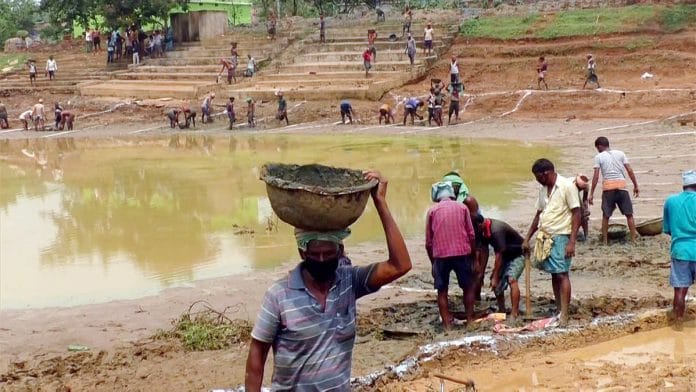



That Prime Minister Narendra Modi had a disdain for Mahatma Gandhi National Rural Employment Guarantee Act, or MGNREGA — the world’s largest rural employment programme, was not hidden from anybody.
Back in February 2015, less than a year into his first term as PM, Modi said this during a discussion on the motion of thanks to the President’s address in Parliament: “I keep hearing talk that the government is planning to scrap MNREGA, or already has. I know that you doubt my experience in many areas but I am sure you will admit that I have political acumen. My political acumen has told me to keep MNREGA alive as a monument to your [Congress’] failures since Independence. After 60 years, you are still making people dig holes.”
There have been talks for long within and outside the BJP-led NDA government to revisit MGNREGA.
That the Modi government would actually go ahead and dismantle the architecture of one of the UPA era’s most significant rural welfare programmes, and also remove MK Gandhi’s name so effortlessly, took even the Opposition by surprise.
To be sure, the scheme has not been done away with. Instead, it has been rechristened and restructured. Called the Viksit Bharat – Guarantee for Rozgar and Ajeevika Mission (Gramin), or VB-GRAMG in short, the new scheme, which Parliament has now passed, in fact increases the number of days of guaranteed and paid employment to a rural worker from 100 days to 125 days every financial year. The law also mandates pausing the scheme for 60 days during the peak agricultural season.
However, the fund-sharing pattern has been changed entirely. Earlier, the Centre’s contribution was 100 per cent. Now, states will have to share 40 per cent of the financial burden, except in the Northeast and Himalayan states, where the share will be 10 per cent.
The key difference now is that the Centre will decide which state gets how much in the Union Budget, in what it has called “normative allocation”, the criteria for which as well will be decided by the central government. This financial control will skew the demand driven nature of the scheme.
No amount of protests from the Opposition benches or advocates of MGNREGA helped. The government’s intent was clear from the way it railroaded the VB-GRAMG Bill in both Houses of Parliament, sitting well after midnight to pass it.
Protests from civil society organisations are picking pace, and it remains to be seen what the political fallout would be, if any. The dismantling of MGNREGA in the winter session of Parliament is ThePrint’s Newsmaker of the Week.
Also read: Why the VB-GRAMG Bill strikes at the heart of MGNREGA
MGNREGA was a safety net
Enacted in 2005, MGNREGA is the only scheme in India, and perhaps the world, which gives a person living in a rural area a legal right to take up 100 days of paid, unskilled manual work per household in a financial year. Failure to provide work within 15 days after an oral or written demand resulted in the worker getting paid an employment allowance by the states.
But the VB-GRAMG scheme makes a fundamental change to this concept. Work will no longer be demand–based. For, the Centre will determine the budget that will be allocated to each state based on the criteria that it sets. If a state spends more than what it is allocated, it will have to bear the cost. Currently, under MGNREGA, the states send their annual work plan and labour budget to the Centre before the start of the financial year.
It’s not that MGNREGA had not come under criticism in the past. With 60 per cent of the allocation earmarked for wages and 40 per cent on meeting the material and administrative cost, the most stringent criticism against the rural jobs programme is that it focuses on only giving work to the rural poor and not on creation of durable assets. Critics had in the past also flagged the need to target MGNREGA better.
There have also been charges of lesser demand, misappropriation of funds, and ghost workers, which led the Centre to make the Aadhaar-Based Payment System mandatory to settle wages.
There might be criticism galore, but MGNREGA proved its mettle in times of rural distress.
The most striking example was how MGNREGA became a safety net for hundreds and thousands of migrant workers returning to their village following the Covid pandemic in 2020.
In fact, with demand for jobs in rural areas seeing a massive spike, the government was forced to revise the scheme’s budget from Rs 61,500 crore to Rs 1.11 lakh crore in 2020-21.
The allocation came down only marginally post Covid. Despite the scheme being a thorn in NDA’s side, the latter failed to significantly cut down its budget over the years. But the dismantling of MGNREGA has given rise to fear that the budget of the revamped scheme might get slashed.
MGNREGA was not just about providing a legal right to work to the rural poor or giving them dignity of labour. The Covid example is a testament to how MGNREGA became the backbone of rural workers, when they lost all sources of livelihood.
The Modi government should modernise MGNREGA and make it better targeted to uplift the rural poor. But dismantling the scheme and taking away the legal entitlement to work may lead to upheaval in the rural economy.
Views are personal.
(Edited by Aamaan Alam Khan)