









New Delhi: India is heading toward a severe shortage of key energy commodities as the war between Israel-US and Iran enters its 15th day. The prolonged closure of the Strait of Hormuz—a narrow maritime passage that accounts for around 35-50 per cent of India’s crude oil supplies—has compounded India’s problem.
India remains heavily dependent on the maritime passage not only for crude oil but also for critical fuels such as liquefied natural gas (LNG) and liquefied petroleum gas (LPG).
Nearly 60 per cent of India’s domestic LPG demand is met through imports. About 80-90 percent of this comes from Gulf countries, including Qatar, the UAE, Saudi Arabia and Kuwait, via the Strait of Hormuz. The remaining 40 per cent is produced domestically.
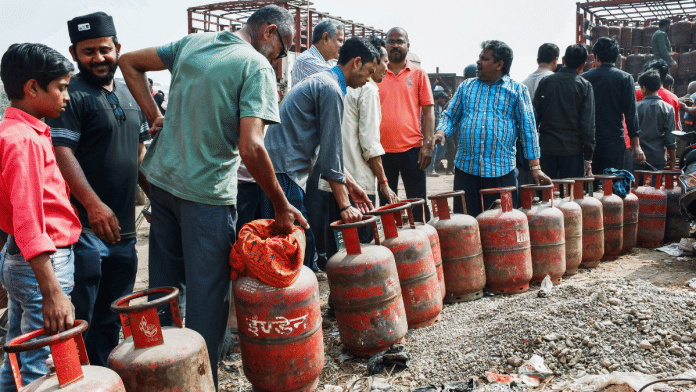
While the Narendra Modi government has stated there is no shortage of cooking gas, social media is flooded with people standing in long queues across Delhi, Uttar Pradesh, Punjab, Maharashtra, and other states. The impact of the gas shortage has been felt across the country, and that is why it is ThePrint Newsmaker of the Week.
Several hotel and restaurant associations have flagged the shortage of commercial LPG. The Chennai Hotels Association wrote to Prime Minister Narendra Modi on Monday seeking uninterrupted supply. The letter stated that “commercial LPG has been temporarily suspended due to the shortage, for usage in restaurants and food industries.”
Similarly, India also relies on Gulf supplies for LNG. The country consumes about 189 million standard cubic metres per day (mscm p/d) of natural gas, out of which 97.5 mscm p/d is produced domestically, while the rest is imported. Nearly 47.4 mscm p/d of imports comes from the Strait of Hormuz, which is being disrupted due to the conflict.
Government invokes supply controls
In response to the supply crunch, the government on Tuesday invoked the Essential Commodities Act through a gazette notification to regulate natural gas supplies.
Titled Natural Gas (Supply Regulation) Order 2026, it outlines priority sectors where gas supply will be regulated and ensured.
Domestic consumers have been given the highest priority and will receive 100 per cent supply with no cuts.
Industrial and manufacturing consumers have been given up to 80 per cent of their previous six-month average supply.
Fertiliser plants have also been allocated up to 70 per cent of their previous six-month average supply, a move aimed at protecting the agricultural input ahead of the upcoming sowing season.
Measures undertaken by government
With imports from Gulf countries affected, the government has issued LPG control orders and stepped up domestic production.
“The LPG Control Order issued on 8 March 2026 directed all refineries to maximise LPG yields and channel the entire output of C3 and C4 hydrocarbon streams, comprising propane, butane, and propylene, exclusively to the three Oil Marketing Companies for domestic cooking gas,” Minister of Petroleum and Natural Gas of India Hardeep Singh Puri informed Parliament on Thursday. The government on Friday informed that LPG production has been increased by 30 per cent through refinery directives, and further procurement is actively underway.
However, market analysts say the increase may still fall short of demand.
“Even if refineries manage to increase LPG output by 10–20 per cent above current domestic production, domestic supply would only rise to roughly 47–50 per cent of total demand, leaving a significant gap that must still be filled through imports,” Sumit Ritolia, lead analyst for modelling and refinery at Kpler, told ThePrint.
In another step, the government has revised the LPG booking cycle for both urban and rural customers. The minimum gap between two-cylinder bookings has been increased from 21 to 25 days for urban areas and from 25 to 45 days for rural areas.
To manage the shortage of natural gas, the government has directed refineries and petrochemical units to reduce their own consumption and divert gas supplies to high-priority sectors such as power generation, CNG for vehicles, and domestic gas connections.
According to the minister, the government is also in talks with multiple countries to secure LNG supplies to bridge the shortfall.
“Large LNG cargoes are arriving on an almost daily basis through alternative supply routes, and India has sufficient gas production and supply arrangements to sustain this position even in the event of a prolonged conflict,” Puri told Parliament.
To address concerns raised by hotel and restaurant associations, the government has formed a three-member committee comprising executive directors from Indian Oil Corporation, Hindustan Petroleum Corporation Limited and Bharat Petroleum Corporation Limited.
“Extensive meetings have been held with state civil supply departments and restaurant associations across the country and are continuing,” Puri said.
Also read: Iran conflict reaches Indian Ocean. India’s balancing act gets harder
Going back to alternative fuels
On Thursday, the government also allowed the temporary use of alternative fuels such as biomass, RDF pellets and kerosene or coal for the hospitality and restaurant sector for one month. The move will allow commercial establishments to switch fuels, freeing up LPG supplies for priority consumers.
The Ministry of Environment, Forest and Climate Change has advised all State Pollution Control Boards to permit the use of these fuels, even though they are more polluting compared to LPG and LNG.
To meet the expected rise in demand for kerosene, the government will release an additional 48,000 kilolitres to state governments, over and above the quarterly allocation of nearly one lakh kilolitres, Sujata Sharma, joint secretary at the Petroleum Ministry, said at a press briefing on Thursday.
However, allowing the use of alternative fuels such as biomass and coal marks a reversal of the government’s earlier push to phase out traditional fuels from Indian kitchens, which it had previously linked to health risks for women and environmental degradation.
Launched in 2016, the government’s flagship scheme, Pradhan Mantri Ujjwala Yojana (PMUY) aimed to replace firewood, coal and cow-dung cakes with the cleaner cooking fuel LPG.
(Edited by Ratan Priya)