









New Delhi: Bangladesh is having its Game of Thrones moment. Power battles are being played out in real time and the politics—ahead of an impending election—has just begun.
For all of December, Bangladesh and its hot and cold relationship with India dominated headlines. Then the curtains came down on the Battle of Begums, Sheikh Hasina and Khaleda Zia. The latter passed away, leaving her son Tarique Rehman to take over the mantle. With that, the country turns over a new page in its history of dynasty politics amid violence and volatility. And that is why Bangladesh is ThePrint Newsmaker of the Week.
Minorities and their mirrored plight
As everyone welcomed the new year, a 50-year-old Hindu man died after he was set on fire in Bangladesh—the fourth such attack in two weeks. This was the latest in a series of attacks on minorities in the country that has been on the boil. What has led to these attacks is, in the words of a Bangladeshi political analyst, Shafquat Rabbee, a rise in fundamentalism and the foothold of their version of the Far-Right.
According to Rabbee, all countries in South Asia have had their share of political violence or and witnessed the rise of the Right. The answers are debatable, the consequences are not.
What began as a series of anti-India protests in front of diplomatic missions after the attack and later death of a prominent independent leader, Sharif Osman Hadi, grew into a full-blown mob violence that raged through the country. The attackers of Hadi had allegedly fled to India.
The fire of fundamentalism gutted two of its prominent media houses, The Daily Star and Prothom Alo, as it raged through closed doors and trapped staff members. Journalists called it the worst attack in more than five decades. Mobs angry over Hadi’s killing also attacked cultural centres and destroyed archives.
Also read: ‘Baba, baba’: After a Hindu father’s lynching in Bangladesh, a child keeps searching
The return of the Dark Prince
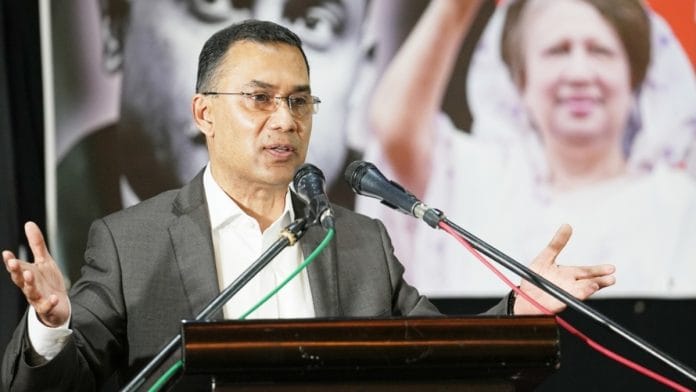
Amid all this chaos, Tarique Rehman, interim chairperson of the Bangladesh Nationalist Party, came back home after his 17-year exile on 25 December. Rehman’s return was perhaps the most keenly observed act in Bangladesh’s current volatility. Called the ‘Dark Prince’ of Bangladesh politics, Rehman is the likely PM candidate for BNP. His mother, Zia, on her part, was known for her warmth toward Pakistan, unlike Hasina, who tilted toward India.
Since the ouster of Sheikh Hasina after the 2024 student-led Monsoon Uprising, the BNP has largely positioned itself as a peacemaker amid the resurgence of the Right, and the return of Islamist party Jamaat-e-Islami after a decade-long ban. With Hasina sidelined and her party outlawed, the BNP remains the largest political force now. Rahman is promoting a reformist image of the party—one that promises calm over rhetoric and places Bangladesh first.
He had earlier said, “Not Dilli, not Pindi, Bangladesh before everything”. In his speech after returning, Rahman laid out his election agenda— sovereignty and safety of minorities, women and citizens more broadly. Taking a cue from Martin Luther King Jr, he proclaimed to a sea of supporters, “I have a plan”.
This shift is significant because, with an interim administration under economist Muhammad Yunus, many expected change— just not a turn to the Right. After Hasina was exiled to India, the Yunus-led regime shifted its strategies along with its diplomatic alignments. Dhaka warmed up to Pakistan and China as the Chief adviser pumped up his rhetoric on India’s Northeast.
Following his footsteps, the newly formed National Citizen’s Party (NCP)—born out of the student movement—issued strong statements, including threats against Delhi and references to harbouring extremists from the Northeast in retaliation for Hadi’s death. The same NCP later entered a pre-poll alliance with the Jamaat, triggering mass resignations, not just of key leaders but also women members who refused to be associated with the Islamist party.
Regional fault lines are now out in the open, and India-Bangladesh relations seem to be taking another nosedive. Diplomats are being summoned on both side, and visas have been shut. And the chill in ties continues to deepen.
Yet Khaleda Zia’s death has marked a shift. Prime Minister Narendra Modi wrote a long condolence letter to Tarique Rahman; the External Affairs Minister S. Jaishankar visited Dhaka to meet him. And Defence Minister Rajnath Singh visited the Bangladesh High Commission. With Bangladesh heading to polls next month and most global and domestic surveys projecting a BNP victory, the symbolism is hard to miss. India, after repeated calls for “free and fair elections”, seems to have made a pragmatic choice— to engage democratically with whichever government gets elected next.
The larger question that looms is not just one of diplomacy but of domestic politics. For much of Bangladesh’s history, generations have witnessed the rivalry of two dynasts—Hasina and Zia, alternating in power since 1991. With Khaleda now dead and Hasina sidelined, the country now appears to be heading into yet another era of legacy politics, albeit under a different name. What will be watched closely is the path Rahman charts, both in regional politics and diplomacy.
(Edited by Ratan Priya)