






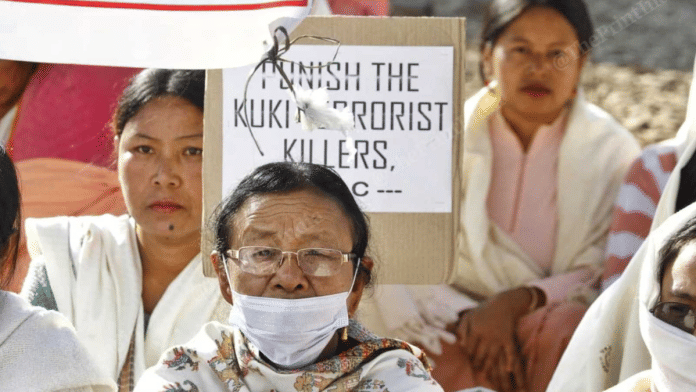



It takes viral videos of extreme brutality for India’s Northeast region to breach the national consciousness. Almost three years since the conflict in Manipur started, the continued suffering of our fellow citizens must be measured in units of spectacle.
This year, it is the horrifying execution of Mayanglambam Rishikanta Singh. The 31-year-old Meitei man—married to a Kuki woman before the violence erupted and had adopted a tribal name—was killed in Churachandpur, while visiting his wife. The perpetrators filmed his death and circulated it with the caption: “No peace, no popular government.” The Ministry of Home Affairs has rushed to block the video, but the Manipur High Court observed that the circulation exposed the state’s failure to prevent the “digital war of words” that precedes physical violence.
Two and a half years ago, it was a video of two Kuki women being paraded naked through the streets of Kangpokpi by a Meitei mob that jolted the nation. In July 2023, the footage spread across social media until the Supreme Court took suo motu cognisance and demanded accountability from the state government. Prime Minister Narendra Modi finally broke his silence on the violence in the state, labelling the incident “shameful.” “What happened to the daughters of Manipur can never be forgiven,” he had said, even though the violence, which began in early May, had already claimed the lives of more than 120 people.
For a brief moment, Manipur had been catapulted on to the national stage and had our attention. Then, by sheer force of habit, we moved on.
But a humanitarian crisis has unfolded between these two spectacles. Since May 2023, nearly 60,000 Internally Displaced People have been languishing in relief camps. Drone bombings and blasts have lashed the state. Internal “buffer zones”—invisible, illegitimate boundaries enforced by the 65,000 troops stationed in Manipur—have effectively partitioned the state.
On 10 January, a 20-year-old survivor of gang rape died in a Guwahati hospital, 30 months after being abducted and assaulted on 15 May 2023, days after the violence erupted. A “zero FIR” was filed 67 days after the crime. Even though the case was transferred to the Central Bureau of Investigation, not a single arrest has been made. The FIR implicates four armed men associated with the Meitei militant group Arambai Tenggol, as well as members of the Meira Paibi—a Meitei women’s vigilante group—who allegedly handed her over to her attackers.
The victim’s mother recounted how the young woman had become a “shadow” of herself. She would break down whenever she saw a white Bolero, the vehicle used in her abduction. She eventually died from complications linked to unhealed physical and psychological wounds.
Her family said that she was “worn down” by the absence of justice. She survived the initial violence, only to be destroyed by the waiting and the state’s failure to act. In this, her death is a perfect mirror to the situation in Manipur.
“Well-entrenched institutional apathy” is how Dhiren A Sadokpam, editor of The Frontier Manipur defined it. “New Delhi has the power to intervene at every level,” he told me in an interview, “and the central government has a mandate to weed out the impediments for a lasting, durable peace.” Yet, the centre continues to frame it as an “ethnic conflict”.
“How can there be civil unrest despite the presence of 60-70,000 troops in Imphal? These are small communities in the middle of a militarised conflict, and yet the Centre has been unable to stop it. Their stance has been to let the communities settle it between themselves, but we are also citizens of this country.”
Sadokpam compared Manipur’s violence to the Gujarat riots or the anti-Sikh pogrom in Delhi, and wondered why those conflagrations were brought under control fairly swiftly. Despite President’s Rule and unified command from the centre, the violence keeps cropping up. Rather than simply critiquing the two groups, Sadokpam said, we have to get rid of the “moral framing” of the issue. “After a point we have to see the overall picture: When do the victims become the perpetrators and vice versa?”
Also read: In Manipur, Meitei man’s funeral procession becomes a public reckoning, with a ‘martyr’s burial’
Vertical to horizontal conflicts
In early January, Bimol Akoijam, the Congress MP representing Inner Manipur, filed a Right to Information application with the Ministry of Home Affairs. His query was: What is the legal basis for the buffer zones operating in Manipur?
Officially, these zones do not exist. The Governor of Manipur, Ajay Kumar Bhalla, speaking with a delegation of IDPs, stated as much. And yet, Akoijam himself was stopped a few days prior by central forces at Saiton-Nganukon when he attempted to travel through his own constituency. Akoijam pointed out that Meiteis cannot enter Kuki areas and vice versa. Kukis must take a circuitous route through Mizoram’s capital Aizawl to leave the state.
These borders have carved the state into ethnic enclaves. The IDPs who want to return to their homes are told—in one of the most militarised regions of India—that it’s too dangerous, and that security forces cannot escort them back safely. “This would never happen anywhere in India,” Sadokpam said. “If we cannot accept this happening in Delhi, why are we okay to accept it in Manipur?”
Last month, Akoijam had touched upon familiar territory when he questioned the long-winded Parliament discussion over Vande Mataram. “You think this is deshbhakti,” Akoijam had asked, repeating his demand to have a debate on the violence and displacement in Manipur. “Today the Northeast is still not included in ‘Indian’ history… The true meaning of Vande Mataram is to uphold the promise we have made to ourselves in our Constitution.”
Akoijam’s question is relevant, but sadly, it assumes that the nation wants to know in the first place. It doesn’t, and the mainstream media is partly responsible for this.
Karma Paljor, editor of EastMojo, told me that when he worked at CNN-IBN, the channel had a bureau in Guwahati. His former colleague Rajdeep Sardesai called the general disinterest in mainstream media toward stories from the Northeast, “the tyranny of distance.” The channel is gone now, subsumed by a larger media machinery, along with the bureau. Several of the bigger networks—many with affinities to the present government—have replaced full-fledged bureaus with stringers, and are focused primarily on Assam.
“When violence erupts in Manipur or Nagaland or Mizoram, they parachute in journalists from Delhi,” Paljor said. “But the Northeast is a very complex region. There are hundreds of tribes and sub-tribes, each with their own identity, insecurities, and issues. It takes a while to really understand.” Mainstream national media is content to produce stories from Delhi or Guwahati, far from relief camps and buffer zones.
That superficial and sporadic coverage is excellent for generating impressions and reels, but dismal for the peace process. “There have been various moves to reconcile between the communities,” Paljor said. “All that gets left out because of the sheer scream of violence.”
Peace-building efforts between Meitei and Kuki-Zo legislators, and attempts to facilitate safe passage for IDPs don’t make for titillating headlines. Instead, we get tidy, digestible binaries like indigenous people vs outsiders, Hindus vs Christians, and “poppy planters” vs victims.
Sadokpam goes a step further. Historically, he said, the Northeast’s conflicts have been “vertical”, i.e., armed resistance against the Indian state, movements for self-determination, or “restoration of sovereignty”.
Over the last few decades, though, these have been “converted” into horizontal conflicts between two communities or tribes. “All conflicts are now framed as internal communal clashes,” he said. “We see this in experiments across India. But these new forms of conflict will be even more dangerous and will recoil badly. There are little fires everywhere.” The advantage of this framing allows New Delhi to remain a neutral party attempting to broker peace within communities, rather than a state with constitutional responsibility and the power to act.
But power and willingness are not the same thing. Outside of the latest viral outrage, India’s Northeast and its citizens cease to matter. For some people, that’s democracy enough.
Karanjeet Kaur is a journalist, former editor of Arré, and a partner at TWO Design. She tweets @Kaju_Katri. Views are personal.
(Edited by Theres Sudeep)