









When the former Chief Justice of Nepal, Sushila Karki, was appointed as the interim prime minister on 12 September last year, with a limited mandate to stabilise the situation and conduct free and fair elections within six months, it appeared to be an uphill task.
The first woman PM of Nepal began her work earnestly, gifting the nation a new government three days ahead of International Women’s Day. The Himalayan Kingdom conducted the general elections on 5 March. Keeping her promise not to remain in power beyond six months, Karki is likely to hand over the charge to the new Prime Minister Balendra Shah soon.
As outlined in Article 84 of the Constitution of Nepal, the 275-member Pratinidhi Sabha (House of Representatives, as the Parliament is called) consists 165 members directly elected from single-member constituencies via the first-past-the-post (FPTP) voting system. The remaining 110 seats are filled through a single nationwide constituency via party-list proportional representation (PR) method of election.
The recent election has signalled a major political shift from the centrist and left-leaning ideologies. Of the 165 FPTP seats, Rastriya Swatantra Party (RSP) secured 125 seats, Nepali Congress has bagged 18, Communist Party of Nepal-United Marxist Leninist (CPN-UML) nine, Nepali Communist Party (NCP) eight, Shram Sanskriti Party (SSP) three and one each by Rastriya Prajatantra Party (RPP) and independent candidates.
With the PR seats added, the RSP tally might reach 175 seats, freeing Nepal from coalition governments and giving single-party rule.
The RSP, founded in July 2022, claims to be a centrist party, advocating constitutional socialism and economic liberalism. It was an ally in the Pushpa Kamal Dahal ‘Prachanda’-led Maoist government with four cabinet ministries from 6 March 2024 to 12 July 2024. The party’s strategy was to go closer to the government and cut its political teeth in the corridors of power.
Since parting ways with the government, the RSP was probably waiting for the elected government to quit, fall or complete its term so as to run for elections. The KP Sharma Oli-led Communist government caved in under the pressure of violent Gen-Z protests that led to arson, looting, army action and several government offices, including the Prime Minister’s Office at Singha Durbar and houses of political leaders, in flames.
Uphill task for Balendra Shah
From Day one, the new prime minister has to begin rebuilding an extremely disorganised state and a highly fractured polity—both literally and metaphorically. Very high levels of corruption, siphoning of wealth and resources by a few, severe unemployment, high income inequality, stagnant economy, and huge debt burden are only some of the issues that ignited a mass protest. These factors were good enough for a regime change but can be equally potent to destabilise the new regime within months if the frustration continues.
RSP, with moorings in student and youth agitations, had ironically suggested the abolition of party-affiliated student unions, trade unions, and civil servant associations in its manifesto. It had set an ambitious goal of achieving 30,000 MW of installed electricity capacity within the next decade, positioning energy as the backbone of Nepal’s economic transformation.
There is little doubt that the single issue of augmenting the hydro potential of Nepal will lead to a huge revenue for the country, which is sitting on more than 83 GW of hydropower potential based on the water resources availability. The unconstrained demand for electricity is expected to increase from an 10,138 gigawatt-hours (GWh) in 2019-2020 to 31,196 GWh in 2029–2030.
The new government can make a new beginning by speeding up land acquisition, clearing the projects of political and bureaucratic hurdles and generally improving relations with India, which has generously extended a helping hand to hydro power generation projects in Bhutan. A similar economic and infrastructure plan can be made for Nepal. It will hugely contribute to its economic growth and prosperity.
A robust India-Nepal cooperation will require several confidence-building measures on both sides and a better understanding of each other’s sensitivities. Nepal’s outgoing Communist government tilted heavily towards China and put India’s security in the Himalayan region into jeopardy. Following a blockade of the India-Nepal border in September 2015 by some Madhesi and Tharu groups who were protesting against the new Constitution, the Oli government blamed New Delhi and signed a transit deal with China, allowing Nepal to use Chinese ports for third-country trade.
While this ill-advised move undermined the traditional, exclusive trade reliance on India, it totally disregarded India’s efforts to include Nepal and Bhutan into BIMSTEC in February 2004, broadening the group from a maritime-focused one to include landlocked Himalayan countries for greater regional integration, in keeping with the “neighbourhood first” policy.
Also read: Balen wave marks the second coming of democracy in Nepal
Multi-party democracy
In 2020, the Oli government adopted a new political map that included Kalapani, Lipulekh, and Limpiyadhura as part of Nepal—a direct challenge to India. India had responded sharply after Nepal objected to the reopening of border trade with China through the Lipulekh Pass, which connects Uttarakhand to Tibet.
The Oli government’s action, taken amid heightened India-China tensions, significantly complicated territorial negotiations. This was followed up with the Nepal Rastra Bank (NRB), issuing a fresh series of Rs 100 notes with the country’s map featuring Kalapani, Lipulekh and Limpiyadhura.
New Delhi has assured the new government in Kathmandu of total support and unbridled cooperation in its efforts to rebuild its economy. No two countries are as closely connected culturally, historically and economically as India and Nepal are.
But this relationship cannot be taken for granted. Nepal should seriously engage in course correction, go back to the old map, withdraw the currency notes and assure India that its territory will not be allowed to be used in any manner that will affect India’s security and strategic interests.
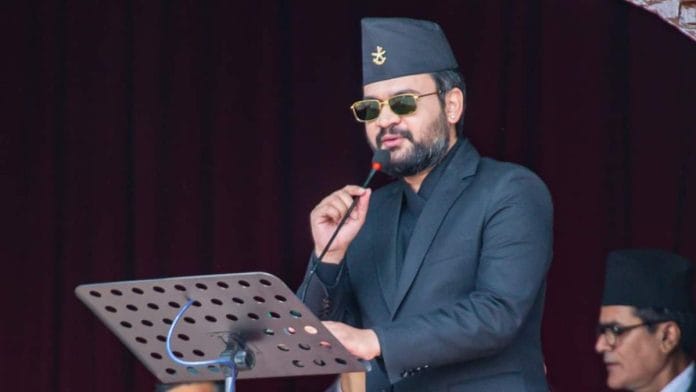
From Shree Paanch Prithvi Narayan Shah to rapper Balen Shah, Nepal has transformed from a Himalayan Kingdom to a vibrant multi-party democracy, experienced a roller coaster ride in politics, seen several ups and downs in the economy and witnessed changes as fast, severe and unpredictable as mountain weather. Voters of Nepal have shown their democratic spirit and effected a regime change through the ballot.
The newly elected lawmakers and their leaders have come to power riding a wave of discontent, like the ones in Bangladesh and Sri Lanka. Those who are catapulted to power by the popular waves, not necessarily of their own making, should heed the warning by Robert Browning’s “The Patriot”, whose path was littered with roses, and was jeered while on his way to the gallows within one year, by the very same people.
Seshadri Chari is the former editor of ‘Organiser’. He tweets @seshadrichari. Views are personal.
(Edited by Saptak Datta)
Both sides should reach out to each other, in a spirit of good neighbourliness and sovereign equality. That applies equally to Bangladesh. India should have more friends in South Asia than it presently does.