






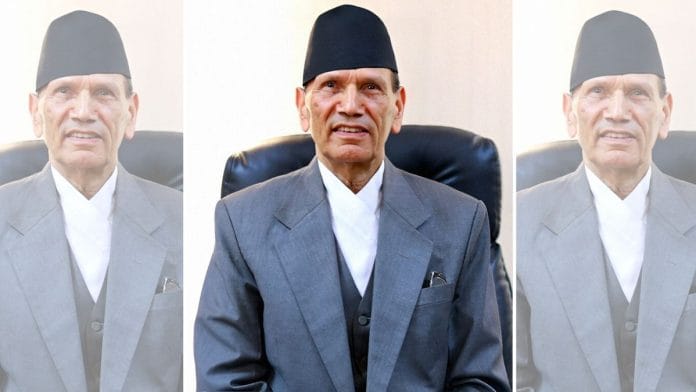



Nepal’s Sushila Karki-led government has expanded its cabinet for the fifth time with the appointment of a new foreign minister. Prime Minister Karki previously held the portfolio. The appointment of Balananda Sharma comes less than three months before Nepal’s general elections on 5 March 2026—a date set by the Karki administration soon after she assumed office.
The expansion of the cabinet reflects the political stability the Karki administration enjoys despite facing the uphill task of holding elections and maintaining law and order. However, the last-minute appointment has left many speculating on the challenges Nepal faces on the diplomatic front. Or is this merely a balancing act with the Nepal Army, considering Sharma comes with almost four decades of service?
Foreign minister was a necessity
Karki now leads a 15-member cabinet, with her retaining the defence portfolio. Not appointing a foreign minister in the early stages presented challenges of its own. The country didn’t have high-level representation at the annual United Nations General Assembly, which was held just a few weeks after Karki assumed office.
Meanwhile, dedicating time to diplomatic dealings amid political stirring at home presented difficulties for Karki. A dedicated minister for foreign affairs was indeed a necessity. Finding a suitable candidate in an interim setup could have been a challenge. And the appointment of Sharma, a former lieutenant general in the Nepal Army, reflects the army’s strong say in the interim government.
Foreign minister Sharma has held key leadership roles. He was part of the UN peace mission in Lebanon and a defence attaché at Nepal Embassy to the erstwhile USSR. He also played a key role in integrating the former Maoist guerrilla fighters into the Nepal Army after a decade-long civil war. However, the last-minute appointment for a 70-odd-day term could be emanating from a diplomatic churn happening in Nepal.
Also read: Asim Munir now gets a foothold in Pakistan economy. Fauji Foundation will be his front
Engaging with key missions
Soon after Karki took office, a significant decision concerning Nepal’s foreign policy was the recall of 11 ambassadors serving in China, Germany, Malaysia, Israel, Qatar, Russia, Saudi Arabia, Spain, the United Kingdom, the United States, and Japan. However, the recall of Nepal’s ambassador to Japan, DB Subedi, was surprising as he is a career diplomat. In contrast, the other ambassadors were political appointments made by the former KP Oli administration, which ran a coalition government with the Nepali Congress Party. Although the apex court stayed the interim government’s decision, the move was executed anyway.
In Nepal’s diplomatic culture, the political appointment of ambassadors to missions abroad has been a long-standing tradition. Such ambassadors typically sustain their term until the new governments come to power. Their recall is also not a new phenomenon. However, such a move by an unelected government appears to be based on feedback and performance reviews. There were other ambassadors, including Nepal’s ambassador to India, who remain in office despite being appointed by the Oli administration.
When a country faces a dire political situation, it also puts a burden on its diplomatic presence abroad. For instance, Nepal’s missions in the Gulf require close and continuous attention due to the large presence of the Nepali diaspora there. However, these missions are often overlooked. This raises questions about the country’s diplomatic priorities and planning.
Diplomacy and foreign policy experts have been calling for avoiding political appointments at key missions, such as those in the US, China, and India. But the nature of the political establishment and the compulsion of coalition governments have kept the tradition going.
Meanwhile, key foreign missions in Nepal are either without an ambassador or awaiting their departure. The Chinese Ambassador to Nepal, Chen Song, left the country on 21 December after serving for three years. Chen’s tenure in Nepal was marked by controversies and social media spats.
The latter part of his term saw allegations emerge against the Chinese firm that constructed the controversial Pokhara International Airport. A recent investigation by Nepal’s anti-graft body found that 55 individuals had colluded with a Chinese state-owned company to inflate the project cost by $74 million.
During a meeting with Karki, Chen had reportedly requested that the Chinese firm not be implicated in the investigation. He had earlier claimed that the Pokhara airport was funded under the Belt and Road Initiative (BRI), a claim that Nepal later refuted. With Chen leaving, the speed at which Beijing sends the new envoy would indicate China’s diplomatic priority in Nepal. Beijing may choose to wait until the elections are held to ensure it selects the right candidate to engage with the new government.
There are also reports that the Trump administration has recalled the US Ambassador to Nepal, Dean R Thompson, who is set to leave by January 2026. Thompson was appointed by the Biden administration in 2022. It was during his term that the US actively rolled out projects such as the Millennium Challenge Corporation to support Nepal’s hydropower sector, spur economic growth, and help reduce poverty. Chinese analysts saw the project as a counter to BRI and termed it a “Trojan horse disguised by Washington as ‘aid’ to Nepal”.
Having two primary foreign missions without a resident ambassador could pose a diplomatic challenge for Nepal, especially as the country prepares to hold elections after the Gen Z movement. There is growing concern that the absence of senior diplomatic representation in Kathmandu—at a moment when Nepal may urgently require hands-on engagement—could complicate its external relations and curtail meaningful dialogue with key international partners.
The appointment of the new foreign minister, even if it is for a short term, is likely intended to enhance Nepal’s diplomatic capacity as the country awaits its political transition to a more stable, democratically elected government. But the key question remains: How long can Nepal continue to maintain leadership roles in foreign affairs in an ad hoc manner?
Rishi Gupta is a commentator on global affairs. Views are personal.
(Edited by Prasanna Bachchhav)