






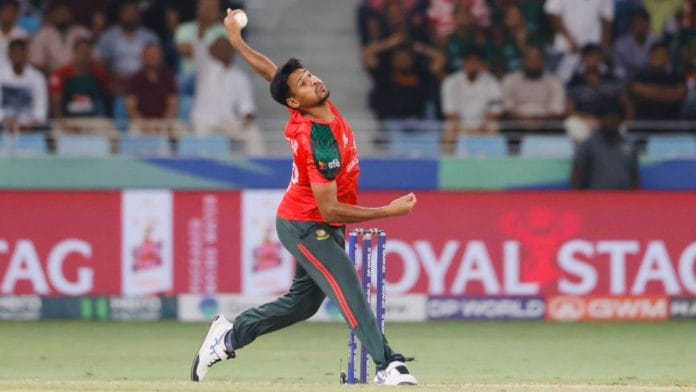



For the past week, India wasn’t really arguing about cricket. On the surface, the question was simple: Was dropping Bangladesh cricketer Mustafizur Rahman from Kolkata Knight Riders the right decision or the wrong one? But the noise that followed made it clear that something else was at play. Diplomacy entered the dressing room, nationalism walked onto the pitch, and loyalty tests replaced sporting logic.
A BJP leader went as far as calling Shah Rukh Khan a traitor for hiring a Bangladeshi player. KKR is co-owned by Shah Rukh Khan, Juhi Chawla, and Jay Mehta, and operates fully within the rules laid down by the BCCI. Bangladesh responded by banning IPL broadcasts and announcing it would not play its T20 World Cup 2026 fixtures in India, citing concerns for player safety.
One franchise decision spiralled into a diplomatic standoff. What should have remained a sporting call turned into a referendum on patriotism and borders.
There is a crucial difference here that seems to have been deliberately blurred.
Boycotting a national team in response to an act of war or terror is not unprecedented, nor is it unreasonable. I have argued this myself in the past—when innocent civilians were killed in Pakistan-sponsored terror attacks, expecting India to continue playing Pakistan as if nothing had happened was morally hollow. In those moments, a cricket team does stand in for the nation it represents. And yet, even then, the BCCI chose revenue over resolve, brushing aside public sentiment because India–Pakistan matches are simply too profitable to give up.
But the Mustafizur episode is different. This was not a national match, not a contest between two flags, and not a moment where a team was acting as a stand-in for the state. It is a private franchise league built on the very idea that players from across the world can come together, play cricket, and leave politics outside the boundary rope.
Mustafizur Rahman was not representing Bangladesh; he was representing Kolkata, no differently from the many overseas players who have worn Indian franchise jerseys over the years. Singling him out simply because of his nationality shows a selective and convenient moral logic. And if national interest, atrocities on minorities, and injustice are truly the yardsticks, then consistency would demand far tougher and more uncomfortable choices. Choices that BCCI has repeatedly avoided making.
Also read: BCCI has sabotaged India’s approach to Bangladesh
Mending fences only to break them
What makes this even more baffling is the timing. Just a week ago, India was sending a very different signal. External Affairs Minister S Jaishankar travelled to Dhaka to attend the funeral of Khaleda Zia, Bangladesh’s first woman prime minister, a gesture widely read as an attempt to steady fraying ties and open a new chapter in the relationship. A signal that was about repair, reassurance, and countering the growing perception that Bangladesh is drifting away from India and toward China and Pakistan under the Yunus government.
Against that backdrop, the Mustafizur controversy sends a jarringly different message; not just to the Bangladeshi state or its leadership, but to ordinary Bangladeshis watching from across the border.
When a Bangladeshi cricketer is sidelined in a private Indian league for reasons that have little to do with sport, it blurs the distinctions between a government’s failures and a people’s identity. That is not how mature democracies build influence; it is how they lose moral ground and strategic leverage at the same time.
This does not mean India’s concerns are illegitimate.
The Yunus government has failed on many fronts—most seriously in protecting minorities, especially Hindus, who have increasingly come under attack. Remarks like calling India’s northeastern states “landlocked” were not just careless, but worrying in a region where geography, trust, and cooperation are deeply linked. India had every reason to protest, and it did so rightly.
India’s concern for the safety of minorities in Bangladesh, or the political choices of its leadership, are battles that have to be fought through diplomacy, pressure, and principled engagement, not by turning individual athletes into collateral damage. Otherwise, we end up doing precisely what we claim to oppose: Feeding resentment, hardening identities, and making it easier for anti-India voices to argue that New Delhi does not distinguish between a government and its people. In the long run, this kind of symbolism costs far more than it ever gains.
At the same time, Bangladesh seems to be overlooking an important truth: India has consistently been its most reliable neighbour. From the “Neighbourhood First” policy to economic support and humanitarian help, India has stood by Bangladesh in difficult moments. Instead of repairing a strained relationship, the Yunus government has chosen to escalate tensions by banning IPL broadcasts and withdrawing from the World Cup in India. These kinds of decisions may score points at home, but they damage long-term ties.
The attacks on Shah Rukh Khan only make this episode more disappointing. Calling him a “traitor” for including a player who was available as per the BCCI’s own decision is unfair and unnecessary, turning a cricketing issue into a Hindu–Muslim debate, something India hardly needs more of. Such rhetoric reflects cheap populist politics, where little-known politicians target a big name just to gain attention and relevance.
There is also a deeper discomfort behind these attacks. Someone like Shah Rukh Khan challenges their politics—he is Muslim, yet loved by millions across communities, including Hindus. That reality doesn’t fit their narrative, and it clearly unsettles them. But that is a larger discussion, and perhaps one that deserves a separate article altogether.
Amana Begam Ansari is a columnist and writer. She runs a weekly YouTube show called ‘India This Week by Amana and Khalid’. She tweets @Amana_Ansari. Views are personal.
In the calculus of national interests, a single cricket player’s participation is inconsequential. When a nation faces systematic marginalization of its minorities, diplomatic signals must be unambiguous. The removal of Mustafizur Rahman is not about one player, but about India’s principled stance against systemic discrimination. International sports are not a sanctuary from geopolitical realities – they are another platform where national sovereignty is expressed.
Countries like Iran have long demonstrated that sporting engagements are never truly neutral. They are political statements. India’s decision reflects a clear message: national security and minority protection are non-negotiable. The IPL will continue, with or without Bangladeshi players. What matters is the signal sent – that India will not compromise its fundamental values for the sake of sporting political correctness.
This is not about emotion, but about pragmatic national interest. A minor disruption in a cricket league is a small price to pay for maintaining diplomatic integrity and highlighting human rights concerns.
Support the ban on Bangladeshi players. Bangladeshis shouldn’t reap any benefits from India. Anti- Hindu hate has run deep and wide for decades in Bangladesh.