









Giant posters of Prime Minister Narendra Modi, paired with feel-good slogans about artificial intelligence, lined New Delhi’s roundabouts this week — greeting the world leaders and global tech executives navigating India’s capital for the flagship AI Impact Summit.
In every corner of the city, Modi seemed to be watching from countless billboards, as he did when India hosted the Group of 20 gathering in 2023.
It’s the fourth major summit of policymakers and AI builders since the launch of ChatGPT, and the first held in the Global South. The theme, “Welfare for all, happiness for all,” aimed for moral gravitas. The inaugural global event, at the UK’s Bletchley Park in 2023, was all about safety. Since then, they’ve largely devolved into industry trade shows. Delhi leaned into the now standard hype cycle: OpenAI Chief Executive Officer Sam Altman predicted that “early versions” of superintelligence were two years away, and Anthropic PBC CEO Dario Amodei said AI can “lift billions out of poverty” and “create a better world for everyone.”
The posters and hype wasn’t the only thing oversized. So was the dysfunction.
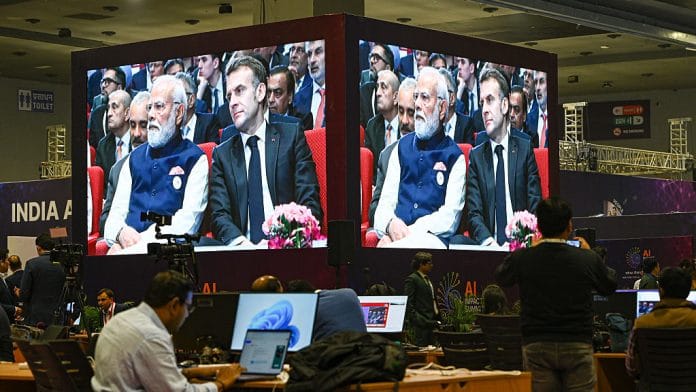
Road closures turned commutes into chaos. Guests hit long, unpredictable lines. On opening day, the venue was abruptly cleared for a photographed Modi walk-through, locking exhibitors out of their booths for hours and stranding visitors. On Thursday, it was unexpectedly shut down to the public again for the keynote parade featuring Modi, Altman, Amodei, French President Emmanuel Macron and other VIPs. (The tech minister apologized for the chaos on Monday, and organizers tried to make up for Thursday’s closure by announcing — at the last minute — that the event would stay open an extra day.)
And yet the chaos had a flipside. It revealed the appetite. Modi is courting Silicon Valley at the same moment US firms are vying to capture India’s young, tech-savvy market. The South Asian nation is now the second-largest userbase of ChatGPT after the US. It also leads the world in generative AI app downloads, growing 207% year-over-year in 2025, compared with 63% in the US, according to Sensor Tower Analyst Sneha Pandey. Much of this is coming from free trials specific to the India market.
The AI adoption figures have been widely cited all week, without noting that India’s huge population of 1.4 billion would naturally skew the data. But they simultaneously exposed an elephant in the convention hall: How does India move from being AI’s most enthusiastic consumer to becoming a serious producer?
The summit produced a flurry of data-center investment announcements. Billionaire Mukesh Ambani promised $110 billion, the Adani Group pledged $100 billion, and OpenAI said it’s partnering with Tata Group on major AI infrastructure. There’s no doubt that Modi can point to this as a win.
But it’s just as likely that these flashy headlines will face obstacles as developers battle to find the land, water and electricity these projects require in India’s notoriously resource-stretched and red-tape constrained environment. Straining the nation’s power grid and water supply also threatens a world of backlash and environmental concerns when many cities still struggle to deliver drinkable water and breathable air. Around the world, buildouts at this scale aren’t merely engineering challenges, but political ones.
The spectacle of this week also obscures a more immediate, unique risk. Throughout the developed world, policymakers sell AI as a solution to aging populations and labor shortages. India has the opposite problem: a huge, young, increasingly educated workforce that needs jobs. The recent “AI scare” selloff has hit Indian IT especially hard, a reminder of how exposed its software sector is. If AI becomes a substitute for entry-level work before India can generate new opportunities, the social impact could be sharper than in the countries exporting the technology. The challenge of translating the AI wave into livelihoods is a bigger governing test for Modi than collecting selfies with Silicon Valley’s elite.
Still, the enthusiasm at the summit wasn’t manufactured. I spoke to a couple of college students who came to check it out on Monday. They didn’t mind the crowds or disruptions, saying the chaos simply proved how much people cared. They insisted that Indians aren’t merely using AI, they’re experimenting and building. The optimism was contagious, and it hinted at the nation’s genuine advantage: a massive, ambitious, mobile-first talent pool willing to try new tools fast.
But optimism doesn’t substitute for an ecosystem. A harder question hanging over this gathering is why India, with undeniably deep tech talent, has never had a “DeepSeek moment,” and still lacks a defining foundational research breakthrough. Adoption can scale quickly, but it’s much more difficult to build frontier capability without sustained investment in research, access to compute, and the kind of capital that lets entrepreneurs take bold bets. If the summit was meant to showcase India as an AI builder, the disarray also exposed why so many of its best and brightest are seeking opportunities elsewhere.
AI’s promises and hypocrisies were on open display in Delhi. Under a banner of “democratizing AI,” hotel rooms went for as much as $33,000 a night while homeless people were forcibly moved along the road to the venue. India is a test case for whether AI diffusion empowers everyday people or widens inequality. The rest of the world will be watching closely.
Walking between meetings in downtown New Delhi, I stopped counting the number of Modi posters after I hit 20. India can host the world. It can sell its vision of the future. But it can’t spectacle its way into AI power. That takes the unglamorous work of dedicated research funding, trustworthy institutions, reliable infrastructure — and a plan for the people expected to live with the consequences of this tech revolution.
This report is auto-generated from Bloomberg news service. ThePrint holds no responsibility for its content.