






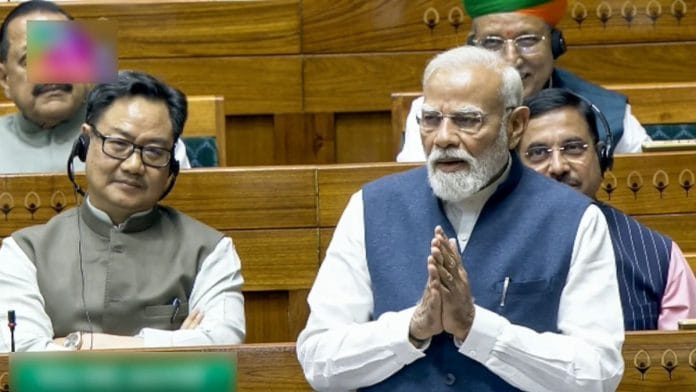


Each time Prime Minister Narendra Modi addresses the nation, it is met with a sense of foreboding. From the shock of demonitisation—abruptly announced at 8 pm on 8 November 2016 when Rs 1,000 and Rs 500 notes were rendered invalid with just four hours’ notice—to the nation-wide Covid lockdown declared on 24 March 2020, which halted public transport and triggered a mass exodus of migrant workers on foot, Modi’s televised addresses tend to generate fear, anxiety and alarm.
But last Saturday, Modi seemed to be in the grip of a rather different mood. Using the platform of India’s public broadcaster Doordarshan—paid for by the taxpayer—he delivered a blisteringly partisan speech, shedding the restraint and dignity expected of constitutional high office to lash out at the Opposition in strident, hostile and vindictive language.
Modi’s vitriolic, campaign-style speech on Doordarshan during the election campaign for the West Bengal and Tamil Nadu Assembly polls was a gross violation of the Model Code of Conduct. But the swaggeringly self-important Modi recognises no restraints, refusing to abide by constitutional propriety or moral responsibility. He operates like a wayward absolute monarch, arm-twisting democratic institutions to his every whim, flaunting executive overreach, talking down to the public in a sneering tone, and using any means available to pursue his frenzied ambition to win elections.
Lust for power doesn’t even begin to describe it. Modi is driven by a greed for power that sometimes seems almost irrational and deranged. Shockingly, Modi even went so far as to call the defeat of the amendments to the Women’s Reservation Bill in last week’s special session of Parliament as “Bhrun Hatya” (or foeticide or aborting a female child). Such a word for a legislative defeat is not just grossly inappropriate—but deeply offensive. It’s a brazen exploitation of women’s trauma to score political points in a political speech.
What was defeated in Parliament by a united Opposition was not the Women’s Reservation Bill. That was unanimously passed by all parties in 2023 and has now been notified. Women’s Reservation is the law of the land. What was rejected instead were the cunning amendments to the Bill, which linked it to an outlandish delimitation formula—raising the number of seats in Parliament to 850—and to the 2011 Census, even though the new census exercise has already begun.
The Modi government was using the Women’s Reservation Bill as a shield to bring in an outrageous delimitation plan and, in one stroke, deprive Opposition-ruled states such as Tamil Nadu and West Bengal of seats and representation in the Lok Sabha. At the same time, it would hugely increase seats in north Indian states like Uttar Pradesh and Bihar. The attempt to ram through these amendments in a special session of Parliament was a naked power grab by Modi and Home Minister Amit Shah. And it was defeated.
Modi’s nakli Nari Shakti
The Prime Minister is now posing as the campaigner for “Nari Shakti” and a champion of women’s empowerment. If Modi believes so much in the representation of women, why did BJP give only 16 per cent seats to women in the 2024 general elections? Of the BJP and NDA’s 21 chief ministers, why is there only one woman? Among the 72 ministers in the Modi government, why are there only a few women?
In the Bengal assembly polls, why has the BJP given only 11 per cent tickets to women? Why is the Modi-led BJP waiting for a law to start giving more tickets to women?
Why did Modi mock three-time Bengal Chief Minister Mamata Banerjee with “didi oh didi” catcalls? Why did he call businesswoman Sunanda Pushkar a “50 crore girlfriend”? Why did the Modi government not act against its MP and President, Wrestling Federation of India, Brij Bhushan Sharan Singh who was accused of sexual harassment by Olympic medal-winning wrestlers and why did the Modi government or Modi himself not utter a word when convicted rapists—who gangraped Bilkis Bano in 2002 and brutally murdered her daughter—were garlanded by Sangh Parivar activists when they were released in 2022?
Modi’s “Nari Shakti” is only “nara (slogans) shakti” or slogans. It’s fake.
The Modi government is led by a pracharak Prime Minister. Narendra Modi was once a pracharak of the Rashtriya Swayamsevak Sangh (RSS) — an organisation that, for a hundred years, has had no place for women in its shakhas, where men in white shirts and khaki shorts—now trousers—have always believed a woman’s place is in the kitchen.
MS Golwalkar, the RSS’s ideological mentor and guru, wrote in his book Bunch Of Thoughts: “Motherland needs men who are young, intelligent, dedicated, virile and masculine… When eternal manliness combines with eternal knowledge, victory is ensured. Such are the men who make history — men with capital M.”
There are approximately 88,000 RSS shakhas with approximately 40 lakh male members, whereas swayamsevikas number only around 55,000, and swayamsevika samitis around 2,700. Why does the RSS not have more women? Why has there never been a woman sarsanghchalak?
The All India Trinamool Congress sends almost 40 per cent women to Parliament, and Mamata Banerjee is an entirely self-made leader who bucks the South Asian trend of “female accession to male martyrdom.” Not only are women given tickets to contest, but they are also placed in highly visible roles and encouraged to blaze new trails.
BJP-ruled states top the National Crime Records Bureau (NCRB) charts for crimes against women. Uttar Pradesh, Maharashtra, and Delhi take the top spots for crimes against women in the NCRB 2023 report. In contrast, in West Bengal, the government has brought the Aparajita Bill to provide the strictest punishment for such crimes, and Kolkata has been ranked among the safest cities for women for four consecutive years in NCRB data.
Even in marriage and personal relationships, the Sangh-BJP mentality is inclined to police women. Gujarat’s Registration of Marriage Act demands parents’ consent. The Hindutva forces invented the pernicious issue of “love jihad” to criminalise interfaith relationships and deny women agency and autonomy. Women making free choices on love and marriage are subjected to policing. Uttarakhand’s Uniform Civil Code forces registration of live-in relationships. This mindset infantilises women, denies them agency, and traps them in the “devi” image so they never achieve full personhood.
In the 2017 Hadiya case—in which a Kerala woman, Akhila Ashokan, converted to Islam and married of her own free will—the Supreme Court made it clear that the right to marry a person of one’s choice is part of Article 21. Patriarchy cossets women, but in the 21st century, women cannot be perpetually protected, sheltered, and controlled. Modi’s nakli “Nari Shakti” is evident in the twisted way women’s empowerment was instrumentalised for a political end.
Also read: Mamata Banerjee vs the mighty Establishment. That’s what Bengal election is really about
Power, control and distraction
RSS Sarsanghchalak Mohan Bhagwat once described marriage as a contract where the wife must look after the house and the husband will “keep her safe” — and if she violates the contract, he can disown her. It is this anti-woman mindset that has resulted in the sidelining of strong and outspoken women in the BJP.
The late Sushma Swaraj was sent into ill-fated contests, for example, against Sheila Dikshit in Delhi in 1998 and against Sonia Gandhi in Bellary in 1999, and became a scapegoat for BJP defeats. She was a highly effective Leader of Opposition but was never considered a PM candidate. In the Modi years, she was somewhat humiliated. As external affairs minister, she was seemingly excluded from the BJP’s top leadership.
Vasundhara Raje was a two-time Rajasthan chief minister, but despite emerging as a regional satrap, she was marginalised by the BJP after its 2023 win—a victory she had helped script. Nirmala Sitharaman may be a high-profile minister, but she is hardly part of the BJP’s decision-making elite in the party. Uma Bharti led the BJP to a massive victory in 2003 in Madhya Pradesh, but was punished for speaking her mind. She even went as far as staging an outburst on TV after the 2004 general elections. Bharti was immediately dubbed a “rebel” and has been marginalised in her party ever since.
The Sangh Parivar constantly engages in moral policing. Former Uttarakhand BJP Chief Minister Tirath Singh Rawat inveighed against a woman wearing ripped jeans in 2021, and Union Minister ML Khattar said women should “dress decently” to remain safe. Cricketer Jemima Rodrigues and other publicly visible women, including myself, are daily targets of ideological foot soldiers of the Hindu right.
The truth is that Modi is only using “Nari Shakti” and women’s empowerment as a Weapon of Mass Distraction. On the day of his TV address, Iran shut the Straits of Hormuz and fired at two Indian carriers. But no serious discussion on West Asia has been allowed in Parliament. It’s so much easier for Modi to simply grandstand, evade the real issues concerning citizens’ daily lives, and build escapist delusions and glittering media fantasies about championing the cause of women.
The Opposition’s open challenge remains: call a session of Parliament and pass the 33 per cent women’s reservation in the 543-member Lok Sabha. Do it now, Shri Modi.
The effect of reserving one-third seats for women in a 543-member House—where women replace men—is far more transformative than expanding the Lok Sabha to 850 and then allocating one-third of it to women. In the first case, you genuinely reshape the gender balance of power. In the second, you merely add more members, the majority of whom are still men. That’s what Modi really wants—the optics of so-called “women’s empowerment” as window dressing while the men keep holding the reins of real power. That’s the reason Modi’s “Nari Shakti” is nakli. Totally fake.
Sagarika Ghose is a Rajya Sabha MP, All India Trinamool Congress. She tweets @sagarikaghose. Views are personal.
(Edited by Ratan Priya)
Modi is a misogynist RSS man doing drama.
And that is why TMC did not vote for the woman President right? Is this the logic netaji wants to take to ?