








How serious is the oil crisis for the Indian economy? What lessons must India draw from the current situation, where shortages and price increases have already begun to hurt economic activity?
First, it is important to understand that the price of Brent crude oil is not a proper indicator for gauging the impact of the oil crisis on Indian petroleum refining companies and the government’s finances. It is the Indian Basket crude oil price that needs to be tracked to assess the impact of an oil crisis on Indian refiners and the government’s external account. As of March 19, the Indian Basket crude oil price was about $150 a barrel. Brent crude oil price on the same day hovered between $105 and $108 per barrel.
The Indian Basket crude oil price is derived from a mix of crude oil varieties comprising sour grade (an average of Oman and Dubai oil) and sweet grade (Brent) oil, processed by Indian refineries in a 79 to 21 ratio. This mix causes a sharp variation between the prices of the Indian Basket and Brent crude. This difference cannot be ignored, as it underlines the nature of the crisis the Indian economy faces.
Indian refiners, therefore, have yet to face the full impact of higher crude oil prices on their operations. During the current financial year, ending in a few days, the average Indian Basket crude oil price was about $71 per barrel. Indeed, this is slightly lower than the average Indian Basket crude oil price of $78.56 a barrel in 2024-25. Therefore, the current financial year may not fully capture the adverse impact of the West Asian war on Indian oil companies and the Indian economy regarding oil prices. However, the impact will be felt during the coming financial year, as the crisis shows no signs of an early resolution.
As the accompanying chart shows, the Narendra Modi government has been relatively lucky with oil prices during its tenure since 2014. In the last three years of the Manmohan Singh government, average annual Indian Basket crude oil prices hovered between $105 and $112 per barrel. In the 12 years of the Modi government, annual average crude oil price has stayed between $46 and $93 a barrel, with seven of those years recording a decline in the annual average price over the previous year.
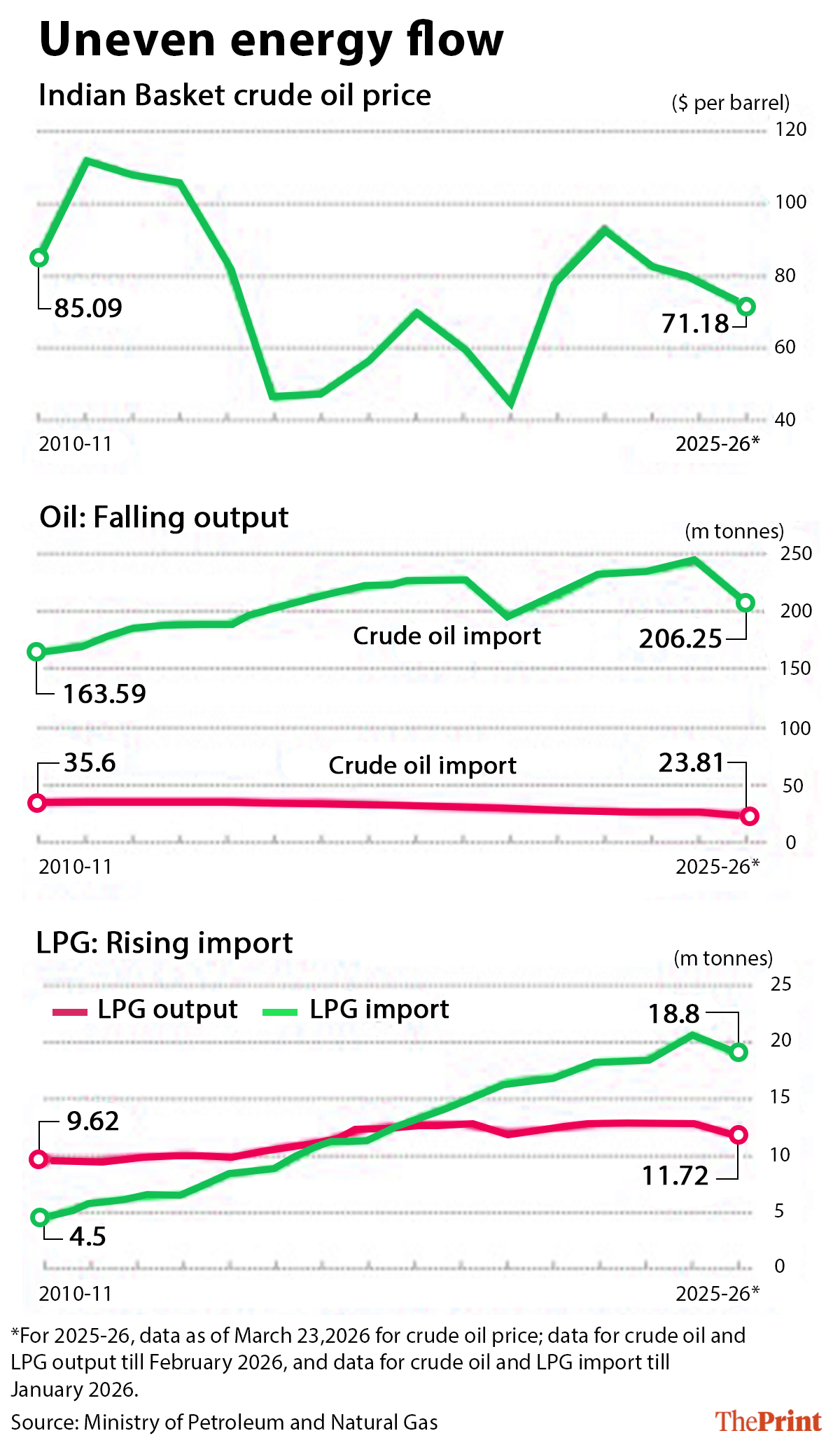
Indeed, the annual average price of the crude oil used by Indian refiners fell by over 11 per cent and 5 per cent in the last two years.
But a disturbing question arises from these 12 years of relatively modest crude oil prices. Did the Modi government use this period as an opportunity to fix the inherent problems of India’s rising dependence on imports in the petroleum sector? The country has done reasonably well in ramping up its renewable energy production capacity. But should the government have paid similar attention to reducing import dependence and increasing domestic processing of petroleum products?
There have been many policy pronouncements and new schemes in the last few years to reduce India’s oil import dependence. But the reality is quite sobering. Since 2014, India’s indigenous crude oil output has been falling every year. Domestic crude oil output fell from 35.9 million tonnes in 2014-15 to 26.49 million tonnes in 2024-25. In the current year, production from April 2025 to February 2026 was 23.81 million tonnes, signifying that the declining trend will continue this year as well. Note that the Indian economy was growing rapidly during these years and its demand for crude oil was also on the rise. Crude oil imports thus rose from 189 million tonnes in 2014-15 to 243 million tonnes in 2024-25. Dependence on imported crude oil thus went up from 84 per cent in 2014-15 to 90 per cent last year.
Clearly, the government’s policy initiatives, such as the switch from the cost-recovery based New Exploration Licensing Policy (Nelp) to the supposedly investor-friendly Hydrocarbon Exploration and Licensing Policy in 2016, have so far failed to yield the desired results. India’s domestic crude oil output has continued to fall, and no significant benefits have accrued from the new exploration policy.
What about petroleum products? Indian oil refining and marketing companies have, of course, increased their domestic production, but this has not been enough to make any dent in their imports. From 2014-15 to 2024-25, India’s imports of petroleum products more than doubled from 21.3 million tonnes to 51 million tonnes. Domestic output of liquefied petroleum gas (LPG) or cooking gas has grown at a snail’s pace, from 9.84 million tonnes in 2014-15 to 12.79 million tonnes in 2024-25. But LPG demand has seen robust growth, from 18 million tonnes to over 33 million tonnes in this period. Thus, dependence on LPG imports has gone up from 46 per cent to 62 per cent. Clearly, the government did not take necessary steps to increase domestic LPG manufacturing, even after launching well-intentioned schemes to promote LPG use among rural homes, which naturally boosted its demand.
One possible explanation for the absence of effective policies to promote atmanirbharata or self-reliance in crude oil and petroleum products is perhaps the modest rise in their international prices. Thanks to relatively benign international crude oil prices, India’s import bill for crude oil rose by an average annual rate of 2.16 per cent in the 10-year period from 2014-15 to 2024-25. India’s cost of petroleum product imports rose at a slightly higher rate — an average annual increase of 9.5 per cent. But even that increase did not push either the oil companies or the government to take adequate steps to boost domestic output in the petroleum sector.
The oil crisis that India is currently facing will be a lost opportunity if the government does not come out with a detailed action plan on how it wishes to reform its oil exploration policies to make a material difference to India’s domestic output of crude oil. A more worrying outcome would be if the government fails to get the entire petroleum refining and marketing companies to take up the manufacturing of petroleum products, including LPG, in a big way. As for the government, it should examine its policies on the pricing of these products so that there is adequate incentive for companies to produce more without either a squeeze on their margins or an increase in their reliance on government subsidies.
AK Bhattacharya is the Editorial Director, Business Standard. He tweets @AshokAkaybee. Views are personal.