






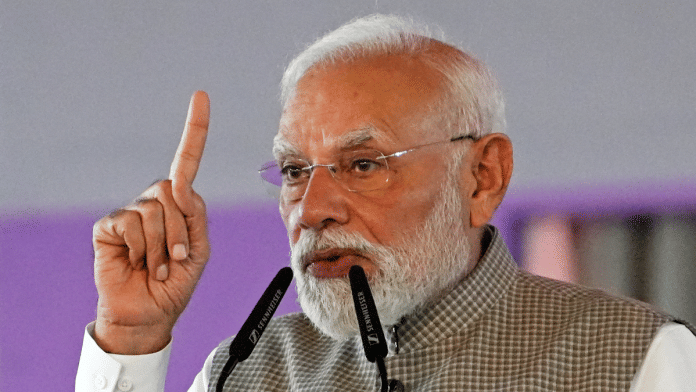



For 11 years, the slogans have come in never-ending spirals of illusion. Like wave upon airy wave of shimmering moisture emanating from thousands of misting fans. Achche din. New India. Viksit Bharat.
It has been 11 years of the politics of slogans—or the sloganisation of politics. The media machine has always stood at the ready. Expertly spin-doctored and managed, newspaper headlines and TV loop visuals spun out daily stories of glitzy ‘development’, high-profile summitry, and aggressive ‘strong-state’ nationalism.
Prime Minister Narendra Modi, now inaugurating a new scheme, now flagging off trains, now striding down a bridge, now saluting a 597-feet Sardar Patel statue, now clasping global leaders, now laughing with a photogenic head-tilt.
Religious fervour, trenchantly pushed by the top government leadership—disseminated by scores of social media handles, on-ground vigilantes, saffron–clad activists, and screaming TV anchors—has been ratcheted up across the land. Multitudinous messages of religious hate have been pummelled into susceptible minds 24/7.
The media glitz blitz and the high voltage religious churn, cow vigilantes, triple talaq bill, Waqf bill, Ayodhya temple inauguration. A spinning multicoloured Hindu Rashtra, a Vedic Valhalla, a new Bharatiya republic inaugurated in 2014 to hammer nails into the coffins of the anglicised children of Macaulay, castigated as “Khan Market gang” or “Pseudo seculars”. All these narratives unfolded before star-struck ‘Modified’ eyes.
Citizens became stupefied. Hypnotised. A zombification took hold. Passive and numbed, citizens meekly lined up outside banks to exchange suddenly useless currency notes, busily banged pots to dispel Covid-19, not batting an eyelid when the prime minister declared in an interview that he believed his own birth was “non-biological.”
But 2025 has broken the spell. The mist fans are no longer scattering gossamer-light illusions. Instead, they are spewing toxic air. And citizens are enraged. Daily governance failures—from the lack of pollution management to chaos in the skies to administrative collapse in “double engine” states such as Goa to reports of acute corruption in the BJP’s higher echelons to economic slowdown and acute hardship for crores—have all punctured the achche din illusion.
The so-called “Modi hai to mumkin hai” dream came crashing down in 2025. Here are five reasons why.
1. Modi-led NDA’s abysmal governance
Be it the mess over IndiGo airlines, the growing anger over air pollution, rising corruption in the BJP–ruled states, or the plummeting rupee, the Modi government is floundering in its own incompetence, struggling to handle day-to-day governance challenges.
A government where all decision-making is totally centralised in the Prime Minister’s Office is overstretched and thus unable to formulate strategies to deal with policy changes. A similar pattern was visible in the IndiGo crisis, too. The Directorate General of Civil Aviation (DGCA) first issued Flight Duty Time Limitation Rules (FTDL) in November, then hurriedly announced a temporary withdrawal of the notification in December, even as a staggering 4,500 flights were cancelled in the ensuing chaos. Why did the DGCA not monitor IndiGo operations after the new FTDL rules were issued? The regulatory system of the Modi government failed to properly oversee its own guidelines and steer IndiGo through the policy changes, forcing lakhs of passengers to endure traumatic inconvenience.
Civil aviation minister Ram Mohan Naidu came gamely out to bat for the government, yet it has been the Modi-led regime that has presided over a civil aviation duopoly in the first place.
In an answer to a question I asked in Parliament, it became clear that there is no national plan in place to combat air pollution. Very few meetings have been held between north Indian states to create a structured cross-state plan.
Modi’s “Na khaunga na khaane dunga” motto has fallen flat. The Supreme Court recently held that it was a “remarkable coincidence” that the friends and family of Arunachal Pradesh BJP CM Pema Khandu had ended up with massive government contracts.
In a shocking revelation of VIP impunity, the Gujarat–based Sandesara brothers, accused of massive fraud, were let off by the Supreme Court. The one-time settlement of Rs 5,100 crore recovered by the court from the Sandesaras is a fraction of what they owed. The government failed to pursue its case strongly against a duo accused of duping Indian banks of $1.6 billion. Once again, the impression was of government cronies—such as in earlier cases, business tycoons Nirav Modi and diamantaire Mehul Choksi, once referred to as ‘humare Mehulbhai’ by Modi—being allowed to flee the country.
Also read: Bondi Beach, Bangladesh lynching — once again, the elephant in the room will be side-stepped
2. Sluggish economy, poor living conditions
The continuing sluggishness of the economy is another reason why the Modi dream has gone bust. Private investment has significantly slowed, and FDI inflows have fallen. The International Monetary Fund recently raised questions about the accuracy of the Modi government’s growth data.
Indians are voting with their feet and leaving the country. Nearly 10 lakh Indians have renounced Indian citizenship in the last five years. A financial advisor recently posted that deteriorating living conditions are forcing rich Indians to exit India.
Questions about Indian statistics are particularly galling. For decades, India’s statistical models and data collection set global benchmarks. The Modi regime’s well-marketed dream of a turbo–charged economy surging ahead with double–digit growth is being revealed as a myth every day.
3. ‘Muscular image’ dented
The Modi government’s so-called “muscular image” has been dented. US President Donald Trump repeatedly took credit for the India-Pakistan ceasefire in May after Operation Sindoor. And international media reports of downed Indian jets sowed public doubt about the government’s claims.
The terror attacks in Pahalgam and Delhi’s Red Fort have disproved home minister Amit Shah’s claim that the back of cross–border terror has been broken. The shocking security lapses at Pahalgam and Delhi, particularly the fact that an explosive–laden car could get free access to the national capital, have blasted the myth of the so-called strong government cracking down on extremism and militancy.
Also read: Behind PM Modi’s choice of Nitin Nabin as Nadda’s successor—many explanations, only one reason
4. Foreign policy failures
India’s foreign policy is in shambles. Despite Modi’s ‘Abki baar Trump sarkar’ slogans, the Modi government is struggling to deal with the Trump administration, which has singled out India for punitive 50 per cent tariffs. The government repeatedly claims that India now sits at the global high table. However, Modi avoided the ASEAN Summit in Malaysia, where he was likely to meet Trump and attended the G20 Summit in South Africa only after the US announced it was boycotting the meet.
The self-styled Vishwaguru once swanned in and out of the White House. Today, the same White House has no qualms about equating India and Pakistan and has even hosted Pakistan’s Field Marshal Asim Munir to a private luncheon.
In the neighbourhood, from Nepal to Bangladesh, India’s foreign policy failures have seen a rising tide of anti-India sentiment. Our neighbours have turned hostile and insecure.
Engineered mandates
A key reason why the ‘Modi dream’ collapsed in 2025 is the nature of the mandates the BJP wins these days—mandates that seem engineered rather than spontaneous. The BJP’s election victories no longer resonate with the same starry–eyed “Modi factor” of the past. Opposition parties have pointed to the manipulation of electoral rolls. In Bihar, voters were openly bribed, with Rs 10,000 being handed to 1.5 crore women even as elections were on. Modi once railed against pre-election ‘revdi’ (freebies) by his rivals. In Bihar, the BJP relied on revdi to win.
The sheen has gone off the BJP’s election wins. Once, they were triumphant displays of the Modi cult. Today, they seem like a dreary misuse of state power to somehow hang on to the chair. A pliant media asks no questions, judges don’t robustly hold the government to account, and an obedient Election Commission turns a Nelson’s eye on the BJP’s flouting of the model code of conduct. Budget announcements were used as poll promises ahead of the 2025 Delhi Assembly polls.
Parliament is being bulldozed.
Parliamentary affairs minister Kiren Rijiju may claim that the government enjoys a majority, but the fact is that it does not. The NDA government is a coalition, and Modi today is crucially dependent on his allies. Yet, the swagger and bombast are undimmed. Bills are brought without consultation, a minuscule proportion are sent to Select Committees, no debate is allowed on the real issues of the day, and the Opposition is forced to toe the government line.
Also read: Govt control has weakened Indian consumers by taking away their right to sue
The mask fell
What’s left of the so-called mighty Modi juggernaut? The so-called game-changer Modi government has today shrunk into a name-changer. It is forced to change the name of MGNREGA and erase the name MK Gandhi simply to try and rediscover some fast-fading mojo and maybe galvanise the Hindutva core. Weak on national security, floundering with Trump, incompetent on the economy and administration, suffocating on the toxic air of its own making, the earlier dazzle of Modi Sarkar is petering out like a slowly dying firework. The fawning media orchestra is no longer convincing. The supremo is flubbing his lines and referring to Bankim Chandra Chattopadhyay as ‘Bankim da’. And the ruling party no longer looks energetic. It has instead become a dull, regimented command and control force, with a relatively nondescript working president appointed not by competition but by top-down diktat.
Attempts to keep on lighting religious conflagrations are increasingly falling on deaf ears as fatigue and failures are rising. The attempt to play up a “Babri Masjid’ controversy in Bengal disappeared fast from the headlines. Hardships and suffering across the country are too all–pervasive for any real interest in yet another religious war.
In 2025, the mask of ‘development’ fell, ‘Modi magic’ fizzled out, and the illusion of achche din was broken once and for all.
Sagarika Ghose is a Rajya Sabha MP, All India Trinamool Congress. She tweets @sagarikaghose. Views are personal.
(Edited by Prasanna Bachchhav)
Very kind and generous analysis by Sagarika.
Perhaps her membership of BJP’s B-Team in Bengal obliged her to be generous.
Maybe her boss (who used to be a member of Vajpayee’s cabinet) asked her to go soft on Modi.
Actually the ‘Achhe Din’ dream, a.k.a Jumla, went into ICU the moment an arrogant Modi refused to concede the post of LoP to the INC in 2014. The utter inaction of people like Pawar and Mamata ensured that Modi continued his onslaught on the opposition.
The Jumla finally died on 8th Nov 2016 when our Supreme Leader wrecked the economy with the Notebandi fissco.
Sagarika laments the death of the ‘Achhe Din’ Jumla. What she refuses to acknowledge is the fact that Modi successfully delivered on the ‘Burrey Din’ nightmare for all those who love and fight for their ideal of Bharat.
Are you just out of your mind. Sluggish economy – India is growing at 8% per year ??
If BJP wins engineered election, then EVERY election that the CPIM won and the TMC won since 2011 is engineered.
The difference is only that BJPs win is engineered by the people.
Sagarika Ghosh is predictable, shrill and screeching in her opinions. She fails to sway the reader. The party she belongs to has mismanaged West Bengal. There’s no word on that. Neighboring Bangladesh is on fire. There’s no word on that. Her hatred of Modi is all consuming that she loses balance in her ear piercing rhetoric. The electorate is unconvinced with such bias and continues to vote the NDA back.
Why does she need to write?
Wasted my time which I will never get back!!
Anyone looking at the opening lines can understand that this piece is biased on one extreme. It pains to see how reporting could be so squint-eyed. It is fair to call out specific cases but this article has generalised everything related to the Indian government as bad. Typical of someone with narrow mindset like looking at a glass full of water and calling it empty because there’s still some portion of it which is unfilled. The way opening narrative to this piece has been set shames journalism and should not be termed so. This, at its best, can be called propaganda. The editor could have done better by not giving this opinion any space because it will not take time for people to call out ‘Print’.
Didi should speak about “valo din” in Bengal ! Did her own party take a vow to finish what the left rule started in Bengal ? It’s industries are non existent and here is didi waxing eloquence about sheen of election wins !