






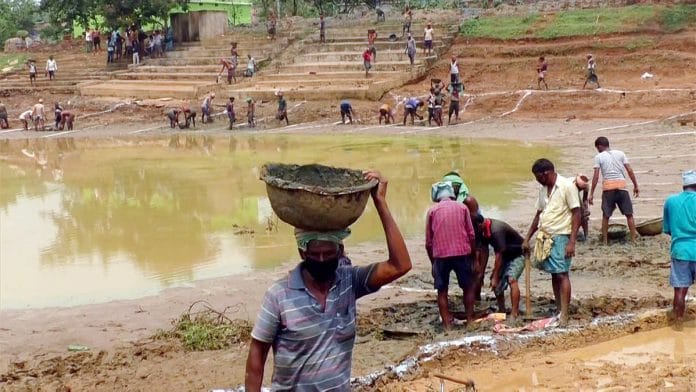



Erratic rainfall, prolonged heat, groundwater depletion, and volatile farm incomes are becoming structural features of rural life in India. Parliament has repealed the Mahatma Gandhi National Rural Employment Guarantee Act or MGNREGA and replaced it with the Viksit Bharat Guarantee for Rozgar and Ajeevika Mission (Gramin)—VB-GRAMG.
Beyond its widely discussed fiscal, federal, and rights-based implications, it carries a less acknowledged consequence. Repealing the scheme dismantles one of India’s few functioning institutions of locally-led climate governance.
MGNREGA has often been described as a rural employment programme, though this description has long understated its multifaceted developmental role. Climate resilience and adaptation have been officially acknowledged as functions of the scheme, including in government-backed evaluations and policy reviews.
In the two decades of its inconsistent yet still consequential functioning, MGNREGA was structurally oriented toward water, soil, land, and ecosystems through decentralised ecological investment. Nearly 80 per cent of permissible works under MGNREGA fell within natural resource management or agriculture and allied activities. This made MGNREGA India’s largest local climate-finance channel, even though it may have never been formally framed as a climate programme.
VB-GRAMG’s critical weakness
Climate shocks are unpredictable. Effective adaptation, therefore, depends on systems that can scale quickly in response to lived needs. MGNREGA enabled this because households could demand work through a rights-based framework. Employment during droughts, lean agricultural seasons, and heat-stressed months functioned as a climate adaptation mechanism in its own right, by stabilising incomes, reducing distress migration and preventing distress sales and debt. Gram Sabhas and Panchayats selected climate-relevant works based on lived experience of drought, water stress, and soil degradation. MGNREGA funds were embedded in Gram Panchayat Development Plans and converged with Finance Commission grants and sectoral schemes, enabling local governments to create durable assets.
VB-GRAMG marks a fundamental departure from the logic that made MGNREGA responsive to climate risk. The repeal removes a statutory employment guarantee and replaces it with a centrally-sponsored scheme governed by executive discretion. Under the scheme, work is no longer triggered by demand as a legal right but is instead shaped by state-wise normative allocations determined by the Centre. When demand exceeds allocations, states are expected to finance a larger share of employment, in some cases the full cost. Responsibility for unemployment allowances, delayed wages, and compensation is thus shifted decisively onto state governments.
This is a critical weakness as climate risk is unevenly distributed and fiscally asymmetric. States facing the greatest exposure to floods, droughts, and heat stress are often those with the weakest fiscal capacity. Under MGNREGA, the financial burden of climate shocks was pooled nationally. Under VB-GRAMG, capped allocations and cost-sharing fragment this risk pooling. The likely outcome for states would be suppressed demand, delayed payments, or reduced work availability precisely when climate stress intensifies.
Against global best practice
This shift also cuts against the global direction of climate policy. Locally-led adaptation is now widely recognised as essential to effective climate action, precisely because communities closest to risk are best placed to identify needs, sequence responses, and maintain assets over time. Recent international climate negotiations, including the agenda shaped at COP30 in Belem, have emphasised devolved decision-making and flexible finance as central to adaptation. By re-centralising control and weakening demand-based response, VB-GRAMG moves away from these principles at the moment they are becoming global best practice.
Design choices in the agricultural context further weaken resilience. The proposed 60-day pause during peak agricultural seasons assumes stable cropping calendars. Climate volatility has already disrupted these patterns. When climate shocks damage crops during sowing or harvest, households risk losing both farm income and access to public employment at the same time. A climate-resilient system requires flexibility to respond to conditions on the ground rather than fixed pauses tied to outdated assumptions.
Demand no longer being legally binding also has more systemic implications. Access to work becomes contingent on notification, allocation, and fiscal headroom rather than on workers’ claims. Local governments lose the ability to respond quickly when climate stress increases demand for employment. Planning becomes norm-based and centralised, making convergence with other local programmes harder to sustain.
Also read: Modi govt’s repeal of MGNREGA is all about extracting money from states, not reform
Losing the means to respond
Locally-led adaptation depends on institutions that can act quickly, expand when needed, and align action with lived risk. MGNREGA mattered not only because it helped households cope with climate shocks, but because it opened doors to deeper, structural change. The Intergovernmental Panel on Climate Change’s Sixth Assessment Report emphasises that effective adaptation must go beyond short-term coping and aim for structural or transformative solutions. This means addressing the underlying social, economic, and institutional drivers of vulnerability, particularly for communities exposed to repeated and compounding risks.
MGNREGA gestured toward this approach by combining income security with local control over natural resource investments and enforceable rights. Its rights-based design shifted power in small but meaningful ways, strengthening bargaining power, expanding women’s economic agency, and enabling communities to engage the state through demand, local planning, and social audits. These institutional feedback loops matter in a climate-stressed rural economy where agriculture alone can no longer absorb labour and alternative employment remains limited in the current state of industrial policy. Public employment remains one of the few mechanisms capable of stabilising rural livelihoods while supporting gradual diversification.
The central tragedy of MGNREGA was its missed ambition. The state could have run a serious experiment of the scheme as a fully demand-responsive safety net and decentralised climate-finance platform. But a repeal arrived before systematic learning. In an era of accelerating climate uncertainty, dismantling institutions that enabled demand, deliberation, and local agency weakens climate resilience and democratic state capacity alike.
Kartikeya Bhatotia is a Climate Fellow at Harvard University. Views are personal.
(Edited by Ratan Priya)