









The Trump challenge is a serious one for Indian foreign policy, as it is for others. US President Donald Trump’s complete lack of strategic sense and superficial understanding of history, international politics, and the US itself—in addition to his venal view of American interests—is both unprecedented and difficult to navigate. One aspect of this challenge is that the potential closing of the American partnership opens up many possible pathways for the future. Unfortunately, many of these pathways are either dead ends or treacherous high-wire acts that are even worse than the Trump problem.
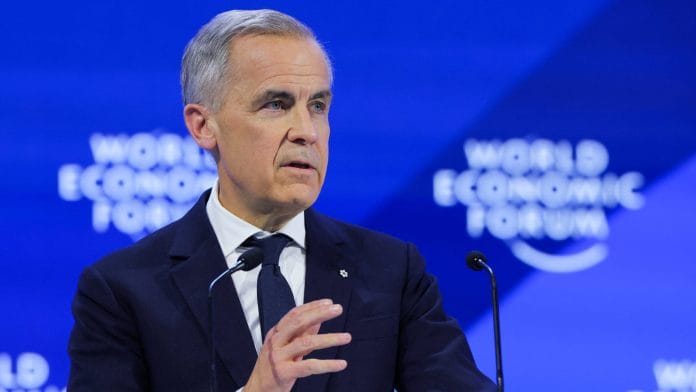
Canadian Prime Minister Mark Carney’s speech at the Davos conference illustrates some of these problems at the intellectual level. Equally, the Indian impulse to look to Europe—among other places—illustrates the policy dangers that stare us in the face.
Canada hasn’t had to consider the possibility of a hostile America for 200 years, though it did have contingency plans for such an eventuality as late as the 1920s, the ludicrous ‘Defence Scheme No. 1’. Ottawa is thus in uncharted waters, and Carney may be forgiven for some of his rhetoric, given Trump’s unhinged utterances. But the essential error that Carney makes is a refusal to look at what the distribution of power reveals as the possibilities in front of him—and India.
Power and proximity
He noted in his speech that we are possibly back in a Thucydidean world where the strong are free to act as they wish, but argued that it is definitely not true that the weak have no agency. But recognising the realities of power and the possibilities and compromises it results in is even more important for the weak: their weakness makes their position much more precarious than that of the strong. The weak have a much smaller margin for error.
One part of recognising this power imperative is understanding that proximity is closely related to power, an issue Carney ignores. Both Canada and India are neighbours to one of the two great powers of this era. This severely restricts their choices, but in different ways.
At least in a crude way, China is a potential partner to Canada in a manner that it is not for India or others in Asia and the Indo-Pacific because the proximity makes China a threat to the region. By the same token, while a rampaging Trumpian America is a possible danger to Canada and others in the Western Hemisphere, it is not so for India or Asia. At least, it is much less so—proximity matters in calculations of power and threat.
That is also why Carney’s hope for a middle power partnership is silly. Middle powers are distributed throughout the world, but geography will have a greater role in determining their choices than power alone. Middle powers such as India, Canada, Japan, Australia, and some of the European powers will make different choices because of this. For Canada and Europe, China offers greater partnership possibilities than it does to powers in the Indo-Pacific, which already live in fear under Beijing’s shadow.
Any middle power coalition will be difficult because India, Canada, and Europe are differently situated and thus have different perspectives on which power is a problem and which, a potential partner.
For India—and others in the Indo-Pacific such as Japan and Australia—China is the problem because it is the proximate power, while the US is the potential partner because it is distant and thus not a direct threat. This is less so for Canada, which is why Carney’s strategic partnership with China will be looked at with more than a bit of suspicion in the Indo-Pacific. For Europe, on the other hand, distance from both the US and China means that it has the possibility of playing one off the other. Carney is mistaken if he thinks this is an option for Canada. For India, such a balancing act is even less feasible.
As an aside, this is why the schadenfreude in India—that others such as Canada are discovering the value of “strategic autonomy”—is so misplaced. Strategic autonomy is not a policy; it is a desire, but also a marker of weakness. The weak don’t have the luxury of strategic autonomy, which is why it is only the weak that constantly talk of it. The strong don’t talk of it because they already have it by virtue of their strength. We will know that India has become a great power when Indian officials stop talking of strategic autonomy.
Also read: Why India shouldn’t risk joining Trump’s Gaza ‘Board of Peace’
Foolish to expect help from EU
Geography is also the reason why Europe is not a particularly great potential partner for India. Sure, India and Europe have no direct confrontations, Ukraine aside. And sure, European technology, as well as markets and investment, may be beneficial to India. But when it comes to balancing against China, India’s overwhelming strategic problem, Europe is only of marginal benefit. It is too far away to help much directly, and too invested in China to want to help India much.
Of course, marginal benefit is not nothing, and beggars can’t be choosers. But the danger is investing too much hope in a regional partnership such as the EU, which cannot even bring itself to deal with a local threat—Russia. European powers should easily be able to handle Russia themselves, but are instead forced to call on the US. Expecting the EU to come to India’s help is foolish. We should also keep in mind that “Europe” or “EU” is also a conglomeration of states, big and small, and getting them to act together is not easy.
We should also not forget other recent failed Indian gambits, such as the ‘Global South’ and the G-20. These efforts petered out—to put it somewhat more gently— because New Delhi misunderstood the sources of international power. India shouldn’t make the same mistake with Europe as it deals with a Trumpian America.
The choices in dealing with a Trumpian America aren’t pretty for anyone. But the fundamentals should be clear: for India and the Indo-Pacific, China is the threat, which means either balancing it or living under its hegemony. And balancing is not possible with other middle powers, whatever Carney may say. The US is the only possible balancer, which means the only choice is waiting out the Trump era, hoping it ends in 2029, and rebuilding a US partnership. Alternatively, learn the art of the kowtow.
Rajesh Rajagopalan is a professor of International Politics at Jawaharlal Nehru University, New Delhi. He tweets @RRajagopalanJNU. Views are personal.
(Edited by Prasanna Bachchhav)