






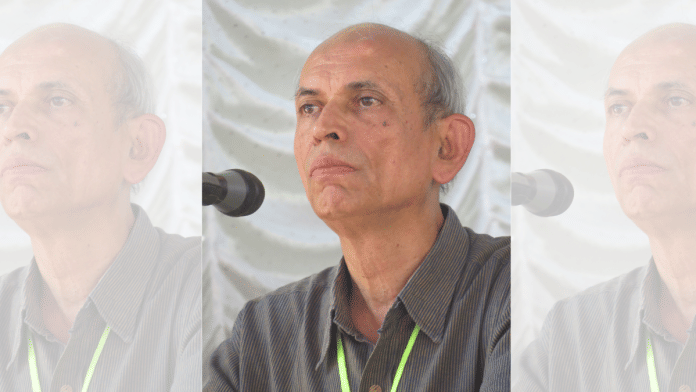



I have never met the man. I have read his books, and I have spent some time getting acquainted with his Report on the Western Ghats. But this limited acquaintance is enough to have turned me into a lifelong admirer of Madhav Gadgil.
The Western Ghats, or the Sahyadris as we call them, have been important in my consciousness from my childhood days. I remember driving past Sakleshpura and Agumbe with my grandfather. I remember my uncle referring to the Kaveri as Sahyadri-Tanaya, the “Daughter of the Sahyadris”.
Later in life, I remember a trip to Coorg and to Bhadra with my son. And then there were trips on my own, driving to Saunda, to Mangaluru from Shivamogga and to Goa from Belagavi. By this time, I could not visit these places without thinking of Gadgil and his report. The ecologist’s thoughts became like a central primer for me to actually feel a connection with these beautiful places. And of course, in the evening of my life, I now choose to spend much time in Lonavla. Here, too, Gadgil remains a persistent, if invisible presence.
Also read: Why Pinarayi Vijayan is going soft on an Ezhava leader’s anti-Muslim hate speech
Have we listened to Madhav Gadgil?
There are many reasons to praise Gadgil’s scholarship and energy. For me, his singular achievement has been to literally force our country to pay attention to our very fragile and beautiful Western Ghats. Much attention is paid to the Himalayas, and many coffee table books have been written about them. But the Western Ghats owe their impact on our collective consciousness almost entirely to Gadgil. And he did it with a seemingly dry government report, simply by ensuring that it was not dry at all. I remember a conversation I had with the great Sir Edmund Hillary. He agreed with me on the fact that, given the tropical and sub-tropical nature of our forests, the Western Ghats may in fact be ecologically more fragile than the Himalayas. It is this overwhelming reason to pay attention to these mountains that Gadgil managed to convey to us.
Have we listened to him? Have we defended our ghats adequately? Of course not. We have pretty much failed. But there is now a small beginning in our collective consciousness. We realise that we cannot love our country if we do not love our hills, rivers, water bodies, native trees, birds, wildlife, and above all, the people who live on our hillsides.
These days, when much is made of the deleterious effects that “anthropos” poses to the environment, Gadgil was one of the few who did not see a conflict. He had a vision of symbiotic co-existence between mankind and nature, and no fancy American degree could convince him to ignore the wisdom in the stories of the grandparents.
If Sven Hedin was the Savant of the Trans-Himalaya, perhaps we can pass down to our children that in our times, there lived a person who could be called the Champion of the Sahyadris.
(Edited by Prasanna Bachchhav)