






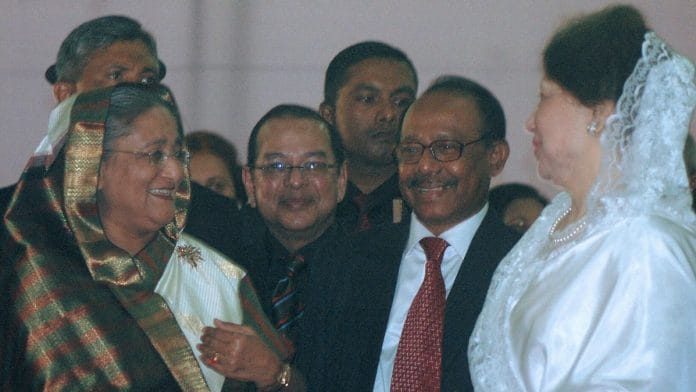



Bangladesh’s first female prime minister and chairperson of the Bangladesh Nationalist Party, Begum Khaleda Zia, was declared dead on 30 December. A pall of gloom descended not just on her immediate family and party supporters, but those in the country who fear a return to the ‘Minus Two’ formula.
Khaleda, who was prime minister from 1991 to 1996 and from 2001 to 2006, was one of the two begums—the other being former prime minister Sheikh Hasina—who shaped much of Bangladesh’s political history. Her death brings to the fore the fear of the controversial political strategy ‘Minus Two’.
First hatched in 2007, the strategy aimed to sideline Bangladesh’s two towering leaders to “reform” politics by keeping them from power through arrest or exile.
The strategy failed, and Sheikh Hasina won the parliamentary election, returning to power on 6 January 2009. But now, Hasina is in India, her bête noire Khaleda is dead, and Bangladesh is walking an uncertain political path.
Yesterday once more?
On 20 December, senior journalist and keen Bangladesh watcher Subir Bhowmik wrote that Muhammad Yunus seeks the presidency through a ‘Minus Two’ plan to sideline the Awami League and the BNP.
“Yunus, now head of Bangladesh’s interim government, is determined to implement his ‘Minus Two’ plan — marginalise both the Awami League and the BNP — and bring to power the Jamaat-e-Islami, which opposed Bangladesh’s independence and backed the cause of a united Pakistan in 1971,” he wrote.
Bhowmik is not the only one with such fears. Omar Hadi, brother of Bangladesh’s assassinated youth leader Sharif Osman Hadi, held a presser alleging that a section within the interim government plotted the killing to derail the upcoming general election.
But the stated aim of the original ‘Minus Two’ strategy was to end corruption by keeping both Khaleda and Hasina out of Bangladesh’s political fray.
“In 2007, the military intervened in Bangladeshi politics and installed a caretaker government in what is known as the ‘1/11 changeover.’ The new regime was accused of pursuing the so-called ‘minus two’ formula — the two being Hasina and Zia — after both rival politicians were arrested. They were released in time for the 2008 election, however, allowing Hasina to retake power and keep it until the mass uprising in 2024,” read an article in the Deutsche Welle on 1 January 2025.
Also read: Bangladesh is worshipping Islamists as heroes. Jamaat is having the last laugh
Hope of democracy
One can argue that the Battle of the Begums was not the best of times for Bangladesh’s internal politics. So bitter was the rivalry that on 21 August 2004, at an anti-terrorism rally organised by the Awami League, 13 grenades were thrown at the crowd. The attack left 24 dead and more than 500 injured. Hasina, then the leader of the opposition, had just finished her address and was injured in the attack. On 10 October 2018, a special court sentenced Khaleda’s son Tarique Rahman and others to life terms for the “well-orchestrated plan, executed through abuse of state power”.
On 1 December 2024, four months after Hasina fled to India, Rahman and all other accused were acquitted by the High Court in Dhaka.
On her part, after Hasina won the national elections in 2009, Khaleda faced an array of criminal charges and jail. It forced her to recede from public life, leaving Rahman in charge as acting leader of the BNP.
“As with Hasina, Khaleda’s legacy is grey: Both women fought for democracy, against authoritarianism. While Khaleda, unlike Hasina, was never accused of carrying out mass atrocities against critics, she was also a polarising figure,” read the Al Jazeera obituary.
The article said that Khaleda’s uncompromising style when she was in opposition—leading election boycotts and prolonged street movements—combined with recurring allegations of corruption when she was in power, inspired intense loyalty among supporters and equal distrust among critics.
Whatever the criticism against their tenures may be, Khaleda and Hasina kept the hope of democracy alive in Bangladesh. Today, the country stands at a crossroads. The big hope from the students’ uprising of 2024 has died. National Citizen Party, the political party that came out of the uprising, has tied up with the Islamist party, the Bangladesh Jamaat-e-Islami. Communal attacks have become commonplace in the country, raising the question of whether religious minorities will have a place in new Bangladesh. The recent attack on the free press has shocked the world, and the law and order situation is worsening by the day.
Khaleda’s death and Hasina’s exile to India have come at a time when Bangladesh needed them the most. It remains to be seen if Rahman can seize the day and bring Bangladesh back from the brink of radicalism.
Deep Halder is an author and a contributing editor at ThePrint. He tweets @deepscribble. Views are personal.
(Edited by Prasanna Bachchhav)