








The last two weeks have seen multiple flare-ups in the Middle East, confusing the rest of global politics about which is more likely: another round of fighting or a peace deal. Now, US President Donald Trump has announced a deal to end the war. Pakistani Prime Minister Shehbaz Sharif has said that the deal will be signed Friday in Switzerland. All these statements may still turn redundant, as many such assurances have in the past two months. There is one new announcement, however. Tehran has announced that the funeral for Ayatollah Ali Khamenei, who was assassinated on 28 February, will begin on 4 July. He will be buried in his home town of Mashhad on 9 July.
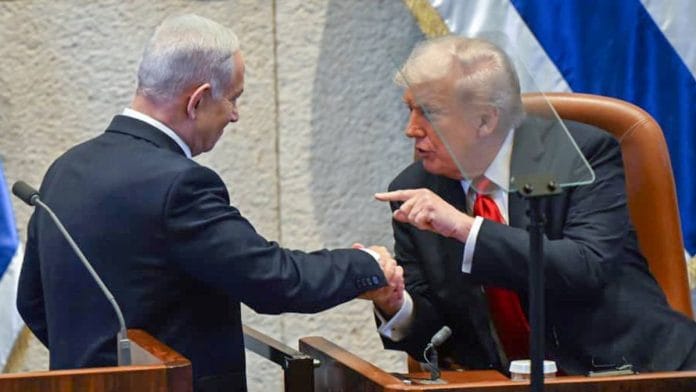
It is for the first time since 8 April, when ceasefire started, that the US and Iran have said that they do have a memorandum of understanding, that they have a deal declaring the end of the war that started on 28 February. The agreement is expected to halt the US blockade of Iran, reopen the Strait of Hormuz, and begin 60 days of talks on Tehran’s nuclear programme. No matter whether the deal is based on the minimum terms such as these, keeping aside the nuclear issue for another two months, this deal is worth supporting. Most countries have welcomed this development. Israeli Prime Minister Benjamin Netanyahu is yet to speak on this, though it’s already public that he has been sidelined and ‘rebuked’ by Trump.
Sitting in Tel Aviv, I find Israeli experts and citizens at larger deeply concerned with the fact that this is not their deal and yet it will be a deal for them. Reports of the number of times Trump has been calling Netanyahu dominate news coverage in the country.
“It’s time to end this war,” Trump told Netanyahu on 11 June. Following another Israeli attack in Beirut that could jeopardise the deal on 14 June, Trump revealed his frustration saying, “Netanyahu has no discretion”.
Strained ties
The Israel-Hezbollah-Tehran escalation almost restarted the war between Israel and Iran around 6-7 June. Hezbollah’s frequent rockets and drones didn’t stop throughout the last two months of the ceasefire. To deter that aggression, the Israeli army said, it marched deep into the south of Lebanon, crossed the Litani river, took over the Beaufort castle, and then attacked Beirut’s neighbourhood Dahiya, which is a stronghold of Hezbollah.
Much against the wishes of the President of Lebanon, Joseph Aoun, Iran launched 20-odd ballistic missiles on Israel in the name of Hezbollah/Lebanon. Tel Aviv had to do with a limited response, as its hands were tied by Trump, who told Netanyahu, “Don’t retaliate.” After an Apache helicopter went down in Hormuz on 9 June, the US president allowed the American forces to attack Iran, but didn’t suspend the long negotiations.
Trump certainly is verbose, and that has been nerve-wracking for the rest of the world. But the good thing is that he has avoided all excuses for the renewal of the war. He would like to walk out of this sordid saga with some face–saving. So, whatever is a good deal for Trump will have to be the deal for Israel, and in fact, for the rest of the world.
David Horovitz, editor of The Times of Israel, captured the tragic fall of interests between Trump and Netanyahu by writing that “the US-Israel alliance against the Islamic Republic on Sunday reached its nadir.” The article carried an AI-generated image of US President Donald Trump on his knees, bowing before Supreme Leader Mojtaba Khamenei, which was tweeted by Iran’s military spokesperson Ibrahim Al-Fiqar on 24 May 2026. The inclusion of such an unkind portrayal of Trump in the article signals the sharp turn of events and unexpected conflict of interests between the special allies. They were partners at the start of the war; they are not with each other by the end of it.
Also read: The world’s conflicts are still rooted in geography. Globalisation didn’t change much
Israel must find a way out of perpetual wars
It is a commonly held view that it is Netanyahu alone who holds eternal suspicions of the Iranian regime. However, Israeli opposition leaders, national security analysts, defense establishment, and public at large view Iranian Shia revolutionaries with dread. The reason for this is Hezbollah and the constant calls of Iranian leaders for the destruction of Israel and its people.
Hezbollah is the extended branch of the Islamic Revolutionary Guard Corps that has been motivated to fight against Israel from Lebanon for decades now. Aoun is desperately defending his country from the Ayatollahs who have thrown the whole nation into their Shia mission. So, any deal Trump makes with Iran will be tough for Israel to come to terms with—and yet, the country has no option but to do so. How much Lebanon is part of the deal, we don’t know yet. Iran, and mediator Pakistan, said the cessation of all fights in Lebanon is part of the deal. If that is the case, Israeli leaders will find it difficult to deal with.
There are several reasons Israel will not spoil the current deal, however opposed it is to the agreement. First, Netanyahu is up for national elections in a few months, which makes him least likely to open a political battle with Trump. The talk in Tel Aviv is that he is planning Trump’s visit to Israel sometime in September. Second, Netanyahu can’t oppose Trump like he once did with Barack Obama on the issue of a nuclear deal with Iran in 2020. While he may want to at least put up a show of independence and Israel’s sovereign will for his domestic audience, his country remains too reliant on American aid and defence. Third, Netanyahu needs Trump’s support at global stage as he doesn’t have much of it from other international heads of state.
Since Israel’s establishment in 1948, most of its wars—at the time, with Arab states—ended in a limbo or in extended periods of hostilities, but none saw diplomatic breakthroughs. The futility of its war with Iran and the inevitable upcoming fight with Hezbollah in Lebanon are two given realities for Israelis, whether a Washington-Tehran deal happens now, later, or never. Trump is hardly at fault for this; Israelis will just have to find a way out of their cycle of perpetual wars.
Khinvraj Jangid is Director and Professor, Centre for Israel Studies, OP Jindal Global University, Sonipat. He is Comper Fellow at The Elizabeth and Tony Comper Center for the Study of Antisemitism, University of Haifa, Israel. Views are personal.
(Edited by Prasanna Bachchhav)