






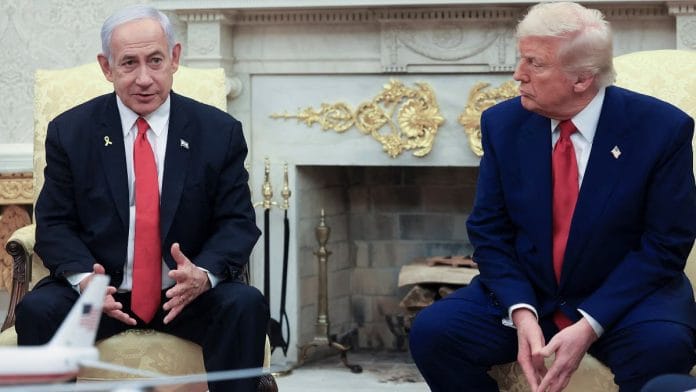



Despite the strong levels of cooperation and military interdependence on display—it will be an error to assume that Israel and the US share perfect convergence regarding war aims, war means, and thresholds of cost vs opportunity trade-offs.
Iran is the primary long-term threat to Israel and has been for decades. A war against Iran is widely popular within Israel, resulting in higher thresholds of cost/pain tolerance. These two conditions are not true for the US, where the war is unpopular (especially if costs increase), and Iran is not considered a primary systemic security threat. This factor of potential (if not live and ongoing) divergence, arguably, has a strong causal influence on the future of the war, its spread/elongation, as well as its termination.
This article seeks to examine the ongoing contest and its potential future trajectories from the prism of ‘shared war aims’ between the key warring parties — Israel and the US.
Lessons from the 12-day operation
Hence, to gauge the degree of convergence, we need to retrace how it was reached as of late February 2026. It is useful, therefore, to start with the 12-day war in June last year and note the imperfect convergence between Israel and the US back then. Notably, as of May-June, the US appeared interested in reaching a negotiated outcome with Iran in order to address the latter’s policy of uranium enrichment through a new agreement.
US President Donald Trump himself was motivated by his pursuit of the Nobel Peace Prize as he was deeply invested in ending conflicts globally, and accordingly conveyed to Israel that efforts to upend negotiations through a military strike will be ‘inappropriate’. Israel remained stridently opposed to the prospect of a negotiated outcome and launched an extremely well-planned surprise attack on Iran that partially paralysed the state apparatus, depleted military assets, and very quickly led to the Israeli Air Force dominating Iran’s airspace.
Subsequently, Israel had arguably offered the Trump administration an opportunity to ‘eliminate’ Iran’s nuclear facilities and thereby claim credit and share in the victory parade – with the added incentive of sending a signal to all US adversaries that its military should be taken more seriously now. Subsequently, the US demonstrated its power projection capabilities by conducting Operation Midnight Hammer and achieving convergence with Israel’s strategic objectives vis-à-vis Iran.
However, this convergence faded quickly when Trump assertively drew in both warring parties from continuing strikes on each other. His famous expletive-laden outburst on White House lawns illustrated that in his vision, the US strike was the last word on the matter (note his preference for short, decisive wars that come without baggage and commitment traps) and that Trump was now returning to his peacemaker role by ending the conflict through his sheer force of personality as well as through leverage over both sides.
Israel had strong strategic reasons to be satisfied with the 12-day operation, but it also had reasons to feel that a rare and extremely rewarding opportunity was both gained and then lost. In its aftermath, it gradually came to understand that this giant window of opportunity (borne of unprecedented Iranian weakness) needed to be preserved (and deepened) – perhaps indefinitely.
The glib and crude phrase ‘mowing the grass’ has come to characterise Israel’s approach toward both Hamas and Hezbollah over the last decade and a half. The underlying idea – elegant and simple – was that Israel had no other option but to occasionally and routinely undertake strikes and ground operations to eliminate its adversaries’ growing military capabilities as well as weaken the morale of its members and civilian supporters. According to many observers and analysts, this doctrine had failed spectacularly on 7 October—leading to the inference that true security might require greater political calibrations, and not just military might and domination.
However, Israel drew a very different inference from 7 October—prioritising offensive measures and extreme pre-emption. This meant a fuller control of Gaza and eliminating Hamas as well as Hezbollah to the degree possible. At the same time, Israel adopted a ‘mowing the grass’ approach to regional adversaries and threats – Syria, Yemen and most crucially, Iran. Note that Israel’s military intervention in Syria in recent years has aimed at destroying the Syrian state’s military capabilities per se and not a particular regime, that is, even after the fall of the Assad regime.
The domination of Iran’s airspace and the extent of Israeli intelligence penetration in June 2025 revealed the possibility of establishing a permanent new balance of power between Israel and Iran, and one in which Tehran is fundamentally on the back foot, demoralised from re-emerging as a threat and perpetually vulnerable.
Hence, Israel’s likely war objectives have as much to do with a deeper weakening of Iran’s state apparatus and military capabilities as they do with a clean endpoint such as regime change. This is key and a point that we will return to.
Meanwhile, a secondary lesson for Israel was regarding alliance management and achieving a more perfect convergence between Tel Aviv and Washington this time around. Unhappy over Biden’s pressure “to refrain from offensive actions in other arenas”, Israel has sought to achieve ‘stockpile independence’ since early 2025. Israel’s key advisors, notably tend to list regime change as just one of many priorities while considering the same as not necessarily likely despite devastating strikes. For the Trump administration however, only a regime change or radical reorientation could justify the costs of war.
Iran’s own lessons
Going by the present escalation, Iran seems to have drawn its own lessons from June, but of a kind that is much more dismal. It had come to understand that its retaliatory strikes in June (especially against the US) were too symbolic, calibrated, and lacking in real cost-imposition. Iran had pursued this restrained approach out of both weakness and a preference to preserve room for diplomacy – especially with the Trump administration.
That restraint, however, may have come at great cost to deterrence and without necessarily leading to real diplomatic breakthroughs or outcomes. It has also encouraged greater opportunity-seeking in both Tel Aviv and enhanced Israel’s ability to persuade the US that a more decisive joint strike will yield in similar restraints by Iran.
In the ongoing war, Iran has sought to compensate for its past ‘mistake’ by undertaking more comprehensive and cost-imposing retaliatory strikes, with ostensibly much less regard for maintaining room for diplomacy. Even as Iran has fervently attacked US forces and assets, its underlying strategic calculation arguably remains the same—to draw a wedge between the US and Israel by convincing the former that it has more to lose and less to gain from war continuation than Israel. The US is likely to consider this increasingly, even as it may seek to double-down in the immediate short run.
Also read: India-US deal doesn’t spell doom for Russia ties. Our relationship is stronger than that
Revisiting the potential divergence
The Trump administration may have believed that the war would be short, decisive, with low-to-moderate costs, and promising a clean endpoint. This has been driven by perceptions of Iran’s historic weakness since last year, confidence in US-Israeli military capabilities, and the assessment that the regime in Tehran is desperate for survival because of recent unprecedented popular protests. These neat calculations are increasingly getting complicated however.
The administration’s attraction toward military operations that carry little to no ‘baggage’ of forever wars—boots on the ground, and uncontrolled escalation—had obviously increased after the stunning success of the Venezuela operation. A decisive regime change or a radical regime reorientation would have (and still could) paved the road for a ‘mission success’ — giving the Trump administration a significant boost domestically as well as geopolitically. A future agreement that included promises against nuclearisation and restrictions on ballistic missile programmes, as well as an understanding on oil agreements with the US offered strong temptations and incentives.
However, the war is growing more unmanageable by the day, and regime diffusion after the assassination of Supreme Leader Ali Khamenei has made US officials nervous. The elimination of the Supreme Leader and his successors has made a negotiated ceasefire — followed by a favourable deal — much more complicated, even as regime change continues to look as evasive as prior to the war. With the Strait of Hormuz closed down, a rise in global oil prices could directly impact the US economy. Concerns over munitions stock depletion and loss of assets and personnel in the region are growing.
The battlefield math of finite missile interceptors versus inexpensive drones is being increasingly seen as challenging. Trump also needs to worry about upcoming midterm elections, which have been an uphill challenge. Pentagon officials, meanwhile, are certainly assessing the impact of stockpile depletion on the balance of power in other theatres – most notably the Indo-Pacific. Notably, Israel does not have the same dilemmas, and it is pursuing the war in a manner that seeks to expand the imbalance of power with Iran in its favor.
A more protracted conflict (although daunting) does not deter Israel in the same manner that it deters the US. This is a variable that is now increasingly central to key decisions over the coming days.
Sidharth Raimedhi is a Fellow at the Council for Strategic and Defense Research (CSDR), a New Delhi-based think tank. He tweets @SidharthRaimed1. Views are personal.
(Edited by Ratan Priya)
In contrast, India couldn’t afford a war with Pakistan beyond four days recently. This is the status of our socialist India.