






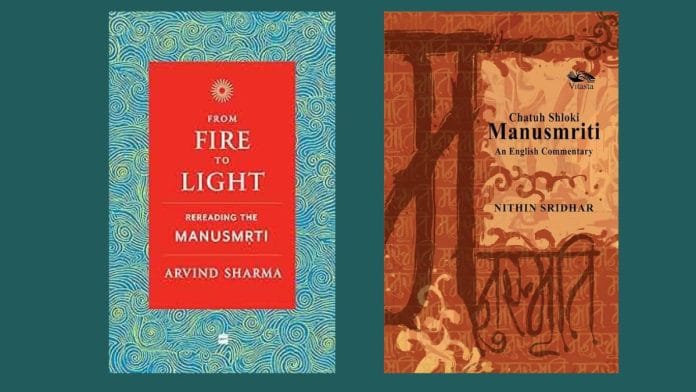



Reading two contemporary books on the Manusmriti has been a delight of a lifetime. The best part is that both books—Arvind Sharma’s From Fire to Light: Rereading the Manusmriti and Nithin Sridhar’s Chatuh Shloki Manusmriti: An English Commentary —are written from an insider perspective. Sharma is the Birks Professor of Comparative Religion at McGill University in Canada.
Sharma describes himself as a Hindu academic, while Sridhar is a Hindu scholar who serves as the Director and Chief Curator of the Indica Center for Moksha Studies.
The Manusmriti, invariably translated into English as the Laws of Manu or the Manav Dharmaśāstra, is one of the most influential and authoritative texts within the Hindu Dharmaśāstra tradition. Sharma compares Manu with the modern-day Supreme Court. ‘Manu said so,’ Sharma declares, “seems to have had the same force in [the Indian] tradition as a ruling of the Supreme Court does in a modern legislative setting.”
Building on Sharma’s comparison, it is important to understand that Dharmaśāstra is a set of ancient Sanskrit texts constituting a major genre of Hindu literature. They focus on Dharma—righteous living, moral duties, ethical conduct, social order, and law.
However, inaccurate readings of Manu’s text, the Manusmriti (MS), have led to it being labeled “controversial” and its legacy “contested” (Sharma).
Colonial readings and contested legacy
The discovery of Sanskrit—an ancient language of the Indian subcontinent—alongside its rich scientific and philosophical literature, intensified Western scholars’ interest. The Manusmriti was among the earliest Sanskrit works translated into English (The Institute of Hindu Law by Sir William Jones, published posthumously in 1794). Yet this emerging fascination was not without its biases. As Patrick Olivelle, an Indologist and philologist, notes, most European scholars interpreted India’s past primarily through the Manusmriti. Over time, the text’s legacy became so fraught that writing about the Manusmriti was likened to playing with fire (Sharma).
The Manusmriti is frequently criticised today as a document designed to entrench “caste” hierarchy and gender inequality, often cited by reformers like BR Ambedkar (who symbolically burned part of the book, an act he would never repeat). Sharma acknowledges the text’s history of being “torched” both literally and figuratively, but argues that common interpretations are one-sided, incomplete, and often inaccurate.
Throughout the colonial period, an increasing number of non-native Western scholars shared information about Hinduism primarily among themselves. As this information flow continued, the West established itself as the primary—if not the only—source of information on Hinduism. Sharma elaborates in “Dharma and the Academy: A Hindu Academic’s View” that this intellectual control not only affected academic discourse in the colonies but also reshaped insiders’ understanding of their own traditions. This influenced self-perception through what Sharma calls the outsider-to-insider channel.
Against this backdrop, these ‘outsiders’—including colonialists, orientalists, indologists, and later Marxists—portrayed Hindu society as beset with social challenges, particularly concerning women and the ‘Shudras’. They also mistakenly asserted that certain “social evils,” such as “suttee” (sati), dowry, female infanticide, slavery, caste discrimination, and others, had always been part of Hindu society.
Sharma argues that existing work on the Manusmriti mainly uses advocacy, outsider (etic), or “pathology” perspectives, but he sees a need for analyses that are instead critical, insider (emic), and traditional in approach. This highlights the contrast between prevailing perspectives and Sharma’s approach.
Those who study the Manusmriti from an advocacy perspective often use it to advance modern ideologies, anachronistically applying present-day values to an ancient text. Sharma suggests this results in interpretations that focus less on the actual content and more on how the text can be used to support different agendas and ideologies. Such reading overshadows more neutral readings of the Manusmriti.
It must be made clear from the outset that the etic, or ‘outsider,’ approach to studying the MS is not based on where someone is from. For example, many Indians—mostly Marxists—analyse the Manusmriti with an etic perspective. Sharma illustrates this by referencing the distinction between Varna and Jati.
Jati, meaning ‘caste proper,’ refers to the “endogamous, comensal, and craft-exclusive group”—precisely the feature the etic viewpoint emphasises when talking about Hinduism. In contrast, when those within the tradition (the emic perspective) describe Hinduism, they emphasise the Varnashrama Dharma, especially when differentiating Hinduism from other indigenous religions such as Buddhism, Jainism, and Sikhism. As Sharma notes, Hinduism “does not describe itself as upholding the jāti, but rather varņa” (italics original).
Sharma claims that negative portrayals of Hinduism and the Manusmriti stem from what he calls a ‘pathology.’ He argues that this trend began with James Mill’s The History of British India and persisted across both capitalist and communist thinkers in India. Their efforts to eliminate the oppressive ‘caste system’ took either economic or revolutionary approaches.
Taking a step back from these modern perspectives, a traditionalist approach sees the Manusmriti as a legal text embedded within the broader Hindu Knowledge Tradition. This legal tradition reflects Hinduism’s ongoing effort to render the age-old Vedic tradition relevant to successive eras.
Also read: India is successfully walking West Asia tightrope. Modi has skilfully avoided taking sides
Rethinking Manu
This brings us to another key aspect: Sharma places the text within its historical context (likely composed between 200 BCE and 200 CE) and employs the “hermeneutics of suspicion” (questioning surface meanings). He thereby offers a nuanced, charitable interpretation while clarifying that he does not fully defend the text’s applicability today.
To elaborate, hermeneutics of suspicion was espoused by Paul Ricœur, who was inspired by Karl Marx, Friedrich Nietzsche, and Sigmund Freud—the three ‘masters of suspicion.’ Sharma demonstrates that applying hermeneutics of suspicion can generate conflicting interpretations of the Manusmriti.
Understanding the historical context further, Manu wrote the text in the aftermath of the devastation Indian society suffered under the Ashokan policy. Following foreign invasions—the Bactrian Greeks, Scythians, Parthians, and Kushanas—society faced massive upheaval. Some texts indicate that about a third of the population of India, known to contemporary scholars, perished. Many within the tradition believed that these invasions, compounded by Ashoka’s efforts to reshape Vedic society into a Buddhist one, brought lasting harm to Indian society, polity, and economy. Manu’s response focused on rebuilding and reclaiming what they thought was lost, with an emphasis on household life and procreation.
Building on this historical analysis, the book draws attention to another overlooked aspect of Indian history: Ashoka’s relationship to native Hindus. While Ashoka and his rule have often been explored globally and nationally, his portrayal within the Hindu tradition remains unexamined. Notably, Ashoka was not celebrated as a great king in native tradition; he received such recognition only after James Prinsep’s discovery in 1837. Prinsep was an English scholar.
Additionally, Ashoka’s supposed religious tolerance is debated. He even ordered the slaughter of 18,000 Ajivikas, followers of a heterodox Indian philosophy. He was also known as Chandashoka, or ‘Ashoka the cruel.’
Methodologically, while Sharma proposes the ‘hermeneutics of suspicion’ to address negative perceptions of the Manusmriti, Sridhar introduces the ‘hermeneutics of Shraddha’ for engaging with Hindu texts, including the Manusmriti. With this method, Sridhar suggests, one approaches the text with faith and respect, seeking deeper meaning through the contemplative process known as ‘śravaṇa catuṣṭaya’ in Vedānta, which encompasses listening (śravaṇa ), intellectual reflection (manan), deep contemplation (nididhyāsana), and realisation of Truth (sākṣātkāra).
Sridhar’s book on the Manusmriti is written in the traditional Dharmaśāstra tradition of the Indian Knowledge System. As an insider to the tradition, Sridhar authoritatively delves into the delicate and complex questions of origination, transmission, and the authorship of the Manusmriti, offering deep insights into Hindu Dharmashastras. The book situates the Dharmashastras within the broader Hindu tradition. It provides a practical, approachable guide to reading the Dharmashastras with Shraddha (devotion) and shastric methodology, thereby giving scholars the proper competence (adhikara) to study the texts.
It is almost trite to reiterate here, as Sridhar does in his Chatushloki, that the purpose of the Dharmashastra texts is to unpack the complexity of Dharma. One of the key questions concerns the sources of Dharma itself. The Manusmriti (2.6 and 2.12) enumerates four sources of Dharma: 1) Shruti, or the entire Veda, 2) Smriti, or the tradition and practice of those who know the Veda, 3) Sadachar, or the conduct of good people, and 4) Atma-tushti, or what is pleasing/satisfying to oneself.
Sridhar emphasises the significance of Smritis as Pramana (proof) within the Dharmaśāstra tradition. The Manusmriti (3.13) describes Smritis as Pramana, the highest authority on knowledge.
In his commentary on the Manusmriti, Sridhar deliberately narrows his scope to the opening four verses—the “Chatuh Shloki” (four shlokas). These foundational verses set the stage for the entire text: they introduce the sages’ request to Manu, his response about the creation and purpose of dharma, and the framework for righteous living. The author treats these verses as containing the seed or philosophical architecture of the Manusmriti, providing a gateway to understanding its intent, relevance, and proper approach.
Reading these two books on Manusmriti gives the readers the satisfaction, a Pramana of sorts, that the Hindu Knowledge Tradition is alive and well.
Avatans Kumar is a linguist and a recipient of the California News Publishers Association and the San Francisco Press Club’s journalism awards. Views are personal.
(Edited by Ratan Priya)