








New Delhi: The outsourcing industry, India’s largest white-collar employer, is a juggernaut that has all but stopped moving. The dollar revenue at the top five software-services exporters has grown slower than 3% for 10 straight quarters — a shadow of the double-digit expansion in the previous two decades. As these firms squeeze hiring to survive the existential challenge posed by artificial intelligence, the aftershocks are starting to upend everything from real-estate demand to mortgage-underwriting norms.
Last week, Bengaluru-based Infosys Ltd. forecast a much slower pace of increase in sales than analysts had been expecting. At smaller rival HCL Technologies Ltd., revenue for the March quarter declined from the previous three months.
After a four-month, $115 billion rout, investors are losing faith in a business model centered on the most-populous nation’s army of young engineers, which gave it a wage advantage over developed countries. Outsourcing generated a million middle-class jobs every year; it also drove ancillary employment in real estate, retail, and services, according to Mumbai-based Marcellus Investment Managers.
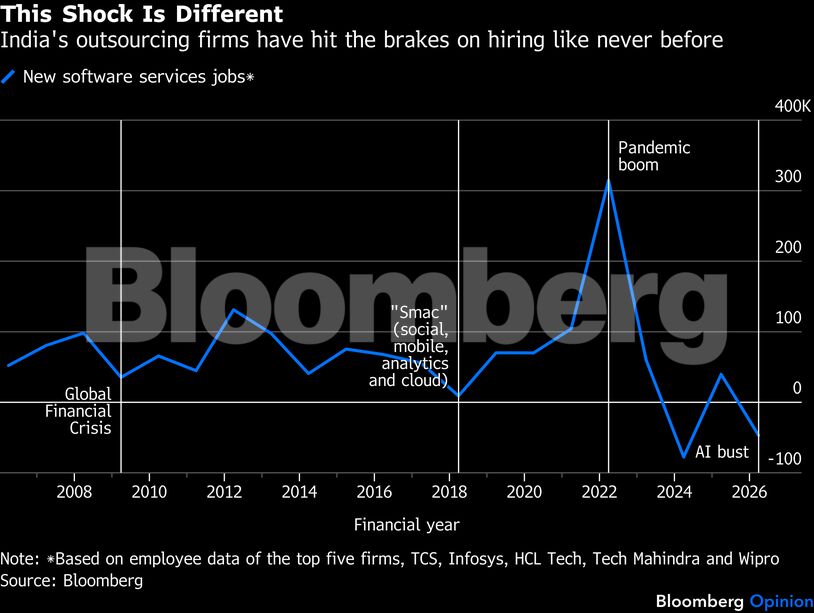
But in the past 36 months, the top five firms have shed a net 85,000 employees. Last year it was uncertainty about US tariffs that led clients to pause tech upgrades. This year, it’s the war in Iran. However, the more durable threat is from models like Claude and Mythos. They fix bugs and write code at a fraction of human cost.
Cities like Hyderabad, Pune and Bengaluru, where knowledge workers account for a significant share of homebuyers, are witnessing sluggish sales and rising inventories of unsold apartments. Investors who bought under-construction properties — hoping to rent them to software engineers — are finding few takers. Even global tech heavyweights would rather invest in high-end chips and data centers than programmers. Thousands of Oracle Corp.’s India employees lost their jobs last month.
Banks are paying attention. After all, their credit portfolios are exposed to stagnating salaries and outright job losses in a customer group that they treated as low-risk until now for mortgages and credit cards.
The economics research team at Canara Bank, a Bengaluru-based, state-owned lender has come up with some interesting proposals: For borrowers who are susceptible to automation risk, mandate a lower loan-to-value ratio — for example, 60% versus the standard 80% — to create a larger equity buffer. For corporate lending, include intellectual property or proprietary data as supplementary collateral. This ensures the bank has a claim on the AI technology that replaced the labor. Finally, require corporate borrowers undergoing AI-led restructuring to divert a percentage of labor cost savings into a debt-service reserve account.
Top executives at software companies are still sticking to their sanguine view that steadily increasing AI adoption will mean more work for them, not less. As AI agents get more powerful and affordable, clients will deploy them aggressively to cut costs. They will rely on their trusted outsourcing firms to automate more of their processes.
While it’s a reasonable thesis, there is nothing here to support the Indian industry’s historic pace of job creation. Yes, cleaning up data scattered around an organization, giving it a proper structure, and putting it in the cloud is labor-intensive work. But it’s a one-time effort. Once the plumbing is fixed, AI agents will take over.
Even for longer-term projects, clients won’t pay the same rates as before. A supplier managing software quality with 2,000 employees will soon be expected to do it with 500 — and AI. As the cost of artificial intelligence plummets toward the price of electricity, contract values for outsourcing will deflate.
Investors agree. On the eve of its quarterly earnings, Infosys announced that it had entered into a collaboration to combine OpenAI’s technology with its own agentic service. Yet the market chose to focus on its weak revenue guidance. The stock fell nearly 7% Friday.
To protect margins, the $315 billion Indian information technology industry will have to shrink its 6-million-strong workforce. Firms will be better off returning cash via buybacks while other sectors take up the slack in the labor market and stake a claim on a bigger share of bank loans.
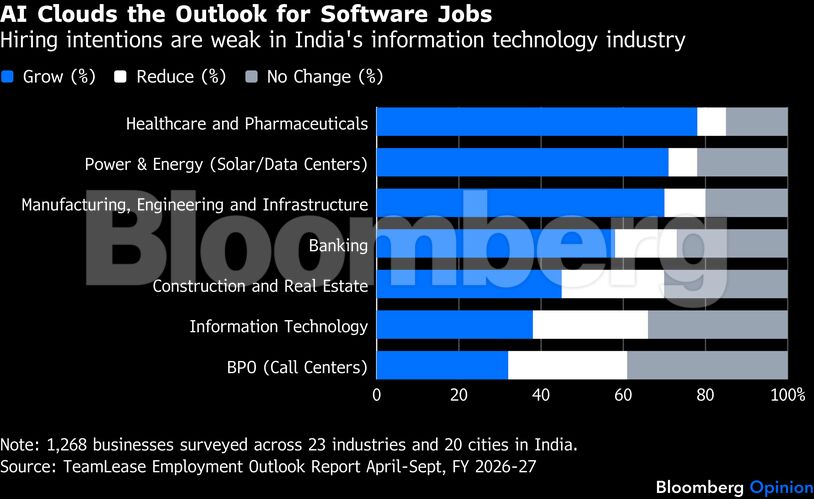
In a survey of hiring intentions across 20 cities conducted before the Iran war, 78% of employers in healthcare and pharmaceuticals, and 70% of firms in manufacturing, engineering and infrastructure said they wanted to expand their payrolls between April and September, the first half of India’s financial year. By contrast, only 38% of IT firms, and 32% of business process outsourcing units — call centers — want to bulk up.
The shift away from AI-exposed employment is unmistakable. As other models match or surpass Mythos’s capabilities in autonomous coding, expect more banks to reassess their lending preferences. Nurses, mechanics, and technicians will have higher job security; they may also enjoy faster wage growth. It stands to reason that they should also command better housing choices and more relaxed underwriting norms.