







Walk into any National Law University in India today, and you are likely to see a near-equal representation of men and women. Women comprise 45 to 50 per cent of law school classrooms. In higher education overall, the Gross Enrollment Ratio for women, 30.2, has now surpassed that of men, 28.9, according to the MoSPI report released on 29 April. This apparent parity is an encouraging reflection of changing aspirations and widening access to legal education.
Yet this fades sharply beyond the classroom. Step into a district court. Then a high court. Then the Supreme Court. At each level, watch the numbers collapse.
Of the approximately 17 lakh advocates enrolled with Bar Councils across India, only 15 per cent are women. This was confirmed in 2023 by then Law Minister Kiren Rijiju in a reply in the Rajya Sabha. As of that year, there were 2,84,507 women advocates on record. The Department of Legal Affairs published state-wise data showing a ratio of roughly 20 men for every three women. Of 24 State Bar Councils, only 15 provided gender-disaggregated data. Nine did not bother to count. The drop from 50 per cent at entry to 15 per cent at enrollment is the first fracture in the pipeline. It is not the last.
The view from the bench
One of the authors of this article served in the Delhi judiciary for 31 years. From that vantage point, the absence of women was not a statistic. It was a daily observation. In matters relating to gender justice, dowry, sexual harassment, and family law, women’s perspectives are essential not merely for diversity but for the quality of adjudication itself.
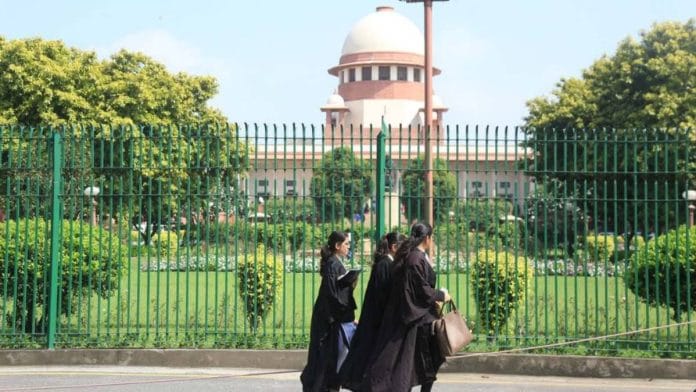
The Supreme Court of India has had 12 women judges in 35 years. Currently, two of 37 sitting judges are women. Justice Fathima Beevi, the first female judge in the SC, appointed in 1989, said she “opened a closed door.” Thirty-six years later, the door remains barely ajar. India has never had a woman Chief Justice. Justice BV Nagarathna is expected to hold the position in 2027, but her tenure will last precisely 36 days.
In the high courts, women hold 105 of 779 positions: 13.47 per cent, as per CLPR data from late 2024, up from 11.4 per cent in 2017. Only 12 women have served as Chief Justices of High Courts out of 242 total appointments since Independence through 2025. That is less than 5 per cent. The Centre for Law and Policy Research has documented that women from marginalised backgrounds—Dalit, Adivasi, Muslim, and first-generation lawyers—are almost entirely absent from the higher judiciary. The Collegium system, which operates without published criteria or transparent deliberation, has been identified as a key structural barrier.
The district judiciary tells a different story, and an instructive one. Women now constitute 38.3 per cent of district judges, according to the India Justice Report 2025, up from 30 per cent in 2017. This is the only level that approaches reasonable representation. The reason is structural: District judges are recruited partly through competitive examinations—typically 50 to 67 per cent of vacancies depending on the state—and partly through promotion from the subordinate judiciary. The merit list is transparent. The process is impersonal. And women consistently dominate it. Samridhi Talwar topped the Delhi Judicial Service examination 2023-24. In the UPSC Civil Services 2024 results, 11 of the top 25 candidates were women. Both first and second ranks were secured by women. In the IPS, 54 women were selected in 2024—28 per cent of the total.
The pattern is consistent: Wherever recruitment is merit-based and examination-driven, women perform at par or better. Wherever recruitment depends on networks, patronage, and informal selection, women are excluded. The collegium appoints. The examination selects. The numbers tell us which system serves women better.
Also read: Bangs, lipstick, low neckline—for Indian woman lawyers, merit evaluation steeped in misogyny
The mid-career exit
An international survey from 2022 found that nearly 60 per cent of women lawyers leave litigation between the ages of 35 and 55. These are the years when careers are built, reputations established, and judicial candidates identified.
Is it because of structural barriers? Safety and security? A non-congenial environment? The outlook of the profession toward women? The answer is: All of these, operating simultaneously.
Litigation in India is location-specific. A woman who relocates after marriage often cannot transfer her practice. There are no creche facilities at most district courts. The India Justice Report 2025 found that 20 per cent of district court complexes still lack basic facilities such as separate toilets for women. Maternity provisions do not exist for independent practitioners. And as recently as 2025, the Supreme Court was still hearing a plea about the absence of a PoSH framework for women advocates. The professionals who argue sexual harassment cases for others have no statutory protection themselves.
The legal profession, whether at the bar or on the bench, is still associated in the public imagination with aggression: Long hours, combative exchanges, and a certain roughness that is often coded as masculine. This perception quietly shapes who is seen as “suited” for the courtroom.
For women, it creates an additional, unspoken hurdle: The need to constantly negotiate between professional competence and gendered expectations of behaviour. The result is a profession where entry is increasingly equal, but retention and advancement remain structurally uneven.
The 2 per cent governance ceiling
The most devastating number is not in the judiciary. It is in bar governance. Of 426 elected seats across 18 of India’s 25 State Bar Councils for which gender-disaggregated data was available, only nine were held by women in 2021. That is 2.04 per cent. In 11 of the 18 councils, there was not a single elected woman. The Bar Council of India has never had a woman president.
The bodies that decide who can practise law, how misconduct is punished, and what professional standards apply are 98 per cent male. Women who contested bar elections faced entrenched resistance. As ThePrint documented in its investigation of the Delhi Bar Council elections in January 2026, the council had “rarely had women members” in its history, and women candidates described a culture of male gatekeeping in bar governance where disciplinary power over practising licenses made male colleagues reluctant to accept female authority.
The Supreme Court intervened in December 2025. In two petitions, the Court mandated a 30 per cent reservation for women in all State Bar Council elections. Earlier, in May 2024, the Court had directed a 33 per cent reservation in the Supreme Court Bar Association’s executive committee. In Karnataka, the Deeksha Amruthesh ruling mandated 30 per cent reservation statewide. In Delhi, the Fozia Rahman petition secured reservation for women with 10 or more years of practice. These are the most significant reforms since women were permitted to practise in 1923. But they are judicial directions, not legislative mandates. If Parliament can reserve seats for women in its own house, the legal profession’s resistance to doing the same in its bar councils is increasingly difficult to justify.
The cross-professional comparison
The legal profession’s gender gap is not inevitable. Other professions demonstrate that different structures produce different outcomes.
Women constitute approximately 14.2 per cent of registered doctors in India (WHO 2020 data), but 70 per cent of the global health workforce. Only 19.5 per cent of India’s 46 leading professional medical associations are currently led by a woman. In AIIMS New Delhi, only one of 16 directors in its history has been a woman. The medical profession mirrors law in its leadership deficit, even as women dominate nursing, paramedical, and community health roles.
In chartered accountancy, women have risen from 8 per cent to 30 per cent of ICAI members over 25 years. Women consistently top CA examinations. The ICAI has established a dedicated Women Members Empowerment Committee. The trajectory is upward, driven partly by the fact that CA practice is not location-specific in the way litigation is.
In management, McKinsey’s 2025 India report found that women constitute 33 per cent of entry-level positions, but only 24 per cent of managers. In 77 per cent of organisations, less than 30 per cent of women hired at the entry level reach leadership positions.
In politics, women constitute 14.4 per cent of Lok Sabha members and approximately 9 per cent of state legislators. At the panchayat level, where reservation exists, the figure is 46 per cent.
In teaching, women constitute over 50 per cent of school teachers and dominate primary education. This is the one profession where women’s participation exceeds men’s, and the reason is instructive: Teaching offers predictable hours, geographic stability, socially sanctioned respectability, proximity to home, and compatibility with domestic responsibilities. In other words, teaching accommodates the double burden. It does not challenge it.
Why teaching succeeds where law fails
The teaching profession’s high female participation is not evidence of gender equality. It is evidence of accommodation. Women enter teaching in large numbers because the profession’s structure aligns with what society permits women to do: Work fixed hours, remain in their locality, be home by the time children return from school, avoid the overnight travel, unpredictable schedules, and adversarial environments that litigation demands.
The question this raises is uncomfortable but necessary. Should professions be restructured to accommodate women’s existing social constraints? Or should the social constraints themselves be challenged? The answer, in practice, must be both. Infrastructure reform, creches, safe transport, PoSH frameworks, and flexible work arrangements address the immediate barriers. Cultural reform, challenging the assumption that domestic responsibility is exclusively female, addresses the root cause. One without the other is insufficient.
Also read: Bias, burnout & lack of infra: SCBA survey lays bare struggle of women lawyers in India
The double burden
Society expects women to bear both responsibilities: At home and at work. This expectation is so deeply internalised that it operates as an invisible ceiling in every profession. But its effects are most acute in litigation, where the demands are least compatible with domestic obligations.
A woman advocate who takes maternity leave loses her cases to another lawyer. There is no institutional mechanism for case continuity. A woman judge who requests a transfer to her husband’s city is seen as lacking commitment. A woman who declines a late-evening hearing because she must reach home is coded as not serious about her career. The profession does not explicitly discriminate. It simply operates on assumptions about availability, mobility, and prioritisation that systematically disadvantage anyone who carries domestic responsibilities, and in India, that person is almost always a woman.
Do we need to change this social phenomenon? The evidence suggests we must. The panchayat reservation experience demonstrates that structural intervention can produce cultural change. Women who entered panchayats through reservation were initially dismissed as proxies for male relatives. Within a decade, research showed that women-led panchayats invested differently: More in water, sanitation, and education infrastructure, less in prestige projects. The reservation changed not just who sat in the chair but what decisions were made from it.
The legal profession drafted and argued for this reservation. It celebrated the amendment. It cited the panchayat data in judgments. And then it looked at its own bar councils, its own courtrooms, its own partnership structures, and decided the same principle did not apply to itself.
Also read:
Six reforms to repair the pipeline
First, amend the Advocates Act 1961 to mandate a minimum of 30 per cent women representation in all Bar Council elections, converting judicial direction into a legislative mandate. Second, require all 24 State Bar Councils to publish annual gender-disaggregated enrollment and active practice data. Nine of 24 currently do not report. Third, publish Collegium deliberations with gender ratios of candidates considered versus appointed at each High Court. Fourth, mandate creche facilities at all district courts and high courts, and establish PoSH committees for independent practitioners. Fifth, create structured re-entry programmes for women lawyers returning after career breaks. Sixth, introduce transparent criteria for senior advocate designations and review gender ratios in designation decisions.
The data presents a pipeline: 50 per cent at law school, 15 per cent at enrollment, 8 per cent after a decade of practice, 2 per cent in bar governance, 13 per cent in the high courts, and 5.4 per cent at the Supreme Court. At every transition, the profession loses women. Not because they lack competence, the examination results prove otherwise. Not because they lack ambition. But because the institutions they enter were designed by men, governed by men, and structured around assumptions about career trajectories that do not account for the lives women actually lead.
The legal profession argues for equality for others. It is time it practised what it argues.
Dr. Archana Sinha served in the Delhi Judiciary for 31 years. Bhavya Razshree is an advocate and co-founder of LawSarathi.in.
(Edited by Theres Sudeep)