






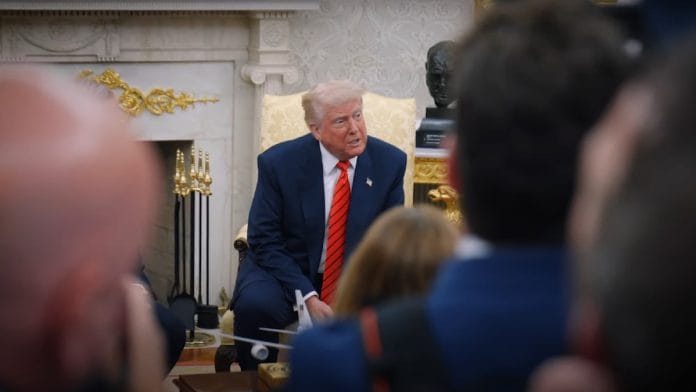



We went to sleep with US President Donald Trump’s nightmare threat, “A whole civilisation will die tonight”. We woke up to as civilised a ceasefire as he is capable of, with his announcement, “I agree to suspend the bombing and attack of Iran for a period of two weeks.”
“At 8:06 a.m. on Tuesday, President Trump delivered an apocalyptic threat to Iran…Ten hours and 26 minutes later, at 6:32 p.m. Eastern time, he lifted the threat, for now…’’ wrote The New York Times on Wednesday morning.
The ceasefire announcement, across many news media outlets, was received with one huge sigh of relief, expressed without any fanfare. “US-Iran agree for two-week ceasefire; Strait of Hormuz to reopen,’’ wrote the Associated Press news agency.
“Trump declares ceasefire, Tehran agrees safe Hormuz transit,” said Al Jazeera, the Qatar-based news channel.
And then there’s this brief and to-the-point headline from The Hindu: `U.S., Iran agree to two-week ceasefire’.
Only the irrepressible Hindi news channels couldn’t resist the temptation to pepper their headlines with some red chilli powder: ‘Trump has lost,’ was Republic Bharat’s conclusion. ‘Trump trapped in Hormuz chakravyuh,’ said News Nation.
Countdown to hellfire
If the announcement of the ceasefire fell short of expectations, blame it on Trump—and many in the news media who made us fear the worst. When Trump spits out threats such as, “Tuesday will be Power Plant Day, and Bridge Day, all wrapped up in one, in Iran. There will be nothing like it!!! Open the ******* Strait, you crazy b*******, or you’ll be living in Hell,” you’re scared.
Then you read ‘Ceasefire or hellfire’ on a normally sober NDTV 24×7 news channel, or ‘Fight to the finish’ on CNN-News 18, and your muscles cramp.
When studio anchors on global news channels such as CNN International, BBC World, and Al Jazeera update the ‘countdown’ every hour on Monday and Tuesday with a grave shake of their heads, your heart develops palpitations.
Their correspondents in Washington, Tel Aviv, and Tehran are silent on the negotiations or report that the talks have broken down.
Instead, they focused on attacks across the Gulf. As late as Tuesday evening, Iran’s ‘beating heart’, the Kharg island, which processes 90 per cent of its oil, was reportedly attacked—and we’re told railway lines in Iran have been bombed.
Is this the “final assault” (Republic TV), you ask yourself—the one Trump promised in his “apocalyptic threat to Iran,” (NYT) warning that unless his demand to open the Strait of Hormuz was fulfilled by nightfall, “a whole civilization will die tonight, never to be brought back again.”? You may be forgiven for thinking so.
The ceasefire deal
So what happened in the 10 hours between Trump’s genocidal tweet and the calm ceasefire?
The news media tried to explain the countdown. In ‘How Iran’s supreme leader reached a truce with Trump’, Axios news website identified what had changed: “with President Trump’s ultimatum looming: Supreme Leader Mojtaba Khamenei had instructed his negotiators, for the first time since the war began, to move towards a deal” The report details the stages of negotiation via intermediary Pakistan and with a push from China.
“Such was the confusion around Trump’s thinking… that multiple people who had spoken with Trump only an hour or two earlier still believed he would spurn the ceasefire offer — right up until he took it,” wrote Axios.
Associated Press also charted the snakes and ladders progress of the negotiation and concluded that “Trump may have ultimately backed down because of a simple truth: Escalation could risk involving the US in the sort of ‘forever war’ that had bedeviled his predecessors.’’
Most news outlets also did a balance-sheet calculation of winners and losers. The New York Times review was mixed. It applauded “Mr. Trump’s tactic of escalating his rhetoric to astronomical levels” to help find “an offramp he had been seeking for weeks… But it resolved none of the fundamental issues that led to the war.”
The Telegraph (UK) was in Trump’s corner, but only just: It said, “The ceasefire gives Mr Trump a win, or at least the appearance of one, at a moment when it really mattered.”
However, The Telegraph did see Iran’s ‘toll booth’ at the Strait of Hormuz for passing ships as a potential money-spinner. “Left in place, it could earn a vengeful rogue state hundreds of billions of dollars and fundamentally reshape both the Middle East and maritime trade around the world,” wrote the UK daily.
‘Asymmetric war’
Indian news channels were not pulling their punches; many seemed convinced that Trump lost. “Trump is empty-handed”, said Republic Bharat. “Iran has emerged strong, US is unsuccessful,” added TV9 Bharatvarsh. “What did the war achieve?’ asked Times Now in a rhetorical question, “Trump’s strategy backfires,” it added.
CNN-News 18 claimed, “Trump loses more than he gains”. News channels also gave headlines to Iran’s claims that the US had “climbed down” and that it had accepted Iran’s 10-point plan.
The international news channels conceded something they have often said during the 38-day war: In the words of BBC’s Persian correspondent, “(For Iran) Winning was not the objective, surviving was.”
On CNN International, an expert, Negar Mortazavi, said that in the “asymmetric war”, Iran put up a “pretty decent fight”.
Also read: Even war is melodrama for Hindi news channels. Music, AI images, ‘ailaan-e-jung’
Pakistan’s role in negotiations
Wednesday morning’s leading English newspapers in India made for strange reading. By the time we unfolded them, Trump had agreed to the fortnight-long ceasefire—an announcement that came hours after the newspapers had gone for printing. The result?
Front page headlines were devoted to Trump’s “A whole civilization will die” tweet. The Indian Express gave this a six-column double-decker headline, Hindustan Times and The Times of India each carried it across four columns.
These newspapers knew of Trump’s deadline to Iran—if they decided to go ahead with the tweet as their headline, they must have believed its importance outweighed its currency. Just suppose Trump had gone ahead with his threat?
Another interesting sidelight: while Pakistan’s role in negotiations has been acknowledged by Trump and the global news media, Indian news channels and newspaper websites have chosen to ignore it. Instead, they carried a story about Pakistan’s role in the possible scripting of Pakistan’s Prime Minister Shehbaz Sharif tweet by the US or Israel. “Pakistan is embarrassing itself by wanting to take credit (for the ceasefire),” said a CNN-News 18 anchor.
The author tweets @shailajabajpai. Views are personal.
(Edited by Ratan Priya)