






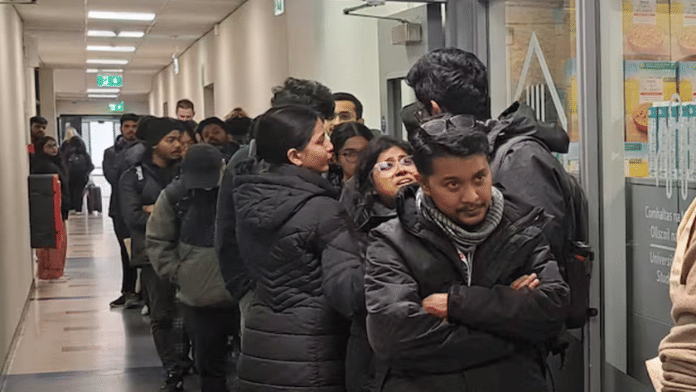



A short video from Ireland’s University of Galway last week showed a serpentine queue of students, mostly South Asians, waiting patiently to pick up groceries from a community initiative run by the students’ union.
The clip soon went viral across social media, but for all the wrong reasons.
Within hours, it was recast as evidence that Indian students were overwhelming food aid systems, draining resources, and freeloading.
The facts were plain: The programme was open to all students and only distributed surplus groceries from supermarkets all over the city. The two-year-old initiative was for students and existed because of a cost-of-living crisis that was squeezing students and young adults across the island nation.
In order to benefit from the food bank, students must register online, there is also a lottery system, and hundreds are left dejected every week. But none of that mattered once the visuals began circulating without context. All the world saw was people of colour taking “advantage” of a benevolent government rather than actually making use of the few additional community aids provided to survive in an unforgiving economy.
Campus food banks are not anomalies. Many foreign universities have institutionalised them over the past decade as rents climbed and grocery bills soared. They are, in most cases, simple welfare buffers — if you are enrolled, you can sign up. They are not nationality-tested, nor are they covert state benefits. They are recognised by institutions as the struggles of students, domestic or international, are real.
Yet when Indian students appear in those queues, suspicion seems to attach more readily.
There is an assumption, often unspoken but widely held, that international education signals surplus wealth. Tuition, visas, flights, accommodation, and food are all expensive. Therefore, the stereotype that anyone and everyone who can cross continents to study must be insulated from everyday financial strain. And so, an international student availing welfare benefits meant for the poor attracts the wrong kind of attention abroad.
But financial life is rarely so linear. Tuition is often financed through loans or family savings that cover little beyond the university bill. Living costs sit in a different column altogether. In cities where a modest room can swallow half a month’s budget, a weekly visit to a campus pantry may just be math and not opportunism.
What transforms that arithmetic into accusation is the alchemy of social media, fuelled by misinformation and a general racial bias.
Screenshots were circulated, faces enlarged, and Indians were branded as “freeloaders”. The queue ceased to represent students under economic pressure and began to symbolise a broader anxiety about immigration and entitlement. Context collapsed, and outrage travelled faster than the truth.
We have seen this escalation before. In 2024, an Indian student in Canada, Mehul Prajapati, posted a video about collecting free groceries from a campus programme. It was the sort of practical tips students routinely exchange online for surviving expensive cities. The reaction, however, was disproportionate. Posts online claimed he held a high-paying job and was exploiting charities meant for the destitute. Strangers with millions of followers tagged institutions, demanded accountability, and effectively staged a digital trial. He was fired from his job due to the online hate campaign, or so they claimed. Even Indians, back home and in Canada, vilified him.
The record was later clarified: he never had the job, he had hardly used the food bank, and the video was just content to help the student community. Nothing happened to him; students and the university stood by him. But the damage to his reputation (and the entire Indian community), along with the mental toll from the threats he had received, left a scar for months after.
This is the new rhythm of contemporary pile-on: An ordinary act reframed as moral transgression; an individual made to stand in for an entire cohort; a debate about policy conducted through personal vilification.
It would be disingenuous to dismiss all discomfort in foreign societies. Immigration has become a pressure point across Europe and North America. Housing shortages, stretched services, and inflation have created an atmosphere in which questions about who gets access to what are politically charged. In that environment, the sight of foreign students in a food queue can trigger resentment. But resentment is not analysis.
Many Indian students do not arrive abroad as caricatures of wealth. Some are first-generation migrants in their families, navigating student debt, precarious employment and visa issues. They bring with them a cultural instinct that carries little stigma in India — make use of what is available. The colloquial shorthand in Hindi is “jugaad” — improvisation, thrift, or an ethic of stretching limited means.
It holds different contexts in India and abroad, and that misreading becomes combustible when filtered through a system designed to reward indignation.
The queue for groceries became a racialised spectacle in no time because the colour of their skin provoked condemnation instead of empathy. The comments, which should have been about rising costs or even debating foreign students availing benefits, leapt swiftly to “these people do not belong here”.
The queue could have been faceless. But brown skin gave the internet someone to blame.
Views are personal.
(Edited by Insha Jalil Waziri)