







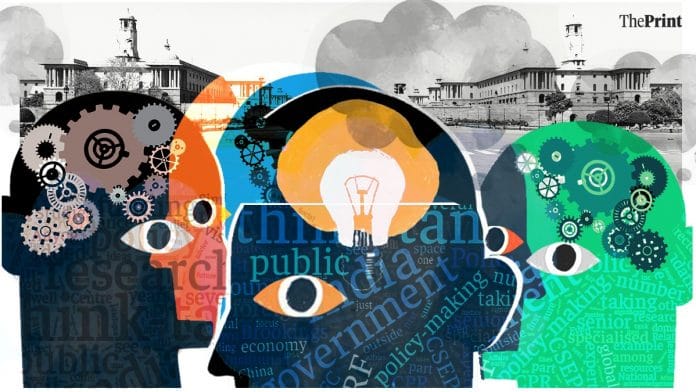


Why do the two key pillars of the world of research — academia and public policy — not always see eye to eye? Academics often refer to policy-based research as ‘shallow’ and ‘superficial’, while the public policy bureaucracy describes academic work as ‘jargonised’, ‘disconnected’, and ‘isolated’ from the real world.
Yet, both these respective worlds agree on their interdependence and strongly advocate for a collaborative approach to ‘make the world a better place’.
This love-hate paradox emanates not just from differences in disciplines and professional streams, but from deeply rooted beliefs, perspectives, and outlooks among individual and institutional actors. These differences also play into the incentives around research. In the Indian context, experts have highlighted that neither a mere numerical increase in public policy institutes and thinktanks, nor academia, with its own challenges of being captured by a controlling state, will by itself contribute positively to social welfare or good governance.
There are five key areas of concern that we need to give attention to, given the dilemma.
Moving beyond buzzwords
First, public policy and academia should be seen as two of the many pillars under the wider umbrella of research, rather than as competing entities.
Ethical, philosophical, methodological, epistemological, and ontological discussions have more or less disappeared from the dictionary of policymaking. In particular, Thinktanks, consultancy firms, and corporate policymaking actors seem to be chasing quick-fix technical solutions to complex social problems by means of eloquently framed buzzwords, fancy reports, and slick outreach and communication strategies. While this might serve contemporary interests, it erodes the first principles and basic tenets of the ethics and philosophy of research in pursuit of ‘actionable’, ‘solution-oriented’, and ‘politically correct’ outcomes.
This can be seen across several areas of research, including energy transition work in India, where a flurry of policy reports seeks to advance a technocratic approach centred on renewable energy penetration, grid modernisation, green hydrogen, green steel, and other such solutions, claiming they would bring justice for all by creating jobs for local communities. This notion is challenged by critical literature, which frames justice more broadly as non-quantifiable, intertwined with political and social realities, and bound up with questions of who benefits from injustice, and how the intersectionality of class, caste, age, sexual orientation, gender, etc. is incorporated into justice frameworks.
Stepping back from a ‘war footing’
Second is an increasing urge and fetish to recommend quick and actionable policy solutions through research outputs that are politically sanitised, ignore rigorous problem analysis and questions of power, and eventually mutate the problems at hand rather than address them.
To quote a 2021 publication by the global thinktank Club of Rome, titled ‘Learning New Ways of Becoming Human’: “In the current system the legitimacy of asking new questions is reserved for a tiny minority having reached the PhD status through more than two decades of being trained in educational institutions generally providing fixed responses rather than developing multilevel learning.”
One must also be mindful of what Donella Meadows, the lead author of the Club of Rome’s landmark report ‘Limits to Growth’, realised in her later years — governance should be like ‘dancing’ with problems, not tackling them as if they were a war.
For instance, official reports on climate action in India, such as the Long-term Low Emissions Development Strategy (LT-LEDS) and the National Action Plan on Climate Change (NAPCC), frequently use terms such as tackling and negotiating climate change. So do NITI Aayog reports such as ‘India Energy Security Scenarios’ (IESS) 2047 and ‘Strategy for New India @75’. Reports by thinktanks also often use such war-like terminology when devising climate action strategies. Such an approach enhances the divide between winners and losers by portraying policy action in black-and-white terms, instead of embracing and embedding the complexities that already exist on the ground.
Incremental fixes won’t cut it
Third, academic and policy research both succumb to funding and political exigencies.
This means that only certain kinds of research enquiry get supported— a key attribute increasingly being a narrowly understood idea of policy relevance. At the same time, the goal is not to further advance a reverberating chaos of academically celebrated theories and concepts in an echo chamber — the real-world implications of which are neither read nor understood by the very people such research papers speak about. Any incremental steps that academics take toward being closer to policymaking, or that the policy world takes toward being academically sound, won’t fructify if the intention is determined purely by the external donor and political landscape.
In the Indian policy-academia context, for instance, a prominent thinktank recently advertised that it was looking to hire a Research Integrity Lead — a qualified PhD professional who would oversee the academic soundness of research work. While these are welcome steps, they are incremental. They presume that the academic-policy gap is a linear one that can be addressed simply by additive measures. This is not the case.
The gap is deeply systemic and requires transformative solutions. The intention should be to democratise the world of research as a whole, and make it more about the intended beneficiaries of research, and less about the self-promotion of researchers and research institutions.
Also Read: What South Korea’s KDI gets right that NITI Aayog never did
Toward democratising research
Fourth, in a rapidly evolving scenario marked by impatient decision-makers, constrained funding for critical social science research, and a largely solution-obsessed society, it is even more important to rethink how research is conducted and communicated. By no means do we suggest succumbing to the wants of the market and the polity in order to produce actionable technocratic solutions. Rather, we argue for a stronger diagnosis of problems, one in which research actors (academic or non-academic) take a backseat, and affected communities and grassroots voices occupy the stage.
This requires a structural and behavioural shift in the way academia and the policy world operate. Instead of being the protagonists, academicians and public policy professionals must be comfortable with being the backend support team that informs the democratic expression and communication of research by the very people the research seeks to work for. A true shifting of power and democratisation of research, not just on paper, but in action and spirit, is the need of the hour.
And finally, a truly meaningful academia-policy collaboration can only come about if the proponents and constituents of both these worlds enjoy a relationship based on trust and mutual respect, not distrust and superiority. The adage ‘practice what you preach’ rings true when one contemplates some of the things academicians and policy professionals often say about each other off the record. A dismissive attitude toward each other’s work goes against the basic tenets of care, respect, humanity, humility, and all the other virtues that both academia and the policy world hold dear in their respective work.
Sarthak Shukla is a PhD scholar at the Swedish University of Agricultural Sciences, Uppsala and Amir Ullah Khan teaches public policy at the Indian School of Business. Views are personal.
(Edited by Asavari Singh)