






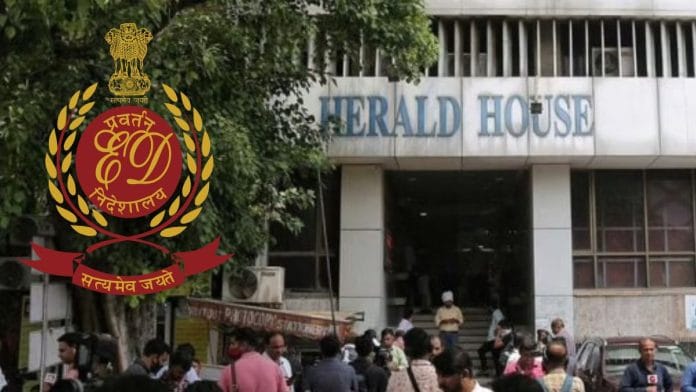



Here’s a thought exercise: cast your mind over all the National Herald case coverage you’ve encountered over the years – the Enforcement Directorate investigation, the eye-popping allegations, Rahul Gandhi’s 50-plus hours of interrogation, and so on. How much space did the prosecution’s insinuations and unverified claims get, compared to the defence?
If one is looking clearly, the defence speaks for itself. How can there be money-laundering when no money changed hands? How can a non-profit entity that took over and revived a failing firm – which runs the National Herald – be accused of fraud when it’s long-established legally that shareholders are not owners? Of the 1,057 shareholders whom the ED claimed suffered a “wrongful loss”, not one has filed a legal complaint.
But this isn’t a column about the National Herald case (full disclosure: the columnist is related to one of the accused), but about the “scam” coverage industry – motivated leaks, shrill anchors, and slanted stories aimed not at truth but at fogging perceptions.
Enforcement Directorate’s overreach
When verdicts finally come, they often run counter to the media circus. In Bofors, 2G, and now the National Herald, court judgments read like indictments of both trial-by-media and investigative overreach. Yet with no real penalties for either the agencies or the outlets, the cycle inevitably resumes.
Consider the recent dismissal of the ED’s chargesheet in the National Herald case by Delhi’s Rouse Avenue court. The court held that proceedings under the Prevention of Money Laundering Act (PMLA) cannot be sustained without a “predicate” offence supported by a First Information Report (FIR), and certainly can’t rest on a private complaint by BJP leader Subramanian Swamy.
It may sound ‘technical’, but the real drama is in the text of the judgment – and it’s not pretty for the prosecution. It notes that “law officers at various levels of hierarchy within the Enforcement Directorate between 2014 to 2021” found no “predicate offence” to pursue. The CBI, “in the know of the allegations made by Dr. Swamy from at least 28.07.2014”, agreed and “decided against recording a FIR (RC) upon these allegations.” In short, both agencies saw no merit in the case. Not what shouting news anchors were telling you, was it?
Then the ED suddenly reopened Swamy’s eight-year-old complaint in 2021. The court judgment called this “a unilateral overreach” and an “ill-advised” reading of the PMLA, adding acidly, “perhaps the ED should have stayed as staid as the CBI”. It’s no mystery which higher powers drove the U-turn.
Such an indictment would once have triggered weeks of media outrage. But the ED, CBI and Income Tax departments act as the regime’s enforcers, targeting outlets from NDTV to Bennett Coleman to India Today. Who now dares to go beyond cursory coverage?
It’s the same old pattern: sensational leaks fuel frenzied coverage, the cases collapse in court, while the accused are already convicted in the court of public opinion. The political beneficiary, almost always, is the BJP.
Also read: 5 reasons Modi’s ‘achche din’ dream died in 2025
Winning the public perception
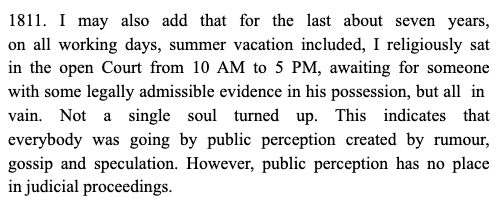
In the 2G case, former telecom minister A Raja and others faced charges of criminal conspiracy, forgery and corruption over 2G telecoms license allocations in 2007. A media frenzy ensued, inflicting huge political damage on the UPA government. Yet eight years later, the CBI Special Court found no evidence of criminality. It stated the CBI’s chargesheet was based on “misreading, selective reading, non-reading and out of context reading of the official record.”
This paragraph from Justice OP Saini’s 21 December 2017 judgement says it all:
Some of you will recall the Bofors scandal, which erupted in 1987 after a Swedish newspaper exposed that agents were paid illegal commissions in India’s purchase of the Bofors FH-77B howitzers. The elections dealt a fatal political blow to former Prime Minister Rajiv Gandhi, whose record 1984 landslide had given him 414 parliamentary seats.
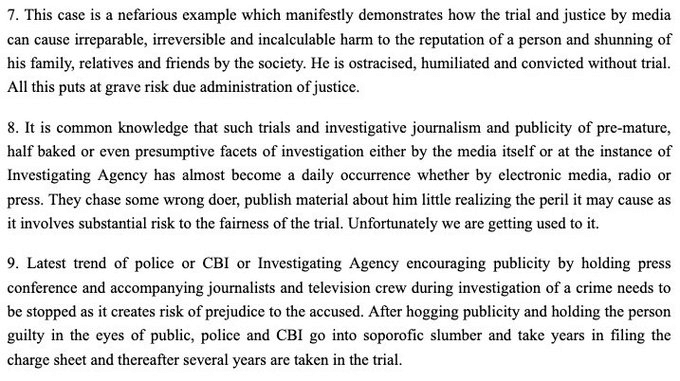
Fast forward to 4 February 2004, when the Delhi High Court noted that, after 16 years of investigation, the “premier agency of the country” had failed to “unearth a scintilla of evidence” against Rajiv Gandhi. It said “all efforts of CBI ended in fiasco as they could not lay hand upon any secret or known account… where the alleged money might have found its abode”. The court’s stinging verdict: The “CBI clutched at straws like a drowning man.”
Not what anyone following the widespread leaks, insinuations and slanders over the years would have expected. And Justice JD Kapoor’s February 2004 judgment had this to say about the behaviour of the investigative agencies and trials-by-media:
But nothing changes. Since Bofors, a pliant section of the media – fed by selective leaks from investigative agencies, seemingly under political instructions – has misled audiences while condemning those constrained by their need to mount a legal defence.
The courts criticised media trials in the Aarushi Talwar and Sushant Singh Rajput cases, but didn’t go so far as to take legal action. Until real costs are imposed on the guilty, this pattern will unfortunately continue.
Amitabh Dubey is a Congress member. He tweets @dubeyamitabh. Views are personal.
(Edited by Ratan Priya)