





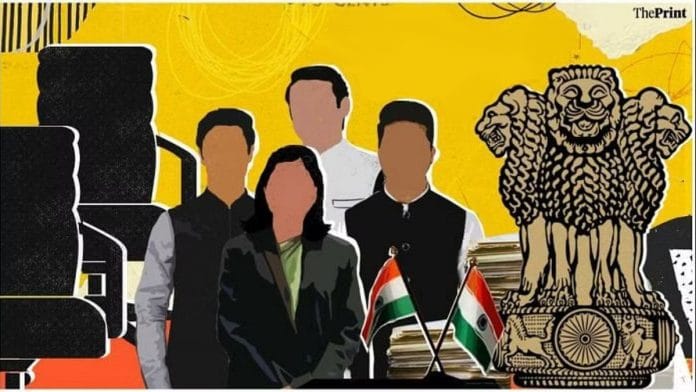



Bureaucracy, which is the machinery through which a government functions, closely follows the politicians in power. The bureau concept is wide enough to encompass governmentally-run undertakings—such as railways or telecommunications, as well as state sector undertakings—in addition to the administrative machinery that administers the law and order system. Irrespective of the wideness or narrowness of the concept, an underlying relationship can be easily detected between the politicians and the bureaucracy. The politician is dependent on the bureaucracy for its services that are in compliance with his interests. In turn, the bureaucracy is dependent on the politician for its annual grants or budgets. Over a period of time, a relationship of mutual interdependence develops so that the activities of a bureau fosters and at the same time feeds upon the politician. But for the fact that this is a socially destructive activity, one would call this relationship symbiotic.
All bureaucratic activities must be subject to what the Americans call “sunset laws”, i.e., any government department must, by a specific statutory provision, have a limited life. Under this provision, on the expiry of the period, which in my view should seldom exceed ten years, its continuance beyond that period would require specific legislative approval and would therefore involve a re-examination of its functions.
Consider now the limitations of the bureaucracy. Firstly, the bureaucracy is not subject to any quantitative test of efficiency. Secondly, there are no economic incentives that could motivate a bureau to make the most of a given budget. In short, there is the absence of a measure of performance and the incentive of “profit”. The word “profit” is anathema to a bureaucrat. Indeed, the secular trend in bureaucracies is that they grow in size rapidly irrespective of the relevance or the efficiency of the function they perform. Inevitably, they find a rationale for their existence even if the underlying basis of their creation may have ceased altogether. Even in areas which are considered as appropriate for a modern government to undertake, there is no method by which the cost of delay by a bureaucracy can be quantified. The Indian bureaucracy has much to account for in this area of delay. Many decisions taken are wise, if not actually profound; but the delay to which the decision-making process is subjected is itself self-defeating.
A bureaucracy may be very effective in its work but the official rhetoric of a bureau is socialistic. One big advantage of socialism over capitalism is clearly a matter of rhetoric and argumentation rather than performance. It simply appears too self-serving when an individual who has profited greatly from the system says: “My labours also improve the country as a whole”. In a socialist system, all are presumably working directly for the common good. The fact that the elites in most third world socialist countries are uncommonly well rewarded for their labour is frequently overlooked. A perceptive and witty scholar has observed: “Those countries devoted to freedom have done more for equality than those devoted to equality have done for freedom or equality”.
The concept of the faceless bureaucrat who self-effacingly carries out orders from above, merely executing but not making policy, and motivated by the noble motive of public interest, is a myth deliberately created by the bureaucracy. Bureaucrats, as has been demonstrated in the last few decades, cannot be considered as economically neutral. They will seek to expand the size of their bureaus since it is universally accepted that the salary and perquisites of office are related directly to the size of the budget which is administered by a bureau. The built-in force for expansion, which inherently exists in a bureaucracy, results in a budget maximising department. Tax payers end up by being no better off than they would be without the provision of a public good or service. All their “net benefits” are squeezed out by the bureaucrats. The implication is that each and every public good or service, whether it is medical services, education, transport or defence, tends to be expanded beyond a tolerable level of efficiency.
It would be ideal if a system of incentives and pecuniary rewards is introduced in the bureaucracy. A competitive environment is as healthy for a bureau as it is for industry.
Anyone who has worked with bureaucrats will agree that so many of them are admirable and gifted individuals. They must surely be capable of better performances in their task than we actually get from them. Is there a place for a counter-bureaucracy, such as that represented by the Ombudsman? Or a separate and competing bureaucracy under the administrative and financial control of parliamentary committees to counter balance the force of the executive’s bureaucracy?
Other likely solutions would be competition between bureaus, altering the reward system for bureaucrats, payments being made on results or on economy in use of resources, turning over the production of certain goods and services to private firms for a price, e.g. education, sewage disposal or waste disposal, hospital services.
This essay is part of a series from the Indian Liberals archive, a project of the Centre for Civil Society. This essay is excerpted from a journal published by the Forum of Free Enterprise, based on an address delivered by M. H. Mody to an international seminar at Goa in December 1980. The original version can be read here.