





The most consequential measure of the Indian diaspora’s arrival in American public life is not the number of its members occupying corner offices in Silicon Valley or commanding positions on Wall Street. Instead, it is the growing determination to influence the institutions that make the rules governing American society. After establishing an impressive presence in corporate America, the community is now attempting to convert economic capital, professional networks, and demographic expansion into enduring political power.
This is not simply an electoral awakening, but a strategic recalibration of how influence is acquired, exercised, and sustained in a political system where the architecture of power extends far beyond Washington.
For much of the past three decades, the success of the Indian diaspora in the United States followed a recognisable trajectory: professional achievement, entrepreneurial wealth, corporate leadership, and political donations. Its ascent into executive suites at companies such as Microsoft, Alphabet, and Adobe demonstrated the community’s capacity to penetrate institutions historically dominated by American elites. Yet corporate prominence, however impressive, offered limited control over the political and regulatory environment in which that prosperity was generated.
The emerging political strategy is therefore moving away from an almost disproportionate preoccupation with congressional representation toward the less glamorous but potentially more consequential terrain of school boards, city councils, county administrations, state legislatures, and local judiciaries. These institutions determine educational priorities, housing policies, taxation, public safety, infrastructure spending, and the administration of justice. They also shape the everyday relationship between citizens and the State.
The diaspora is beginning to recognise that political power is not merely exercised through legislation passed on Capitol Hill; it is accumulated through institutional participation at every level of government.
The midterm elections to be held on 3 November illustrate the community’s expanding ambition. Indian-origin candidates are contesting positions across political geographies and ideological constituencies, from Taral Patel in Texas to Kesha Ram Hinsdale in Vermont to Kevin Thomas in New York. Their significance lies not merely in their individual electoral prospects, but in the widening geographical footprint of the community’s political participation.
Organisations such as Indian American Impact are helping turn this ambition into an organised political enterprise, identifying candidates, mobilising donors, and developing networks that can sustain campaigns beyond a single election cycle. The emergence of professionals from technology, healthcare, finance, and law also introduces a distinct technocratic dimension, with candidates presenting administrative competence, fiscal discipline, and institutional experience as political assets.
But a structural transformation is underway. Corporate America rewards individual advancement. Democratic politics requires coalition-building, negotiation, and the ability to represent constituencies whose interests may diverge sharply. For the diaspora, the transition from boardroom influence to public office therefore involves more than transferring managerial expertise into government. It requires learning the difficult grammar of democratic accountability.
Also read: China is fighting over names in Ladakh. India should notice who else is watching Beijing
Political maturation of the Indian diaspora
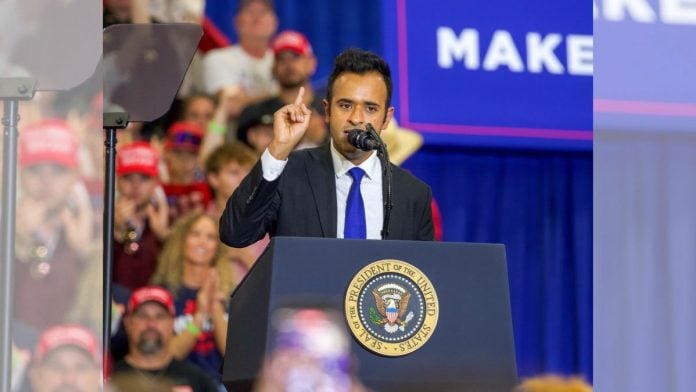
There is a larger ideological consequence. The assumption that Indian Americans constitute a cohesive, predominantly Democratic constituency is increasingly untenable. The emergence of conservative figures such as Vivek Ramaswamy alongside progressive lawmakers such as Ro Khanna and Pramila Jayapal reflects the community’s incorporation into both major political parties. Generational differences over immigration, taxation, social justice, and economic opportunity further complicate the political landscape.
This pluralism could become an asset. By developing influence across party structures, the diaspora reduces its dependence on any single political formation and creates multiple channels through which its interests can be articulated.
The implications extend into America’s economic and geopolitical relationships. Immigration policy, skilled-worker visas, technology regulation, trade protectionism, and energy security are not abstract diplomatic concerns for a community whose professional and family networks straddle the United States and the Indian subcontinent. The growing political participation of Indian Americans could make these issues more visible in state and federal debates, including the future trajectory of US-India relations.
Yet the diaspora’s political maturation will ultimately be judged by a more demanding standard than its ability to secure representation or influence bilateral diplomacy. It must demonstrate that its growing institutional presence can address housing affordability, educational inequality, discrimination, healthcare, and economic insecurity affecting communities beyond its immediate ethnic constituencies. That is the distinction between entering the American establishment and helping reshape it.
The corporate ascent established economic permanence; grassroots political participation offers the possibility of democratic permanence. By planting roots in institutions that survive individual administrations and election cycles, Indian Americans are building a political infrastructure capable of producing successive generations of candidates, policymakers, and public leaders.
The most consequential development therefore is not the election of another Indian American to Congress, but the creation of an institutional ecosystem in which political leadership becomes an enduring feature of the community.
R Suryamurthy is a contributing editor of the Washington-based South Asian Herald. His X handle is @suryamurthy. Views are personal.
(Edited by Prasanna Bachchhav)