



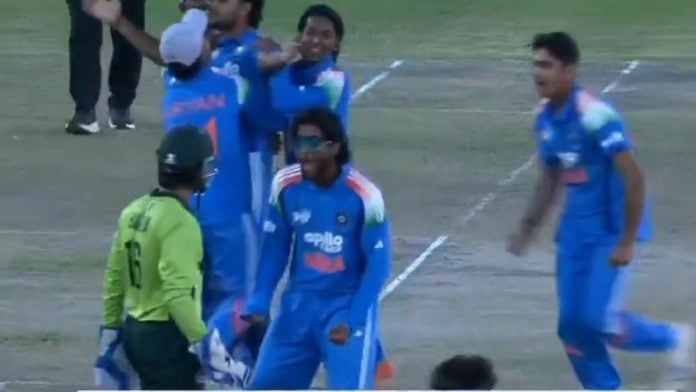
When India dethroned Pakistan in a nail-biting U-19 Asia Cup final to reclaim the title after five years, the Men in Blue were naturally ecstatic. Yet their high-intensity celebrations had a section of observers wagging their fingers at the players over their ‘aggressive’ behaviour on the field. Some even deployed well-worn ‘liberal’ insults such as “jingoism” to describe the players’ joy.
India defeated Pakistan by one wicket off the final ball on 14 November in Muscat, chasing down 338 after falling to 252 for 8. After the miraculous comeback, Indian players rushed onto the field, with some shouting at Pakistan wicketkeeper Hamza Zahoor and others making kicking motions toward the Pakistan dressing room. The Indian support staff stepped in to calm the players down.
That should have been that. But those few minutes of rambunctiousness got more attention than the triumph itself from some, who proceeded to deliver moral lectures. Ironically, some of these very critics took a much more sympathetic view of youthful defiance when the Cockroach Janta Party led its protests at Jantar Mantar.
Also Read: Palestinian player’s nose-fanning gesture at Indian U-17 captain sparks racism row
Josh, ‘jingoism’, Jantar Mantar
Several commentators, including journalists and former players, sermonised about how the young players celebrated a hard-fought victory.
Former India batter and commentator Sanjay Manjrekar criticised the aggression on X, calling Pakistan a “soft and easy target” and suggesting that the Indian cricketers should now pick on “guys of their own size”, such as Australia, South Africa, New Zealand and England.
Indian cricket should now pick guys of their own size if they want to show ‘aggression’ on the field. Pak is now a soft & easy target.
I suggest Aus, SA, NZ & Eng…
— Sanjay Manjrekar (@sanjaymanjrekar) November 15, 2026
Such statements coming from people who have not played cricket or watched it are still understandable. But it is surprising to see a former international cricketer who has “been there, done that” dismiss a fierce rivalry so bluntly rather than focusing on the pressure and context of the game.
The next name might just surprise you. The former Pakistan fast bowler Shoaib Akhtar. Yes! The person who could never behave on the field and always used to get schooled by Rahul Dravid is giving “ethics” classes to Indian players. Such is the irony.
“Look, we are not just here to play cricket; we also have to uphold certain values. Even today, I say good things about Sachin Tendulkar, Virender Sehwag and Sourav Ganguly,” he said after the match.
Funny how Akhtar forgot his own track record of send-offs, heated sledging, and ball-tampering bans before lecturing teenagers on how to celebrate.
Meanwhile, journalist Parth MN announced that he had “nothing but contempt for the India U-19 team.”
“Disgusting, but sadly, not surprising to see even the teenagers fall for jingoism like many in the senior team,” he posted on X.
Nothing but contempt for the India U-19 team.
Great win, obnoxious celebrations.
Disgusting, but sadly, not surprising to see even the teenagers fall for jingoism like many in the senior team.
— Parth MN (@parthpunter) November 14, 2026
Another journalist, Sreshth Shah, posted, “Great win. Horrible celebrations.”
A few social media spectators got in the game too.
“The constant spread of hatred in our society over the past years is bound to reflect in the conduct of the younger generation,” lamented one post on X.
The constant spread of hatred in our society over the past years is bound to reflect in the conduct of the younger generation.
A thoroughly disgraceful display from the India U-19 cricket team. They managed to take away the grace and sportsmanship that should have accompanied a…
— Sini (@SiniiMayo) November 15, 2026
The problem lies in how selectively these high standards of conduct seem to be applied. Rarely does one see similar censure when players from other countries show a little extra ‘josh’. For instance, in the same tournament, when Pakistan spinner Niqab Shafiq gestured towards the pavilion after dismissing Aaryavir Sehwag, it was mostly described in articles as a “fiery” or “animated” send-off.
Similarly, during the CJP protests in Delhi, some of those now criticising the cricketers seemed to admire the fighting spirit of Gen Z. For example, Parth MN has posted about the movement and its leader Abhijeet Dipke in sympathetic terms. In July, he shared an image of security personnel at the protest site, captioning it, “Ironically, Gandhi looks on right above them.”
Manjrekar has been a supporter of the protests as well and has posted on X about standing in solidarity with Gen Z agitators. “Do not suppress them, give them wings,” he wrote in one such post. Yet out came the stick when young cricketers showed their passion. Why such different readings of youthful fire?
‘They started it’
The last-ball finish alone was reason enough for the Indian team to rejoice. But to decode the form the celebrations took, several other aspects should be taken into account.
First, on-field emotions ran high as the Indian cricket team reclaimed the title after five years. Second, the low-order heroics dashed Pakistan’s hopes of winning two titles in a row. Third, the win avenged India’s group-stage defeat to Pakistan earlier in the tournament and their loss in the 2025 U-19 Asia Cup final.
These three things would excite any cricket lover, let alone an on-field player who has been experiencing every inch of the drama. It’s easy to see why emotions boiled over.
Both the Indian U-19 players and the Board of Control for Cricket in India (BCCI) defended the celebrations, saying the reactions were natural after a last-ball victory. Several Indian players also said they were responding to taunts from Pakistani players during their group-stage loss on Diwali.
“We had lost a match earlier, and we were hungry to win this one. People should see how Pakistan celebrated on Diwali. They started it, and we did the same. It was just pure emotion, as we had worked very hard to win the final,” India U-19 captain Lakshya Raichandani told Sports Today.
Batsman Yashveer Goud also backed his team’s actions, saying, “One also has to give something in return”.
“We had lost the match on Diwali. There was some exchange of words between us, including abusive language. We couldn’t say anything after losing that match. We were waiting for the final,” he had said.
Meanwhile, videos from the stadium captured spectators in the Pakistani stands hurling racial slurs such as “kaala kaluta” and “kaale kutte” at the Indian teenagers. Pakistani users on X also directed similar insults at the Indian squad.
An unrealistic obsession
Sports have always been aggressive, political and messy, and that’s exactly what makes rivalries worth watching. So why act shocked when players show a little passion for the game? It’s peak hypocrisy.
Take Ben Stokes, for instance. His extraordinary 135-run innings against Australia at Headingley in the 2019 Ashes, which helped England pull off an improbable one-wicket victory, was celebrated as one of cricket’s greatest performances. His emotions after hitting the winning boundary did not go unnoticed. He roared, threw his arms in the air and soaked in emotion in front of the home crowd. Fans celebrated his intensity, determination and never-say-die attitude. He was hailed as an Ashes hero.
In contrast, Virat Kohli often came under fire for his on-field antics. In 2017, former Australian wicketkeeper Ian Healy called Kohli’s verbal battle with Steve Smith during the Bengaluru Test “unacceptable” and said he was “losing respect” for the Indian batter.
This is a reminder that Indian players are expected to display decorum during an emotional situation, but foreign players’ aggression is romanticised as competitive spirit and sportsmanship.
Criticising the U-19 teenage players for experiencing their biggest moment in their cricketing careers is unreasonable. After all, they pulled off an astonishing victory against their arch-rivals and reclaimed the continental title.
Expecting them to behave like ‘gentlemen’ rather than young cricketers exposes an unrealistic obsession—policing emotion in a high-stakes and high-intensity game. Players should be criticised when they cross the line, but that criticism should not be selective.
Views are personal.
(Edited by Asavari Singh)