









Over the last weeks, American missiles have pummelled Iranian cities and destroyed Iranian ships off the coast of Sri Lanka. But India has had little to say about the war reshaping its neighbourhood, and endangering its diasporas and energy flows in the Gulf of Hormuz.
The silence points to something older than oil prices: India has lost the language for what Iran actually means to it. This column is an attempt to recover some of it—not just the Indian history of Farsi itself, but of the Iranians who became Indians, from a poet in Lahore, to a Nawab in Lucknow, to an Ayatollah in Tehran.
Persian, an Indian language?
In an earlier Thinking Medieval column, I argued that ideas flowed continuously between India and Iran until the imposition of colonial national borders. The focus here is on the generations of Iranians who came to India, stayed, and changed the subcontinent. Their story begins with the Persian language.
Persian is often seen as a conqueror’s language, a colonial imposition. It arrived on horseback, wielding the sword. It was the court language of the Ghaznavid sultans; the Delhi Sultanate continued to patronise it over the next three centuries. However, the fact is that within a generation of its arrival, Indians were writing Persian—and within a few more, Indians had become an influential and distinct set of Persian voices. The 11th century poet Mas’ud Sa’d Salman, born in Lahore to an Iranian immigrant, is considered the foundational writer of this tradition, which would run unbroken until Ghalib.
By the 16th and 17th centuries, Persian poetry written in Mughal India had developed what its practitioners called taza-gu’i — fresh speech, which contemporary poet Shamsur Rehman Faruqi describes as possessing “high imaginative flourishes and unusual images and unconventional constructs…. a potency, vigour and éclat which mainline Iranian poetry would be hard put to match.” Sa’ib, an Iranian poet who spent years at Shah Jahan’s court, elegantly described this transformation: “until henna came to India, it acquired no colour.” Chandar Bhan Brahman, Shah Jahan’s court secretary, was a Brahmin from Lahore and a respected Persian literateur.
Faruqi notes that some innovations of taza-gu’i may have developed from contact with Sanskrit, as well as patronage from the eclectic society of North Indian courts. However, the appeal of the style transcended the subcontinent: many prominent Iranian poets—even those who had never visited India—wrote in taza-gu’i. Its popularity provoked considerable controversy among conservative literati; especially in the 20th century, with cultural nationalism on the rise, some Iranian critics chose to dismiss it as simply an ‘Indian style’ (sabk-i Hindi).
Even beyond poetry, historian Muzaffar Alam, in his The Languages of Political Islam in India, 1200–1800, traces how Persian had, by the 18th century, become the medium of Baniya scribes, Rajput aristocrats, and Maratha chancelleries. Delhi and Lucknow had become centres of Persian literary innovation, not Isfahan or Tehran. And Persian vocabulary and syntax had merged into various dialects of Hindustani, the direct ancestors of Urdu and Hindi today. When the British East India Company replaced Persian with English as the administrative language in 1837, it uprooted something that had grown here for seven centuries and become, in every meaningful sense, Indian.
Also read: India lived in ancient Europe as a positive ‘Other’. Ties are way older than colonialism
The systems-builders
Iranians also helped develop influential administrative and cultural systems in India. Take, for example, Mahmud Gawan—a middle-aged horse-trader turned itinerant scholar, who spent years crossing the fractious courts of Anatolia, Egypt, and the Iranian Plateau. Arriving in India in 1453, he was recruited by the Bahmani Sultanate, a breakaway province of Delhi, that was just barely holding its own against the Vijayanagara and Gajapati kingdoms. Gawan brought with him an extensive Persianate framework of governance. He divided the Sultanate into eight provinces and systematised revenue collection. More importantly, perhaps, he introduced new fortification and artillery techniques: A substantial contribution to the subcontinent’s military history. Centuries earlier, South Indian kingdoms had imported Brahmin scholars from the Gangetic plains—men trained in ritual, governance, and architecture—as institutional scaffolding for new courts. What the Bahmanis were doing with Iranian expertise, then, already had plenty of precedent in Indian statebuilding.
When Gawan was assassinated in 1481, the Sultanate collapsed, but its now-independent regional governors continued the pattern. Iranian engineers, as I wrote in an earlier column, brought water systems like the qanat, which made new capitals like Bijapur viable in the rocky Deccan. These were among the earliest true municipal water systems in urban India, and are still valuable to communities today. Fatullah Shirazi, an Iranian polymath who had worked on some of the Bijapuri systems, was recruited by the Mughal emperor Akbar in 1582. According to the Encyclopaedia Iranica, Shirazi devised a solar agricultural calendar to align tax collection with harvest cycles, and assisted Raja Todar Mal, Akbar’s finance minister, in revenue reforms. A variant of his calendar is still the basis of the agricultural year in Bangladesh. Shirazi also translated several Sanskrit works into Persian and invented multi-barrelled guns for Akbar.
Also read: The story of India’s forgotten Afghans — horse-traders, mercenaries, kings
A final flowering
Circulations like this created an Indo-Persian cultural continuum, extending from the Iranian Plateau deep into the subcontinent. In the 18th century, Saadat Khan, born in Nishapur in Iran, arrived in India, became a Mughal officer, and became the first Nawab of Awadh. His descendants would govern the richest province of the subcontinent for the next century and a half. While this is sometimes dismissed in contemporary discourse as a case of “Muslim colonisation”, the truth is more complex.
In The Lion and the Lily, historian Ira Mukhoty discusses the aftermath of the Third Battle of Panipat in 1761, when the Afghan ruler Ahmad Shah Durrani defeated the Maratha confederacy. The third Nawab of Awadh, Shuja-ud-Daula, had joined forces with Durrani, but petitioned Ahmad Shah to allow the Maratha dead to be cremated with proper rites. His letter described himself and his allies as “the permanent Muslim residents of India who had to deal with the Hindus all through their lives.” This is a revealing self-definition—the Nawabs did not consider themselves Iranians, or Afghans, or solely Muslim. They were specifically Indian Muslim, bearing responsibilities to their neighbours and their subjects.
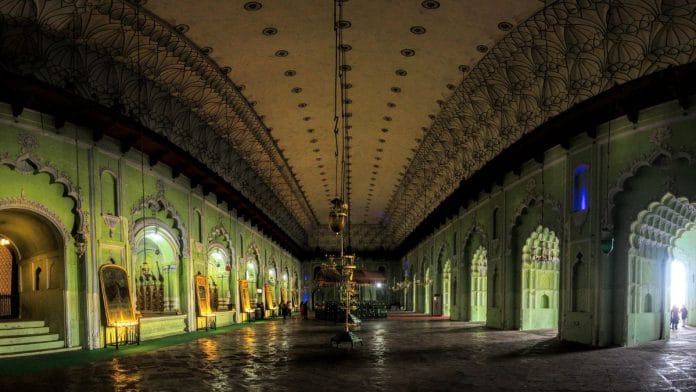
The next Nawab, Asaf-ud-Daula, built the Bara Imambara in Lucknow during the famine of 1784. Mukhoty notes that this was both a monumental Shi’a religious structure and a relief project, employing thousands of workers, Hindu and Muslim, through the worst of the hunger. The spectacular Muharram processions of his court drew Hindu participation, with Imam Hussain recast as Ram, his half-brother Abbas as Lakshman, and the Caliph Yazid, their persecutor, as Ravan. Ira Mukhoty characterises the resulting Ganga-Jamuni tehzeeb—the composite culture of Awadh—as a deliberate policy encouraged by the Nawabs: A way of being Indian that was true to the region’s cosmopolitan history.
Even as they patronised Awadh’s composite culture, the Nawabs endowed Shi’a seminaries at Najaf and Karbala, both in present-day Iraq, for generations. This is quite similar to Indian-Americans today funding, say, the Tirupati Balaji temple, while still remaining very much American. Interestingly, the Awadhi intellectual Syed Ahmad Musavi, who emigrated to Najaf in the 19th century, was the paternal ancestor of Ayatollah Khomeini—the late Supreme Ruler of Iran. And so the fates of India and Iran continued to remain intertwined.
Crude oil prices will, over the next few weeks, balance out. Supply chains will be rerouted, deals renegotiated. What is harder to reroute is the historical imagination—the capacity to see, in a country sliding ever-deeper into disaster—the civilisation that shared so much with India over the centuries.
The author wishes to thank Dr Sumaira Nawaz for feedback on Sabk-i Hindi.
Anirudh Kanisetti is a public historian. He is the author of ‘Lords of Earth and Sea: A History of the Chola Empire’ and the award-winning ‘Lords of the Deccan’. He hosts the Echoes of India and Yuddha podcasts. He tweets @AKanisetti and is on Instagram @anirbuddha.
This article is a part of the ‘Thinking Medieval‘ series that takes a deep dive into India’s medieval culture, politics, and history.
(Edited by Theres Sudeep)
What Kanisetti Got Wrong: The article romanticizes a civilization while whitewashing a regime. These are not the same thing.
Khamenei’s Islamic Republic has nothing in common with the Persian culture the author celebrates. That composite world was largely destroyed by the ideology the IRI represents.
The gaping holes: Iran never supported India on Kashmir. Not once. The author doesn’t mention this.
Khamenei publicly interfered in India’s internal affairs, amplifying anti-India narratives that serve Pakistan’s agenda. Silence on this too.
Iranian agents allegedly plotted on Indian soil against Israeli diplomats. Unmentioned.
Iran backs Hamas. Hamas coordinated with Pakistani networks linked to the Pahalgam Hindu killings. The author wants India to mourn Iran while ignoring this chain entirely.
The Nawabs he glorifies continuously sent funds back to Karbala and Najaf. Their loyalty was never exclusively Indian.
The entire article places the emotional burden on India alone. It never asks what Iran owes Bharat.
Nostalgia is not foreign policy. Reciprocity is.
When the Indians replaced English with Hindi, Indians lost the ability to participate in British freedom struggle from Brussels. Persian was a shitty language for low IQ sycophants. That’s why smart Iranians run away from that shithole.
Diplomacy should be pragmatic and practical. Emotions don’t pay for progress.
Very biased reporting..go and search the news..Iran has granted access only to India for ships to pass through strait of Hormuz.had India not supported Iran this would not be allowed .India maintains diplomatic relations behind the curtains and sometimes it doesn’t need to be loud.Only thing whether things are functioning smoothly is needed to assured