






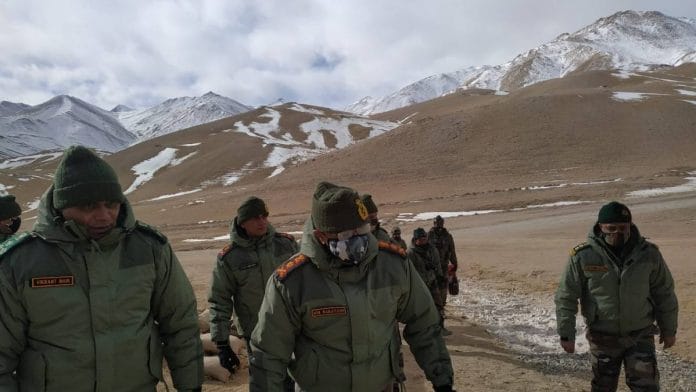



The events on the night of 31 August 2020, when India and China were on the brink of war across the heights of the Kailash Range, will be remembered as one of the most consequential moments in India’s recent military history. The tactical brilliance of the occupation of the Kailash Range has been widely acknowledged. Yet the larger significance of the episode lies elsewhere — in what it revealed about the state of India’s civil-military relationship and strategic decision-making under conditions of crisis.
The account offered by former Chief of the Army Staff (COAS), General Manoj Mukund Naravane, in his unpublished but widely excerpted memoir Four Stars of Destiny has reopened an uncomfortable but necessary debate.
At 2015 hours on 31 August 2020, as the People’s Liberation Army’s infantry and armoured elements advanced towards Rechin La, the COAS sought political direction. The response, as described by General Naravane, came two hours later at 2230 hours from the Raksha Mantri, Rajnath Singh, in broad, ambiguous, and cryptic terms. The RM said he had spoken to the PM and that it was purely a military decision: “Jo uchit samjho woh karo” (Do whatever you deem is appropriate). This effectively left the decision to the military.
Neither the government nor General Naravane have denied this version of events. The debate in the media is about the propriety of the COAS seeking directions with respect to a tactical military situation and the PM conveying ambiguous directions in five words rather than assuming full responsibility to give more specific strategic guidance. Such a situation developing four months into an ongoing conflict is both unimaginable and disturbing.
The Rechin La incident raises a fundamental doctrinal question: how should political authority and the military hierarchy interact when tactical decisions may trigger strategic escalation? The issue is not about personalities or political choices. It concerns an institutional reality — India’s civil-military architecture and strategic decision-making remain doctrinally incomplete.
Also Read: 2026 defence budget is not good enough to achieve Viksit armed forces
When a tactical moment exposed a strategic gap
The Ladakh crisis of 2020 unfolded under conditions fundamentally different from conventional war. Through a pre-emptive operational manoeuvre, the PLA re-secured the 1959 Claim Line, denying India control over approximately 1,000 square km at five locations. India initially treated this as routine border brinkmanship, assuming that, as in the past, the status quo ante would be restored through diplomacy. The flawed implementation of the initial disengagement agreement, however, led to the unforgettable Galwan incident of June 2020, in which India lost 20 soldiers, including a commanding officer.
During the crisis, many meetings of the Cabinet Committee on Security (CCS) took place, and the China Study Group (CSG) acted as the interface with the military. This was unusual, as the CSG was formed to render advice on border management and development. Surprisingly, the National Security Council never met and remained out of the picture. After being strategically and tactically surprised, the government evolved a broad strategy: confront China with massive deployment of troops while avoiding escalation to war. Strict rules of engagement were laid down, specifying non-use of kinetic force. As in the past, this strategy was conveyed verbally, without formal written directions. The situation on the ground was dynamic, fluid, and potentially explosive.
The military, smarting under its initial failures, prepared contingency plans for quid pro quo actions to put pressure on the PLA. Notable among these was the re-securing of the Kailash Range in the Chushul Sector, which dominates 25-30 km of the Spanggur Tso valley, and the occupation of the higher heights above Finger 4 to dominate the PLA intrusion north of Pangong Tso. Both these operations could be undertaken without violating the LAC. By end August, a force of four beefed-up brigades and mechanised forces were waiting in assembly areas.
The pre-emptive quid pro quo operation, as highlighted in then Northern Army Commander Lt Gen Y K Joshi’s book Who Dares Wins: A Soldier’s Memoir, was successfully sprung on the intervening night of 29 and 30 August, with consolidation effected over the next 48 hours. The PLA was taken by surprise and reacted to confront the deployment. According to General Naravane, the Army launched the operation due to a likely pre-emptive move by the PLA to secure Kailash Heights on the night of 29 August.
In my view, this was most likely a case of the military presenting a fait accompli to the reluctant political leadership to obtain sanction for a face-saving military action to uplift military and national morale — which was contrary to the informal political aim. The ex post facto sanction was surprisingly given by the CSG on 30 August, and not the CCS.
On the insistence of the COAS, the rules of engagement were also modified. “It was agreed upon that as a last resort, if our own physical security was at stake, that detachment and that detachment alone, could open fire in self-defence,” he wrote.
With a major operation in progress, the Chief should have insisted on complete freedom of action in the use of kinetic force. The political leadership was clearly reluctant to sanction it.
The occupation of the Kailash Range by Indian forces was an audacious operational move. It seized the initiative, imposed costs on the adversary, and altered the tactical balance. But the episode also simultaneously revealed a deeper civil-military friction. When the possibility arose of direct engagement with advancing Chinese armour, military commanders reportedly sought political clarity on rules of engagement and escalation thresholds. The political response, as described, was cautious and open-ended.
General Naravane demonstrated sagacity and resolve with restraint, thereby avoiding a certain escalation to war, which was also the political aim. Yet strategic systems cannot rely on success achieved through individual judgement alone. Institutions are judged not by favourable outcomes, but by whether they produce predictable behaviour under stress. Rechin La, therefore, becomes more than a battlefield episode — it becomes a case study in civil-military ambiguity.
Strategic decision-making without doctrine
Constitutionally, the Indian military functions under civilian control through the elected political government. The decision to use the military to safeguard national interests is the prerogative of the government. Over the years, India has formalised instruments to manage national security — the Cabinet Committee on Security, the National Security Council (which includes the Strategic Policy Group, National Security Advisory Board, and Joint Intelligence Committee), the Defence Planning Committee, and the Chief of Defence Staff.
Yet, surprisingly and inexplicably, India does not have a formalised national security vision, strategy, and defence policy. The armed forces struggle to evolve a military strategy based on ‘strategic thoughts’ emerging from rhetoric-laced political speeches or generic addresses (mostly prepared by the armed forces and vetted by the Ministry of Defence/PMO) delivered at the Combined Commanders Conference and in other forums.
The above shortcomings have a cascading effect on strategic decision making in times of conflict. Political directions are verbally conveyed to the CDS and Service Chiefs during CCS meetings or in person by the PM, RM, or NSA. The political aim of a conflict or war, limitations with respect to timing, duration, scale of operations, escalation control, and rules of engagement are not formally issued as a written directive either by the CCS or by the NSC Secretariat on its behalf. The primary reason for not formalising national security strategy and policy and written political directives in times of crisis by successive governments is to avoid accountability.
The problem is further compounded by an acquiescing military hierarchy that does not adequately explain the operational implications of restrictions or limitations imposed. Even more dangerous is a situation in which the military does not stand firm in pointing out the implications of being assigned missions beyond its potential, as in 1962.
The events at Rechin La were a manifestation of the above doctrinal shortcomings. How could a superior adversary like China be confronted with large-scale deployment of forces within close contact without clarity on the use of kinetic force? And that too after 20 soldiers had been killed in action at Galwan. Ironically, this is a legacy of the 1961-62 ‘forward policy’, when outnumbered and isolated Indian forces, deployed in penny packets, were surrounded by the PLA. This eventually led to the nation blundering into a war by giving the military a mission beyond its potential, based on cryptic political directions conveyed under the signature of a Joint Secretary.
While Operation Sindoor was a resounding success, the declared political and military aims were rhetorically focused on punishing terrorists and their backers (implying Pakistan’s military). And if these were indeed the political and military aims, it is a cause for serious concern, because it suggests that the strategic outcome of imposing our deterrence on Pakistan was by default and not by design. The political meddling in the conduct of military operations by laying down limitations with respect to targets to be engaged led to initial tactical setbacks.
Also Read: India’s bravest fought the battle of Rezang La in 1962—yet there’s no official record of it
It’s time to reform
India’s emerging security environment — characterised by a two-front challenge involving China and Pakistan — makes doctrinal clarity in civil-military relations and strategic decision-making imperative. But before that, a national security vision, strategy, and the contingent national defence policy to rapidly transform the armed forces with a committed defence budget, must be formalised.
In times of crisis, conflict, or war, the decisions of the CCS must be formally issued as a political directive. The directive can be prepared by the NSC and issued to the CDS and Service Chiefs by the MoD. It must spell out the political intent and aim in unambiguous terms. Limitations, the escalation ladder, and rules of engagement must be clearly specified, particularly in grey-zone conflict, without violating the fundamentals of military operations. Commanders must know what actions are politically acceptable.
Once the directive is issued, the military must be given operational freedom within the explicitly stated strategic intent. While the chain of command flows from the CCS to the RM and then to the CDS and Service Chiefs, during prolonged conflict or confrontation, as is common on India’s borders, the NSC can act as the nodal agency for advice, decisions, and crisis management.
Rechin La was a tactical success and a strategic warning. It demonstrated courage, initiative, and professionalism at the tactical and operational levels. But it also exposed a system still evolving — one where political leaders seek control without formally defining boundaries, and commanders assume strategic responsibility in the absence of formal political directions.
India’s future conflicts will likely unfold in ambiguous environments, below the threshold of declared war but with the potential for rapid escalation. In such conditions, military strength alone will not suffice. The decisive factor will be the ability of the state to align political intent with military execution through institutionalised doctrine.
The ultimate lesson is simple: nations do not improvise their way through crises indefinitely. What worked once through individual judgement must now be transformed into predictable statecraft. Only then will India’s civil-military relationship move from episodic adaptation to strategic maturity.
Lt Gen H S Panag PVSM, AVSM (R) served in the Indian Army for 40 years. He was GOC in C Northern Command and Central Command. Post retirement, he was Member of Armed Forces Tribunal. Views are personal.
(Edited by Asavari Singh)
What you have written is too technical for layman to understand.
But this can be easily misquoted and misinterpreted for propaganda by opportunistic small-minded politicians like Rahul Gandhi, who has no real agenda, than being anti-Modi.
RaGa has been clutching on straws or trying to turni anything into straw, to get engagement for personal political gains.
This controversy took attention away from important announcements in the budget on AI, semiconductors, bullet trains, customs reforms etc, which should have been the centre of discussion.
It is an unrealistic expectation for a poor and socialist India—with one fighter jet, one boat, and one Lee-Enfield rifle—to take decisive action and accept accountability. The nation is preoccupied with corruption and socialism and has neither the time nor the money for its armed forces.