






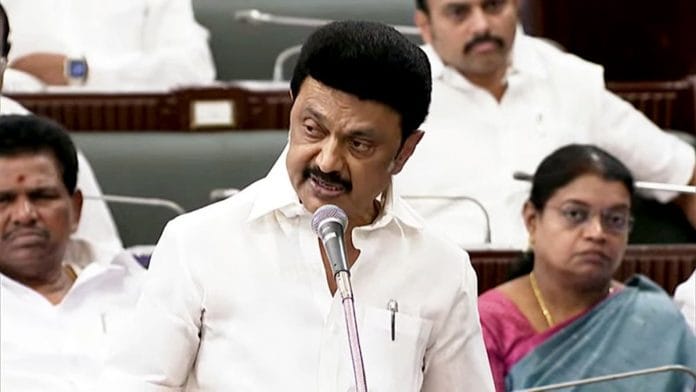



MK Stalin has been arguing, with considerable vigour, that the federal compact in India is badly out of balance. His core grievance is not difficult to understand. The Union government has, over the decades, developed a propensity for governing through centralised blueprints and tightly conditioned schemes, reducing state governments to the status of glorified implementing agencies.
Credit flows upward, blame flows downward. Stalin’s proposed remedy is not a weakened Centre — he is careful to say that — but a “right-sized” one. The standard rejoinder that states lack administrative capacity is indeed a self-fulfilling prophecy. Starve a government of real authority long enough, and it will stop developing the muscle to exercise it.
So far, so reasonable. But the Tamil Nadu CM’s argument needs testing against some constitutional inconveniences that tend to get glossed over.
What the Constitution says
It is quite fashionable to speak of India’s “federal structure” or “federal polity” in political discourse, academic writing and, increasingly, in judicial pronouncements. But the word “federation” — or any of its derivatives — does not appear anywhere in the Constitution of India. It was a deliberate choice. The founding fathers did not conceive of the Indian Republic as a compact among sovereign states that had decided to unite. They built a Union — and the distinction matters.
When British rule ended at midnight on 15 August 1947 — at the very moment of that famous “tryst with destiny” speech by Jawaharlal Nehru — as many as 565 princely states, each technically sovereign, suddenly found themselves having to decide where they stood. Within barely two years, 562 of them were absorbed into the Indian Union through the combination of diplomatic skill, political pressure and, where necessary, force, as in Hyderabad. Not so much an exercise in voluntary federal confederation, it was nation-building, led principally by Sardar Vallabhbhai Patel and VP Menon. The states that exist today did not create the Union; in most cases, the Union created them.
Articles 2 and 3 of the Constitution make this architecture explicit. Parliament can, through ordinary law, form new states, alter existing boundaries, and convert a state into a Union Territory. It does not require a constitutional amendment. The creation of Telangana, the Punjab Reorganisation Act, 1966 and, most recently, the reorganisation of Jammu and Kashmir into two Union Territories — all of these were accomplished through simple parliamentary legislation. Articles 256, 257 and 356 complete the picture. A Union government that can, under specified conditions, effectively suspend a state government and govern directly from Delhi is not, in any classical sense of the term, a federation of equal units.
Fiscal grievances
None of this settles whether the current balance of fiscal and legislative power between the Centre and the states is fair or optimal. In my view, it is not.
The growing use of cesses and surcharges — kept outside the divisible pool and not shared with states through Finance Commission devolution — has been a sore point, and justifiably so. It allows the central government to augment its own revenues while presenting an apparently generous headline devolution. The GST regime, whatever its merits, has curtailed states’ independent revenue-raising capacity even more. When both taxation and borrowing are controlled from the Centre, meaningful fiscal autonomy for states becomes notional. Centrally sponsored schemes, with tight conditionalities, have only reduced state governments to field offices of central ministries rather than autonomous democratic governments.
The migration of subjects from the State List to the Concurrent List — education being the most prominent example — has compounded this issue over time. The result is a de facto centralisation, regardless of what the formal constitutional architecture says.
Political alarm bell
The growing alignment among the five southern States — Tamil Nadu, Kerala, Karnataka, Andhra Pradesh and Telangana — on Centre-state relations is a structural signal. The specific grievances are well-known: delimitation, fiscal transfers and, most viscerally, language.
The concern about delimitation is legitimate. The freeze on seat redistribution since 1971 was itself a political compact — states that implemented family planning effectively would not be penalised electorally for doing so. Reopening that compact without compensatory arrangements sends the wrong message on population policy. Expanding the total number of Lok Sabha seats, rather than redistributing existing ones, is worth serious consideration.
On fiscal transfers, high-performing states that contribute disproportionately to the national tax pool but receive allocations primarily based on backwardness will always see the system as punishing performance. Whatever the technical justification, this perception erodes federal trust over time.
Language is the most emotionally charged of the three issues and the least open to rational argument. Administrative and institutional defaults that nudge Hindi into a de facto national role — even without any explicit policy — are sufficient to trigger fierce political reactions. Tamil Nadu’s history with Hindi imposition needs no retelling here.
Irony is hard to miss
There is, however, an aspect of this debate that the southern states would do well to reflect upon honestly. The 73rd and 74th Constitutional Amendments — enacted over 30 years ago — were designed to carry out precisely the kind of decentralisation that these states now demand from the Union government, except at the sub-state level.
The results, across most states—including the southern ones—have been decidedly mixed. Local bodies are routinely treated as implementing arms. State Finance Commission recommendations gather dust. The irony of a state government demanding fiscal autonomy from New Delhi while starving its own Municipal Corporations and Gram Panchayats of both funds and decision-making authority is hard to miss — and harder still to defend. Cooperative federalism, if it is to mean anything, must run all the way down.
Also read: IAS, IPS cadre allocation has structural problems. Why the revised policy doesn’t solve them
What must change
The reset India needs is neither as dramatic as Stalin suggests nor as unnecessary as Delhi tends to assume. Cesses and surcharges outside the divisible pool need a transparent framework with the states having a genuine say. The conditionality architecture of Centrally Sponsored Schemes needs a serious relook. On delimitation, political statesmanship must prevail over demographic arithmetic. And on language, some institutional humility from the Centre would go a long way.
The Union will hold together only to the extent it is perceived as fair. And the states would do well to remember that the same logic applies, with equal force, to their own relationship with local governments.
Who in Delhi is listening? And in the state capitals?
KBS Sidhu, IAS (retd.), former Special Chief Secretary, Punjab. Views are personal.
(Edited by Ratan Priya)