






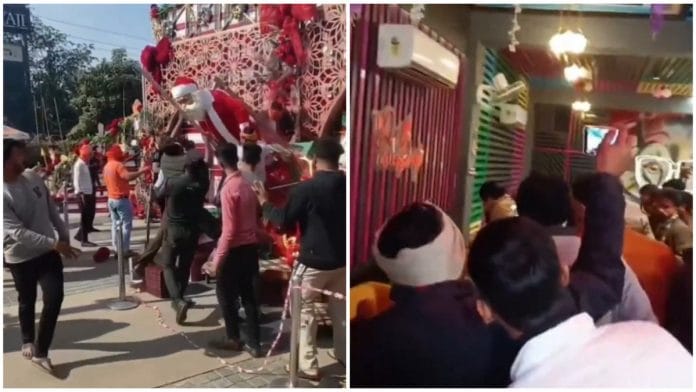



I spent last week celebrating Christmas, going to church and soaking in the quiet beauty of the season. For the first time in my life, I attended a midnight mass. It felt intimate and grounding, the kind of experience that stays with you long after the candles are blown out. Festivals have always held a magical space in my memory.
https://youtube.com/QOo8hAmUZNs
And yet, alongside this warmth, there was a dull ache. Reading news about Bajrang Dal members attacking Christmas decorations and disrupting school celebrations drained some of that joy. It is hard to hold on to the spirit of peace when hatred insists on knocking at the door.
What makes it even more unsettling is that this violence did not stop there. Around the same time, members of the same group attacked a simple birthday party in Bareilly. Their reason? Two Muslim friends were present at a Hindu girl’s celebration, and thus it was labelled “love jihad”. Now friendship itself has become a crime that needs policing.
Growing up, I often heard reports about the Bajrang Dal, a militant group and youth wing of the Vishwa Hindu Parishad, attacking young people on Valentine’s Day or storming pubs in the name of protecting “Indian culture” and sanskriti. This urge to “protect tradition” is not new. Similar impulses exist across cultures, religions, and nations, where groups claim moral authority over how society should behave. But though I find such thinking deeply regressive, what troubles me far more is the enforcement of that belief on others, against their will.
The moment culture becomes something that needs to be imposed through fear and violence, it stops being culture and turns into control. Tradition, if it has any strength, survives through choice and continuity, not coercion.
Also Read: Bareilly birthday party attack puts all friendships with Muslims on trial in India
Even insiders aren’t safe
There are always arguments that such incidents are selectively highlighted to build a narrative of India as anti-minority. I understand that concern. In a country of this scale, the voices of the moderate and the silent majority often get drowned out by loud fringe elements, and that distortion is real.
But focusing only on how India is perceived misses the more pressing and uncomfortable question: the ground reality of mobs using violence, indulging in moral policing, and doing so without any visible fear of consequences. That is what should worry us. Because it is not global headlines that shape a nation’s future—it is what becomes normal on the ground. What kind of society are we slowly accepting? What kind of everyday life are we preparing for the next generation? This is not about whether these are “just a few incidents”. It is about why even these few incidents are allowed to happen at all, and why they keep repeating. A healthy society has zero tolerance for such acts, because even one is too many.
Such violence creates fear through moral policing. It redraws the boundaries of what is considered acceptable, how one dresses, who one befriends, what one celebrates. Cultural diversity erodes, debate suffocates, and a single way of life is pushed as the only legitimate one. That hegemony is the end goal.
But what people fail to understand is that this violence ends up victimising those it claims to defend. It is not really about safeguarding culture or values; it is about control.
As a Muslim, I have seen this pattern far too many times. Moral policing and enforced dress codes imposed on women are always framed as “protection”. But protection from whom and at what cost? More often than not, it is about disciplining women and limiting their autonomy.
This logic does not stop with one community. Any group that refuses to respect individual autonomy operates the same way. They stand beside you only as long as you conform. The moment you step out of line, you are no longer “one of us”. Worse still, conformity is never enough; you must keep proving your loyalty. Eventually, such movements run out of external enemies and begin searching for “others” within their own ranks. Because without fear and control, their very existence starts to collapse.
Also Read: Dehradun, Bareilly, Tamil Nadu attack—Indians are turning violent. Don’t keep blaming politics
Moderates must rise
A few years ago, I wrote about how grateful I am, as an Indian Muslim, that my ancestors chose to stay in a pluralistic India rather than migrate to the theologically defined Pakistan. That choice was rooted in faith in an idea: an India where difference could coexist, where citizenship mattered more than belief. The normalisation of vigilante groups, where mob rule begins to replace the rule of law, is a betrayal of that idea.
We have reached a critical juncture for India. The actions we take (or don’t) will define the future for a long time. The responsibility now lies with the moderate majority to draw a clear line. Everyone who believes in dignity, freedom, and coexistence — Hindus, Muslims, Sikhs, Christians, Buddhists, and the irreligious alike — must close ranks and reject extremists in their own communities and freeze them out of political and public life for good.
Many are already speaking up, but many more are choosing to stay out of the muck of the political arena. This silence is being colonised by fringe elements who claim to represent and protect the public. We must reject this decisively and vocally, or risk becoming a Hindu Pakistan, where religious identity dictates belonging. We must raise our voices now to protect the India that was imagined, and the India that still deserves to exist.
Amana Begam Ansari is a columnist and writer. She runs a weekly YouTube show called ‘India This Week by Amana and Khalid’. She tweets @Amana_Ansari. Views are personal.
(Edited by Asavari Singh)
For true secularism we should also remove
HUF tax benefits.
Anti -conversion laws should be extended to Hinduism. buddhism, Jainism and Sikhism or it should be entirely scrapped.
Govt should stop funding temples or madrassas from tax payers money.
Relinquish government control over temples
No salary from tax payers money for temple priests and clerics
No government funding for temple or religious statues construction.
Ban display of religious symbols in schools. Colleges and offices. Or allow all religious symbols including hijab, burqa, crucifix etc in public schools and colleges.
Remove exemption given to adivasis in civil code especially for polygamy, divorce laws etc
To avoid becoming Hindu Pakistan, we need true secularism.
Uniform Civil Code. Reservations only on basis of caste.
If backward caste converted Muslims and Christians want reservations, then special minority privileges should be removed. Because if converted Christians/Muslims are still backward, then upper caste Muslims and Christians must be taking all the minority benefits.
Minority exemptions in Right to Education Act, must be removed. If not, entire RTE should be scrapped.