






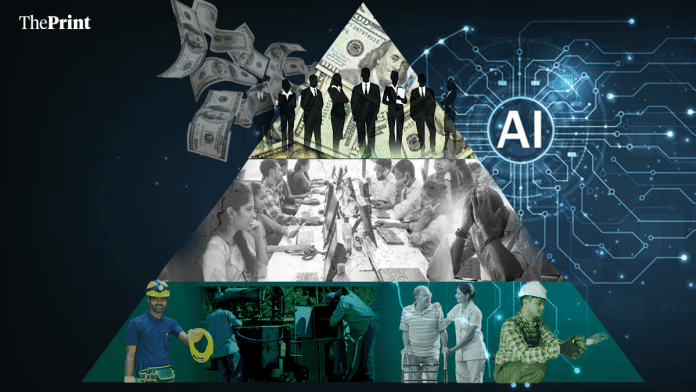

India is chasing a trillion-dollar digital economy even as Western AI agents displace its five-million-strong IT workforce. Yet New Delhi remains more focused on regulating AI-generated content and deepfakes than on creating a transition policy for the very workers who built ‘Digital India’ and now face the risk of their roles becoming obsolete due to automation.
For three decades, the fundamental business model of the Indian economy has been global labour arbitrage. India provided the human labour that the West needed for writing codes, maintaining servers and executing business processes at a fraction of the cost. This engine built the modern Indian middle class, transforming Bengaluru, Hyderabad, and Gurugram into the back offices of the world.
Today, that model is breaking down in real time, and the Indian policy apparatus is misreading the primary risk.
The West is transitioning
The danger to India’s $250 billion IT services sector isn’t that AI can write Python scripts faster than a junior developer. The threat is that Western enterprises are deploying autonomous agents to execute entire workflows. Effectively speaking, they are transitioning from ‘outsourcing to India’ to ‘insourcing to software’.
The Ministry of Electronics and Information Technology’s engagement with AI has focused primarily on deepfakes, regulating model behaviour, platform accountability, and the conditions under which AI models may be deployed for public-facing services. While these are legitimate regulatory concerns, they don’t resolve the issue of labour-market transition. If the government spends the next five years regulating AI outputs, it will wake up to find it has lost the very workforce that built its services-led growth model.
Another concern is that the discussions surrounding OECD governance and negotiations related to ISO/IEC AI standards suggest that a major compliance and assurance architecture is taking shape, which could potentially overhaul India’s IT export market.
Going by the EU AI Act and how US federal AI frameworks are evolving, a multinational firm deploying AI will soon be legally bound to ensure their AI systems, including those provided by Indian vendors, are safe and adhere to regulatory compliance. But the problem is that the Indian government is acting as a regulatory bottleneck. Indian IT majors carry equal responsibility; many have been slow to invest in the compliance and governance capabilities this transition demands.
India needs to shift focus
New Delhi must shift its regulatory bandwidth from content enforcement to labour transition. The demographic dividend becomes a demographic disaster if millions of engineering graduates enter a market where mid-level software services are completely automated. India needs a massive, aggressively funded upskilling mandate to produce AI governance professionals who are specialists in AI compliance, audit methodology, and the technical assurance frameworks that Western enterprises and regulators now require. India has the workforce depth to lead this space globally. What it lacks is the policy intent to build it.
At the same time, Indian IT majors must transition from labour-arbitrage vendors to compliance infrastructure providers. The auditing, verification, and monitoring layer that large-scale AI deployment demands is a substantial, growing, and defensible market, one for which India is better positioned than any other country. Capturing it requires the government to function as a strategic enabler: facilitating standards adoption, building institutional capacity, and treating AI governance capability as a national economic asset rather than a procedural compliance obligation.
India built its IT sector on genuine technical depth accumulated over decades. Agentic AI redirects that depth to where it is most valuable. Will New Delhi act on time or will it continue to allocate its regulatory attention to content governance while the economic transition runs ahead of policy?
India cannot build a trillion-dollar digital economy by acting as a speech-centric AI regulator. It must build the governance architecture the world actually needs, and it must transition its workforce before the market structure rules out the possibility to do so.
Rohan Sharma is founder and CEO of Zenolabs.AI. He tweets @techie150. Views are personal.
(Edited by Prashant Dixit)