






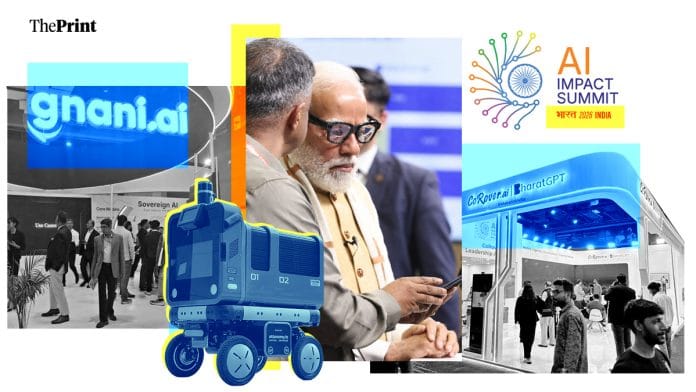



As a young woman, I read George Orwell’s 1984, which envisaged a world where technology was ubiquitous and all-invasive. Humanity was under constant surveillance by technology. This future is not far off, as we have seen with all the innovations displayed under one roof at the India AI Impact Summit 2026, held at the Bharat Mandapam in New Delhi this past week.
The Orwellian concept of “Big Brother is watching you” can also be interpreted to mean that the eyes of the entire world were on us as this was the first time that a global AI event of this magnitude was hosted in Global South, a developing nation; the first three being in the UK in 2023, in Korea in 2024 and Paris in 2025. It was a matter of great pride and national importance that we were able to attract and retain the eyeballs of the world, over 5 lakh visitors, and many more joining virtually as the sessions were made available online. Eighty-eight countries signed the New Delhi Declaration on AI, and all acknowledged Prime Minister Narendra Modi’s contention that technology must be democratised to make a difference.
Moving beyond the smokescreen of the shameful debacle and noise of the Galgotias Gate, the tamasha of Rahul Gandhi’s Baniyan Boys, this is about quiet introspection on the hits and misses of the world’s largest AI summit. Let us analyse the key takeaways.
The three P’s
The three sutras of planet, people, and progress were the framework mooted by PM Modi for the AI Impact Summit 2026. India is no stranger to this idea as our ancient wisdom acknowledges that Earth is a shared inheritance, not a commodity. AI, therefore, must become a tool of inclusivity, rather than exploitation.
The spirit of Vasudeva Kutumbakam guides India’s approach to resource sharing, which applies as much to AI as it does to natural resources—and can lead to the technological transformation of the entire society. This inclusivity is already visible in everyday life: even the nukkadwala sabjiwala now accepts UPI payments. In the farthest corners of the border-bound Himalayas, where internet connectivity may be patchy, UPI still works. I could make purchases through my smartphone. This is true inclusivity.
India’s approach places people, not platforms, at the centre of technological transformation. And this is the balance of true progress. As Modiji said, “It is believed that this summit will play a crucial role in building a human-centric, sensitive global AI ecosystem.”
True progress, therefore, will occur when fast-moving innovation allows values to move first; where AI advances prosperity while remaining anchored in dharma, inclusion and trust.
Global corporate leaders and India’s tech ecosystem see the country at a critical AI inflection point, able to leverage vast human capital and data to become a deep tech and AI leader.
Industry voices such as the Tata Sons Chairman Natarajan Chandrasekaran at the AI Summit highlighted AI as a transformational opportunity for sectors including healthcare, agriculture, finance, and manufacturing, emphasising skills and employment creation.
At the same time, government and industry initiatives are pushing AI investment and governance through platforms such as the India AI Impact Summit engagement and other ecosystem-building efforts. Together, these signal the government’s strategic priority of expanding AI capabilities and indigenous innovation.
Larger than Life
The speed at which AI is moving resembles a centrifugal force, whipping winds of change along the way. Even Modiji has called it a disruptor during his address at the plenary session. “Today, we once again face such an opportunity. Together, we must transform this disruption into humanity’s biggest opportunity.”
We Indians are the biggest disruptors. We are also the world’s fourth-largest economy and the second-largest population with nearly 1.4 billion people—translating into a mind-boggling absolute number of consumers for AI. Studies show that India is currently experiencing one of the fastest rates of AI adoption in the world, with over 65 per cent of those interviewed having experimented with AI, double the global average of 31 per cent.
As many as 77 per cent of Indian knowledge workers use AI in the workplace, saving between one and three hours of work daily. Indians primarily use AI for translations, answering queries, helping with schoolwork and enhancing workplace efficiency. During the recent T20 World Cup, I was pleased to note OpenAI’s ChatGPT being advertised in Hindi, and I understand that there are other ads directed at various vernacular users. In fact, ChatGPT has been offered to Indians as a subscription-free model for a limited period, with the view that increased usage will help train LLMs to perform better in the Indian context.
In this context, the emergence of indigenous models such as Sarvam AI and BharatGen can only bring cheer to the public at large.
According to Fortune Business Insights, “India’s artificial intelligence market size was valued at USD 9.51 billion in 2024, and this market is projected to grow from USD 13.05 billion in 2025 to USD 130.63 billion by 2032, exhibiting a CAGR of 39.00% over the forecast period.” The numbers speak for themselves. India is a huge market for emerging AI technologies, and the sheer scale makes it an attractive prospective market for global AI companies.
Reflecting this momentum, the summit witnessed participation from over 500 AI leaders, more than 100 founders and Chief Executive Officers, 150 academicians and researchers, and nearly 400 Chief Technical Officers.
India’s digital economy is exploding: enabled by low-cost internet access, massive 4G/5G adoption, and digital payments infrastructure. With these drivers, the digital economy is expected to grow faster than the overall economy. According to the World Economic Forum, 70 per cent of the global economy will be digital.
Reports project India becoming a $1 trillion digital economy by 2028, with digital payments alone surging toward $10 trillion in 2026.
Management and safety and security
Keeping in mind the disruptive potential of AI, it is also wise to give a thought to the access AI companies have to the data of India’s 1.4 billion people—and the potential hazard of such a vast data mine falling into the wrong hands. India is a civilisation that has always treated knowledge as a sacred trust, and the question of where the data of the world’s largest democracy resides one of technical, moral and legal importance.
Unlike Aadhar, which was developed by homegrown institutions, most basic LLms are owned by American (OpenAI’s ChatGPT), French (Claude AI), and Chinese companies. When the intimate digital lives of our citizens, i.e., their health, habits, language and livelihoods, are processed and monetised by foreign AI systems beyond our regulatory reach, sovereignty acquires a new meaning. We have seen this in the case of Facebook and X.
Leadership in AI demands indigenous LLMs and technical infrastructure. Data, like land and water, is now a national resource to be protected, governed and used for the public good. India’s challenge is, however, not to retreat from global innovation, but to engage with it on equitable terms, ensuring that AI trained on Indian lives ultimately works for the Indian people, by the Indian people, and of the Indian people.
India must build its own AI stack, and for this, clear guardrails are required—on sovereignty, localisation and accountability. This needs backing through public digital infrastructure and digital oversight, so that India can engage with the world as a strategic partner in innovation. As Orwell’s 1984 warned of a world where power flowed to those who controlled information, the AI age gives rise to the question: Who owns the data that defines our lives?
I watched a dystopian futuristic series called Upload (2020) on one of the OTT channels. It imagined a world where even consciousness is hosted, priced, and controlled by corporations. It serves as a reminder that when digital lives collide with commercialisation, autonomy and personal freedom risk becoming subservient to big data.
Against this backdrop, India has developed its own self-reliant AI platform, Sarvam AI, and preliminary reports are good. “Built with the vision of creating AI systems specifically for India, Sarvam AI is an organisation that is developing artificial intelligence tailored to India’s needs by building foundational components and applying them to the country’s unique linguistic, enterprise, and governance requirements,” the organisation describes its mission. This full-stack AI platform has been completely designed, developed and deployed in India, truly a Make in India initiative.
Brainrot or super human Intelligence?
Some experts from the American Academy for Yoga in Medicine have shared concerns that increased dependence on AI tools like ChatGPT is “shrinking our brains”. Writing used to flow easily and prolifically, but now seems like an onerous task. Much like how spelling skills declined with the advent of the word processor, ChatGPT is killing our ability to use our cognitive abilities successfully.
A popular reel is floating around on Instagram, depicting the inability of a group of students to compute 67 + 33. Some early research by cognitive experts has shown that AI reliance has led to less effortful reasoning and a decline in thinking skills. There is a high risk of passive thinking and a lack of interest in challenging assumptions.
This is a threat that we have to be highly cognizant of, as per neurologists. Evidence suggests a decline in attention span and a rise in neurological disorders such as ADHD and autism due to excessive screen dependence; this can be multifold when you throw in AI as well.
“Convenience may erode cognitive stamina. But there is another side. Used wisely, Al can expand thinking, by helping users explore ideas faster, ask better questions, and learn more efficiently. The brain doesn’t shrink from tools; it shrinks from disuse,” an editorial in the newsletter of the American Academy for Yoga in Neuroscience, Tennessee, observed.
Also read: Rafale deal, AI summit, Sewa Teerth have something in common. See Verse 13.13 of the Gita
Bedlam by Baniyan Boys
I will merely refer to the symbolic disrobing of Youth Congress Activists under the leadership of LoP, Rahul Gandhi. Neither is he a modern-day Draupudi, nor was the Bharat Mandapam the court of the Blind King Dhritharasthra. To conduct such an inappropriate act during an international summit of global importance was shameful to say the least.
We may differ in political ideology, but when the nation takes centre stage in its endeavour to lead the AI future, then political differences must be set aside to further the interests and aspirations of the Indian people as a whole. In global memory, summits are remembered as much for images as for intent. The informal, unserious optics associated with moments of ‘political casualness’ have turned our country into a laughing stock and a meme. In an age when perception travels faster than policy, such imagery can dilute the seriousness of India’s technological ambition. Rahul Gandhi-led opposition would do well to know that the job of opposition is not to oppose but to propose an alternative mode of governance, and dare I say that they are failing miserably.
We can safely say with cautious optimism that the AI Impact Summit 2026 has been a resounding success. Mukesh Ambani has offered to invest Rs 10 lakh crore over 10 years to revolutionise AI as he did with mobile data. PM Modi laid the foundation stone for the HCL-Foxconn JV in semiconductors in Jewar.
India’s digital inflection point isn’t a buzzword. It reflects a real, measurable shift in which digital technologies are deeply influencing economic structures and productivity, the public and private sectors are co-building scalable, interoperable infrastructure, and Innovation is creating global leadership opportunities—especially in AI and deep tech.
Every day life, from governance and payments to education and healthcare, is becoming digitally enabled.
In essence, India’s digital trajectory is no longer linear growth; it’s moving into a high-impact phase where digital becomes fundamental to national development and global competitiveness.
Meenakashi Lekhi is a BJP leader, lawyer and social activist. Her X handle is @M_Lekhi. Views are personal.
(Edited by Ratan Priya)
Yes. Please tell me the true author of this paper is a 14-16 year old child who wrote this as as part of their school work.
Poor, socialist India has no money, water, and competence to build AI.