






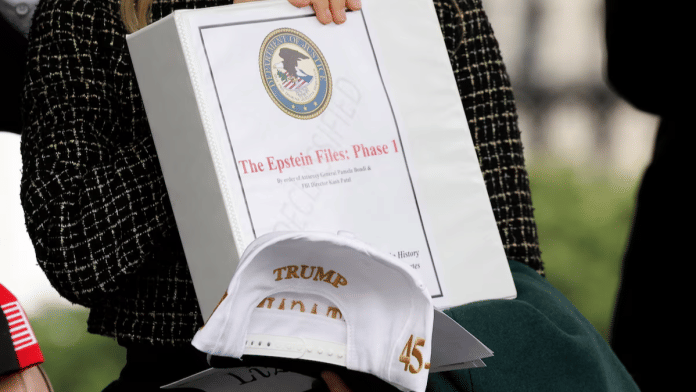



Imagine a hypothetical scenario.
Rahul Gandhi, Akhilesh Yadav, Abhishek Banerjee, MK Stalin, or any other Opposition leader named in the Jeffrey Epstein files.
Imagine if an Opposition leader were exchanging several friendly emails with a convicted sex offender.
Imagine the furore. Imagine the hysteria.
The ruling BJP would have held relay press conferences. And the notoriously pliant media, the mainstream “legacy” media, the sharp-suited TV anchors and the newspaper headline writers would have been galvanised into 24X7 action.
They would have picked up the baton of opposition-bashing from the BJP and run with it far and wide, somersaulting in glee. Anchors would screech. Banner headlines would publish lurid details of emails. Thundering shows and huffily self-important editorials would project the Opposition’s failings and repeatedly announce its obituary.
Instead, what do we have today, when it has been revealed that one of Narendra Modi’s ministers, Hardeep Singh Puri—the high-profile Minister of Petroleum and Natural Gas—has been writing to Jeffrey Epstein? A reluctance, a wilful unwillingness by many Indian media outlets to raise issues and ask legitimate questions.
In the emails (sent in 2014, well after Epstein was convicted of child prostitution in 2008), Puri refers to Jeffrey Epstein as “Jeff”, “my friend”, praises his “exquisite taste in people”, and tells him to “have fun, not that you require encouragement from others for that.” Puri also refers to Epstein’s “exotic island,” and signs off “warmly”.
Far from a formal professional interaction, Puri’s is an eager, gushing tone. It is inexcusable that a long-standing veteran diplomat like Puri thought nothing of dealing with someone with a shocking criminal record in the hope of gaining influence in the US government. At the very least, it shows extremely poor judgment.
At a press conference, Puri was aggressive and defiant, downplaying Epstein’s paedophilic crimes by euphemising child sex abuse as solicitation of an “underage woman”.
Members of Parliament raised this issue both within and outside the premises. MPs questioned why the Modi government is standing by Puri, why the minister is not being asked for a detailed explanation, and why there is no pressure on Puri to resign.
All over the world, whether in the UK or the US, the international press is demanding accountability from Epstein-linked figures who find themselves in embarrassing situations.
The missing watchdog
But, where is the voice of India’s once-brave press, which is supposed to be the permanent opposition? Why is it that only the Opposition and Opposition MPs are raising questions?
When I joined the Rajya Sabha in 2024, I wrote an article in ThePrint explaining why I was moving from journalism to the opposition: because the Opposition is the only entity at the moment—apart from the courageous bare-handed digital outlets and online activists—that seems to be asking questions or demanding accountability from the Modi government.
That article is being proven right again and again. Today, the political Opposition must not only work in Parliament but also do the work of the press.
The contrast with the days of the UPA government couldn’t be starker. In those years, every single BJP jibe or cheap shot at Prime Minister Manmohan Singh was turned by the same media into breaking news, prime-time debates, and screaming front-page headlines.
Now, those same outlets are at pains to hand Modi a lifetime of clean chits, ignore mountains of controversy, and play defence lawyer at every turn. The same media that turned even minor slips of the UPA into national scandals on loop — now bends over backwards. In the UPA years, there were ‘policy paralysis’ witch-hunts every week. Today, there is only cowardly, servile silence.
From the demonetisation debacle that plunged millions into misery, to the grim toll of Covid deaths hidden behind official triumphalism, to the studied opacity shrouding the PM CARES fund, to the cascade of serious allegations of scams and corruption in BJP-ruled states—most of the TV media pretends these scandals do not exist, refuses to spotlight them, and recoils from putting the Modi government on the mat.
On Pegasus—the spyware that pierced the privacy of citizens and critics alike—no piercing questions. On the Chinese ingress that nibbled away at Indian territory—no sustained outrage, no forensic investigations launched, no demands for transparency and accountability.
Also read: 10 examples of the BJP’s ‘Bengal Virodhi’ mindset—mispronunciations to unpaid dues
No demand for accountability
An outwardly glittering trade deal was recently signed with the United States. The Minister of Commerce and Industry, Piyush Goyal, strode out for a triumphant press conference outside Parliament—yet refused point-blank to allow a single debate on it inside the House. This is not mere oversight; it is a brazen breach of parliamentary privilege, a deliberate sidestepping of the very institution that embodies the people’s sovereignty.
Inconvenient questions? They simply vanish from the script. The TV media gets swept away by masterful PR choreography—“the mother of all deals”, “the father of all mega-deals”—without pausing to demand scrutiny of the fine print, the concessions, the long-term costs to Indian farmers, workers, or national sovereignty. The Opposition is denied its constitutional right to interrogate the nitty-gritty. Debate? What debate?
The Prime Minister will not hold press conferences—that quaint democratic ritual of prime ministers is now extinct in India. Narendra Modi has made it abundantly clear: no unscripted interviews, no accountability in the glare of cameras.
The TV media scarcely dares to ask. Instead, the daily drumbeat, the daily din is calibrated to one obsessive target: the opposition, the opposition, the opposition. Punch holes in the Opposition’s credibility, caricature their leaders, blame them for every government failure or scandal.
The script is relentless, the echo chamber deafening.
The noise on TV every day is how to rubbish the opposition’s arguments, how to stereotype this opposition leader, how to shame that opposition leader.
When politics needs fresh fuel, the religious Hindu-Muslim pot is kept boiling on TV. A loud bigoted voice is platformed, amplified, and looped endlessly across screens until hate simmers and divides deepen. Polarisation is not an accident; it is a TV media strategy. Yet another Weapon Of Mass Distraction.
The functioning of the Election Commission, the opacity shrouding Special Intensive Revision (SIR)—these are barely whispered about. Why is there no sustained demand for EC accountability? Why no forensic probing of electoral roll manipulations? Why must a chief minister from an opposition-ruled state, the doughty, fearless Mamata Banerjee of Bengal, travel to Delhi to protest, to make the people’s voice heard?
What about the Nikhil Gupta case—the chilling allegation that an Indian government official was directly involved in a plot to murder an individual, a Khalistani separatist Gurpatwant Singh Pannun, on American soil? A serving officer, according to US court filings, green-lit an assassination on foreign territory. This is not some fringe conspiracy; this is a diplomatic earthquake. Yet the government faces no sustained, forensic questioning. No TV news channel is asking the tough questions. No fulminating editorials demanding a white paper, or demands for a parliamentary probe, a full public accounting.
But the questions are not going to go away. And future generations will know who refused to ask them.
Sagarika Ghose is a Rajya Sabha MP, All India Trinamool Congress. She tweets @sagarikaghose. Views are personal.
(Edited by Ratan Priya)
Why does print allow such scums to write articles. She and her father are parasites. She should first speak about how her father made money and how her great good for nothing Mamta useless has taken Bengal to new heights.
Waise, does she pay you to get her article online
Imagine if Epstein files named Mamataless Banerjee or Rajdeep Sardadsai. BJP would have awarded Bharat Ratnas to them, made them prime minister and the president. Long live Sagarika. Death to everyone Tommy, Dicky, and Hurry.
Please .Seriously. This Whataboutery does not even merit to be called as an opinion. Don’t insult our intelligence.
Rape as a means of political enforcement has been happening in TMC ruled Bengal. Sexual exploitation and coverups by TMC leaders have happened on multiple occasions. Will Sagarika Ghose talk about that? Epstein files are in the USA. See what is happening in your state. It is bad enough that the BJP ruled centre has done nothing to address these crimes.
Imagine if people were killed for voting for the opposition in a state election. Think Netaji , think which state it could be?