









The suspiciously rapid issuance and withdrawal of the new UGC regulations for the ‘promotion of equity’ should not be read in isolation, but as part of a larger nexus of pernicious phenomena which I call neo-casteism. It helps us comprehend the inventiveness of the upper caste sections in almost all walks of life in maintaining caste dominance under changing modern conditions. Neo-casteism is the new morphology of caste-discrimination.
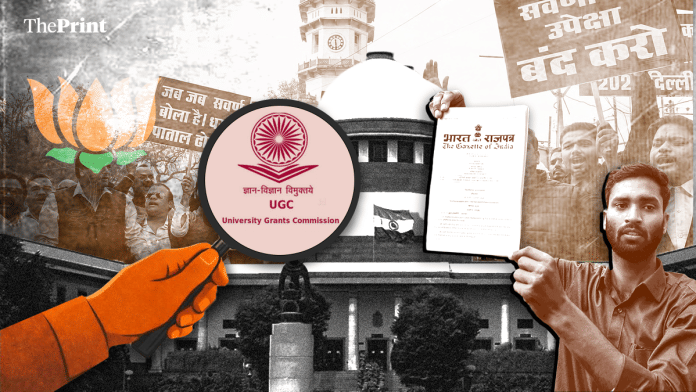
The latest instance unfolded last month when the Supreme Court stayed the University Grants Commission (Promotion of Equity in Higher Education Institutions) Regulations 2026, calling them “vague” and “capable of misuse”. The stay came after objections from sections of the so-called general or upper castes, who alleged that the regulations were biased against them for presuming that only SCs, STs, and OBCs can be oppressed.
Since the abolition of untouchability in 1950, universities became more accessible to Dalits and Adivasis, while the entry of OBCs increased only post-Mandal in 1990. Correspondingly, casteism, segregation, and untouchability (outlawed, though still intact) could not be practised as usual by the upper castes in the educational landscape.
However, casteism continued in new forms that are not codified under Article 15, and which escape the letter of the SC & ST (Prevention of Atrocities) Act.
Also Read: ‘Why discussing caste is a crime?’ Faculty, scholars shocked by IIT-Delhi probe on conference
How to identify neo-casteism on campus
In the domain of the Indian education system, neo-casteism encompasses the many forms of caste-based profiling, manipulation of nomenclature, political rigmaroles, institutional erasure, and fearmongering under modern constitutional conditions.
None of these can yet be codified as discriminatory under existing laws or guidelines, even though they ceaselessly produce lasting harmful impact on lower caste students, who form the majority in the country, but not in institutes.
Upper castes now call themselves “general” class or category, refusing to acknowledge how they have benefited from the inherited privilege of what BR Ambedkar called graded inequality, in which they occupy the “upper” position.
While reservations were meant to ensure a minimum number of scholars from Dalit, Bahujan, and Adivasi (DBA) communities enter the institute, the 50 per cent cap was interpreted by institutes as ‘no more than’.
The term ‘general’ comes from the school and university admission category for applicants from all castes who do not avail reservations. In reality, implementation often shows that “general” has been turned into a 50 per cent quota for upper castes, which then allows them to pose as the only ones capable of competing in that category.
Today, “general” functions as a synonym for “upper caste”, and as a marker of exclusion of DBA scholars. The “general” is fiercely guarded. Often, those DBA scholars who choose not to avail reservation, or succeed in the “general” category, are accused of ‘stealing’ a seat from upper castes. The nomenclature is common among upper caste students, faculty, and administrators. It’s a form of everyday casteist slurring, but is not legally codified as such.
The Brahmanical and other dominant castes are an affluent and powerful minority, forming less than 10 per cent of the Indian population, and have suppressed the Bahujans within the caste order perpetuated over three millennia. Since the exposition of population numbers in the 2023 Bihar Caste Census, the upper castes are arguably building a myth of being a persecuted minority. This is despite them comprising more than 60 per cent of Supreme Court justices, and occupying 80 per cent of all faculty positions in the prestigious IITs and IIMs. Manifestly, the upper castes have always enjoyed reservation, but have stigmatised the reservation for the Bahujan majority. Ironically, they are now demanding reservation for themselves in newer ways.
Access to educational institutes has always been mediated by one’s caste, and is particularly traumatic for lower caste people. Upper caste students and professors profile Dalit students based on their surnames, entrance examination rank, proficiency in English, and degree of urbanity, to ferret out their caste. This is analogous to classic techniques of racial profiling and policing.
Institutions, both schools and colleges, exclude lower-caste intellectuals, iconic leaders, or texts from syllabi, to ensure the history (or any other discipline) studied in the classroom is Brahmanical. Profiling achieves the humiliation and ostracisation of DBA students, whereas invizibilisation of DBA history achieves their alienation and intimidation through the outright refusal of belonging. These practices should be interpreted as caste-based discrimination, and addressed.
Why were the new UGC rules stayed?
In 2012, the Dalit intellectual, economist, and then chairman of the UGC, Sukhadeo Thorat, with inputs from the National Campaign on Dalit Human Rights (NCDHR), drafted the UGC equity regulations in response to multiple suicides of students from the lower caste community in AIIMS and JNU.
In response to the petition filed by the mothers of Rohith Vemula and Payal Tadvi, both of whom died in what is often called institutional murder, the Supreme Court directed the UGC to draft improved guidelines. Disha Wadekar and Indira Jaisingh, their lawyers, observed that the 2012 UGC guidelines were not implemented by most universities. The revised regulations introduced a major clause on non-compliance: universities could now be penalised for not following the guidelines.
Let us now examine the sequence of events. It takes nothing less than multiple Dalit suicides for the Supreme Court to address caste discrimination in higher education. The court directs the UGC to draft new guidelines. The UGC notifies them. The Savarna lobby then uses fearmongering and false information on streets and social media to allege the potential misuse of these measures — even as the simple provisions of the 2012 guidelines have so far not even been ‘used’.
The BJP is accused of being ‘anti-Brahmanical’ (which it is not, being the political wing of the Brahmanical RSS) and of pandering to lower castes for loyalty and votes (without empowering them). The vocal, financially affluent Savarna lobby influences the Supreme Court to put a stay on the guidelines. The Supreme Court echoes the language of those protesting the regulations, calling them “capable of misuse” and “unfair”. A full circle is completed, and we are back to the beginning.
Also Read: ‘Underestimating upper caste unity’: Resentment & resignations within BJP over new UGC rules
The neo-casteist orchestra
Neo-casteism fractures movement and progress in reducing social inequality, bringing things back to where they began.
The neo-casteists set up a symphony orchestra. First, they called for better guidelines to make the lower castes feel reassured. Second, they watered them down, while keeping a few clauses to signal institutional reform. Third, they appropriated the victim narrative (a term they already use as a slur against the testimonies of the oppressed) and spread fear of the Dalit male, reminiscent of the way Black men were constructed in relation to White women. Fourth, they legitimised these upper caste fears, while also creating a perception that ‘we tried, but we failed to progress’.
The French philosopher Etienne Balibar in Race, Nation, Class (1991) discusses the development of ‘neo-racism’ in a post-colonial world, where racial attitudes relied primarily not on biological but cultural differences. A new world order evolved a new form of racism. The practice of racism changed, but the intent to inferiorise and humiliate, or what the Indian anti-caste philosopher Divya Dwivedi calls the “denigrate-dominate function” in her paper ‘The Evasive Racism of Caste’ (2023), remained the same.
Seen through the lens of neo-casteism, it appears that the UGC guidelines were never intended to succeed. The upper castes could demonstrate their power, even though their vote would always go to the current ruling party. The BJP, meanwhile, could pretend to cater to the interests of the Dalit, Adivasi, and OBC community, without attempting serious reform. In the grand orchestra of upper castes, universities still remain afflicted with caste-discrimination, which still awaits legal recognition.
Aarushi Punia is an anti-caste political thinker. Her PhD at IIT Delhi compared Dalit and Palestinian literature. She posts on X @aarushipunia. Views are personal.
(Edited by Asavari Singh)
This opinion piece coins the term “neo-casteism” but fails to back it up with concrete evidence. Where are the specific examples? Which universities? The author relies on sweeping unsubstantiated accusations rather than documented incidents.
The Supreme Court called the UGC guidelines “vague” and “capable of misuse” – legitimate legal concerns that deserve engagement. Instead, the author dismisses this as upper-caste fearmongering without actually analyzing what the regulations said or why they might be problematic.
The “symphony orchestra” metaphor assumes every objection to these guidelines is coordinated bad faith. This leaves no room for genuine disagreement about policy design. Not everyone who questions these regulations is trying to maintain caste dominance.
After decades of reservations, scholarships, and support programs, where’s the accountability? What’s improved? What hasn’t? Why? The author offers no metrics, just demands for more amd more without acknowledging what already exists.
Most troubling aspect is this: She stereotypes upper-caste students and faculty as inherently discriminatory while criticizing stereotyping. That’s hypocrisy, plain and simple
When 81% of the SC/ST Act cases are against OBCs, why were they put in protected category?
And you have the audacity to label, the minority GCs which are guilty of a smaller percentage of cases, as neo-casteist? You are simply a bigot, indulging in gaslighting.
We aren’t even addressing the creamy layer problem, where one caste each in OBC, SC and ST, are cornering most of the seats. The politically powerless unreseved castes, are not willing to take other people’s culpability. Look into your own.
And atleast the SC/ST act was targeting adults who will somehow manage. But you want to target our children, and that will not be tolerated.
We are not fooled by your gaslighting. People like you are the problem.
For proponents who claim to follow the well educated Babasaheb Ambedkar , it does not behove well to indulge in name calling and sitckering label of “neo casteist”. The funny thing is the so called “neo casteist” position has been accepted by the honorable Supreme Court too. It is advisable to present generation youth like the writer herself to indulge in deep intellectual exercise when it comes to legislative matters rather than election rally style jingoist name calling. A fair and equitable society tries to reduce discrimination against every class and not just a few. That is what Babasaheb wanted too. Lest the writer wants the same old divisive casteist trope to exist few generations down the line but with the tables turned. Historic atrocities has a shelf life, it is not forever. Especially when modern day classrooms are progressing beyond such casteist poison.
If this person was not a communist living in their communist echo chamber they would have taken the effort to read what countless amounts of research and what the so called “Neo casteist” side was talking about.
What the UGC notification was going to do was increase caste based division. If you think otherwise then you are a very stupid person. In a country where divorce/rape laws are misused do you really have the audacity to come and tell – “no one is going to misuse them”.
This was only going to create caste wars amongst all kinds of caste – OBCs vs OBCs, General vs SC, SC vs SC, ST vs OBCs etc. This lady is part of the larger 5th column who wants to see Hindu society divided because it benefits the Congress and their allies. Don’t believe me – look at what SP leader said in a recent debate – they are going to fight UP elections based on caste politics.
These kind of people are enemy to the Hindu society. This what a 5th column looks like.
The print team is a bunch of tools who like to delete and moderate comments just like this country does with its free speech. TBH free speech doesn’t exist on right or left in this country so its important to talk about it and point it out.
Also, one question – what was the RSS founder primary reason for launching this organization ? This lady is going to distort the history so let me set the facts straight – it was to unite the Hindu society which was fragmented because of caste fossilization which the British and people like her were successful in doing.
Such loads of BS in this article. Seriously this is what victimhood epistemology looks like.
Your intention is not to remove caste from the society but it’s too make sure that it remains so that you can blame all your problems on that factor.
We will make a caste blind society whether you like it or not. Also RSS was started because of the fragmentation of the society in the name of caste. Obviously a delusional Marxist would not know that.
Seriously we wont let you divide the society anymore. Also let’s look at the facts – how many percentage of caste based atrocities towards SC/ST is done by OBCs ? – 86%. As someone who comes from a so called OBC background (my caste is just categorized as one but it’s absolute BS just like the caste system which is why when our income rose we became the creamy layer and were pushed towards general category which is great)
No one other than you lefty friends in the communist bloc or the ambedakarites are going to fall for this trap.