






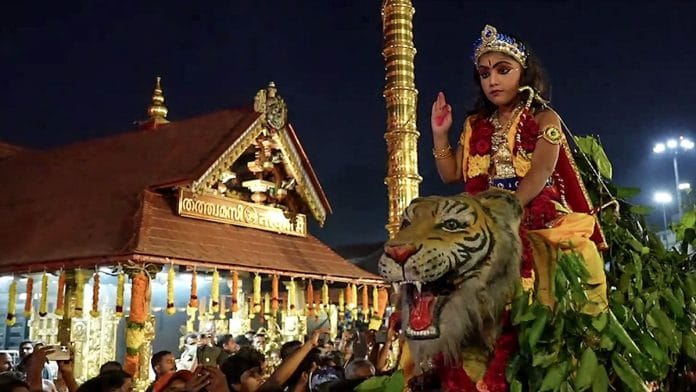



Over the next weeks, a Constitution Bench of the Supreme Court is hearing petitions that may lead to the most significant judgments on religious freedom in India. At the heart of all this is the question of a woman’s right to enter the temple of the god Ayyappa at Sabarimala. A 2018 Supreme Court order to enforce access provoked both a Right-wing backlash and progressive mobilisation around the issue.
However, the god has a longer history beyond this controversy. The focus on ‘essential’ religious practices in India forgets how traditions are constantly being reshaped and projected backwards—primarily by upper-caste voices. From ancient nature-spirits to Chola-era religious assimilation, from Dravidian activism in the 1950s to Ayyappa’s women-exclusive worship in a Coorg temple, here is the god’s epic story.
The origins of a Hill-God
Over the decades, several scholars have attempted to understand where and how the worship of Ayyappa began. While his temple at Sabarimala draws the most pilgrims (and is most visible in the national news cycle), forms of Ayyappa are worshipped in Tamil Nadu and Karnataka as well. In Coorg, Karnataka, he is worshipped as a hunter. In Tamil Nadu, he is known as Ayyanar, and is more of a village protector-god. It is in Kerala that his mythology is most integrated into the Puranic and Brahminical traditions—though even this seems to be relatively recent.
Like with many Indian gods, the evolution of Ayyappa was a back-and-forth process, tied to cultural and political currents across regions. According to historian Fred W Clothey, in his paper “Theogony and Power in South India”, the earliest evidence of a divinity called “Ayyan” dates to after the 3rd century CE. The Kalittokai, a compendium of early Tamil poems, mentions that Ayyan was revered by peasant chieftains called the Ay, active in the Western Ghats. Around the same time, the epic Silappadikaram mentions a hunter god known as Chattan and Ayyanar, though it’s not clear which—if any—of these figures came first.
Also read: Shaivites wiped out Jain influence in medieval Karnataka—200 years before Delhi Sultans
Convergence and divergence
By the 7th and 8th centuries, a deity known as Shastha, the Teacher, was mentioned in Tamil devotional literature, and early images of this god began to appear across Kerala. An Ay chief is recorded as building a stone temple to Ayyan at Kanyakumari in 864 CE. Somewhat later but in the same region, an inscription from the reign of the Chola king Rajaraja I (r. 985–1014 CE), refers to Ayyappa and Shastha as one deity. According to archaeologist Ajit Kumar, Ayyappa-Shastha was particularly popular in central Kerala, around Kollam, suggesting an influx of ideas from Tamil Nadu across the Shenkottai pass.
From this point onward, it seems that the Coromandel and Malabar coasts headed in different directions with Ayyan/Ayyanar/Ayyappa. In Kerala, this god was integrated into the precincts of both Shiva and Vishnu temples, typically with a Brahmin priest, and with vegetarian offerings.
Ayyanar, on the other hand, is rarely mentioned in temple inscriptions in Tamil Nadu, as he had become a god of ‘lower’ castes, such as potters. Clothey notes a 13th century inscription from Srirangam attesting that a “Shudra-Devata”, probably Ayyanar, was installed by a Brahmin priest “to control erosion of the temple grounds and to prevent the interference of shudra elements by the river”. However, this god was kept at a distance from the main Vishnu temple. He is rarely depicted in medieval bronzes, suggesting he was revered mostly in temporary shrines, which have not survived.
Despite the divergence, Ayyanar and Ayyappa continued to influence each other. They share iconographic links, as both are occasionally depicted on elephant-back, or more frequently riding a white horse wielding a sword, with warrior-guardian figures. Either way, the conceptual foundations had been laid for the future god of Sabarimala.
Also read: How did Nepal become a ‘Hindu Rashtra’?
Sabarimala: The Sanskritic version
After this, for several centuries, the historical evidence grows patchy. It is difficult to trace out a clear trajectory of Ayyappa’s evolution. Some scholars have argued that, after sectarian strife in the 13th and 14th centuries, South Indian rulers patronised Harihara (the combined form of Shiva and Vishnu), which seeded a legend of Ayyappa as the son of both gods. However, this trend was sporadic, and happened mostly in southern Karnataka and in Tamil Nadu—not on the Malabar coast.
All that can be said is that, by the 19th century, Ayyappa as he is known and loved today appears full-fledged in the Sanskrit Bhuta-natho-Pakhyanam. Here, his legend serves as a sequel to the destruction of the buffalo-demon Mahishasura by the goddess Chamundi, one of the most popular stories in the Sanskritic tradition. The demon’s sister Mahishi terrorises the gods, and Shiva and Vishnu (in the form of Mohini) decide to conceive a son, the future Ayyappa. The Pakhyanam also explains Ayyappa’s aversion to women, claiming that Mahishi was in fact the reborn wife of the sage Dattatreya, whom the sage had cursed to reincarnation as a buffalo owing to her carnal desires—until eventually liberated by the future Ayyappa.
Left on the banks of the river Pampa, the divine child is adopted by the childless king Rajashekhara of Pantalam. When he is twelve years old, the jealous queen conspires to send him out to get tiger’s milk to cure her (feigned) stomach-ache. In the forest, he destroys Mahishi and returns riding the god Indra, who has taken the form of a tiger. Before departing for the heavens, the young god shoots an arrow to mark the site at which a temple is to be built to him—and that site, according to the Bhuta-natho-Pakhyanam, is Sabarimala.
Also read: Here’s how Khilji, Akbar, and Hindu rulers dealt with Halal
Sabarimala and popular religion
That was the Brahminical version, overlaid onto a forest-god to link him to better-established epic cycles. In her 2020 paper “Sabarimala and Women’s Identity in Kerala”, journalist and historian Parvathi Menon interviewed a number of scholars on Sabarimala, and argued that Ayyappa was once a god of local forest-peoples, before becoming linked to Nairs and Pulayas, who guarded the mountain-passes between Madurai and the West Coast. Over the centuries, diverse groups would travel through this pass, including Buddhists, Muslims and Syrian Christians. Much later, a sixteenth-century ruler claiming the title of “Pandya”, a possible ancestor of the Pandalam royal family, formalised the worship of the local god as the orthodox Ayyappa-Shastha. Their kingdom was then conquered by Marthanda Varma of Travancore (r. 1729–1758).
Popular ballads, analysed by Dr Sekhar (The Ayyappan Cultus), support this view. They narrate how Ayyappa was born to a princess of Pandalam, terrorised by a Maravar bandit-chief. Rescued by a Brahmin, she conceives a child with him, who is then adopted by her father, the king of Pandalam. The child then grows to defeat and recruit warriors from various backgrounds, such as the Muslim pirate Vavar—possibly representing the integration of many local hero cults. As his power and followers grow, , in part due to celibacy, Ayyappa refuses to marry a beautiful girl who falls in love with him, promising to do so only at the end of the eon. Finally, he kills the Maravars and rescues Pandalam, before building a shrine at Sabarimala. Enjoining his men to follow the principles of fraternity, he transforms into a bolt of lightning.
It is possible, then, that the Sanskritic tradition was seeking to explain a unique feature of this forest-god: His association with warriors and masculinity. Either way, the taboo on women’s entry was in practice by 1820, when the British lieutenants Ward and Conner wrote of the Sabarimala temple. They claimed it was visited by 10,000–15,000 pilgrims annually of many castes and creeds, despite the dangers of the forest journey. Women, they noted, were not allowed to approach “as all sexual intercourse in that vicinity is averse to this deity.” They also attested to the wealth of the temple. Menon notes (citing activist KN Ganesh) that this was one reason Sabarimala was soon handed over, by the indebted Pandalam royal family of the time, to the strictly upper-caste Travancore Royal Devaswom Commission.
However, events would soon catapult this out-of-the-way temple to fame across Southern India. The 1920 Vaikom Satyagraha, which forced the Travancore state to open temples to all castes. The Independence struggle and Hindi imposition debates of the 1950s, which brought Ayyappa across the Western Ghats to new Tamil devotees. And the Kerala High Court judgement of the 1990s, legalising the temple’s restrictions on women, feeding into new notions of pilgrimage and masculinity in Kerala.
Simultaneously, though, Ayyappa in Coorg, isolated from these currents, would retain some of his ancient attributes as a hunter—and, in fact, would be revered solely by women in some temples. We will examine all of these in next week’s edition of Thinking Medieval.
This is the first column in a series about the history of Ayyappa.
Anirudh Kanisetti is a public historian. He is the author of ‘Lords of Earth and Sea: A History of the Chola Empire’ and the award-winning ‘Lords of the Deccan’. He hosts the Echoes of India and Yuddha podcasts. He tweets @AKanisetti and is on Instagram @anirbuddha.
This article is a part of the ‘Thinking Medieval‘ series that takes a deep dive into India’s medieval culture, politics, and history.