









In the olden days, before Yash Raj Films and Dharma Productions glamourised marriages in movies with seductive ambiance and Manish Malhotra lehengas, the sacred union symbolised significant changes in the lives of the newlyweds. Filmmakers of different sensibilities portrayed different perspectives of the fragile equation.
It was a reality check for Basu Bhattacharya in Anubhav (1971) and later, Avishkar (1974). For Gulzar, it was a negotiation for space and power in Aandhi (1975) and for Hrishikesh Mukherjee, it was envy eroding the core of a sensitive relationship in Abhimaan (1973). The audience loved these movies, identified with the characters and the complexities and were secretly relieved that they were not the only ones battling with intimate challenges.
As we gear up for another round of elaborate winter weddings and prepare new wardrobes for more mehndi and sangit celebrations, I recall some popular and some unsung marriages on screen and what they signified over the decades.
Marriages in cinema’s history
In an extremely romantic and important scene in Sanjay Leela Bhansali’s Hum Dil De Chuke Sanam (1999), an emotional Aishwarya Rai leads a curious Salman Khan around an extinguished fire and explains the relevance of ‘Saat Phere’ to her beloved. That is the closest any narrative came to decoding the Saptapadi or the marital vows in a Hindu traditional marriage. My mind rewinds to Bimal Roy’s 1953 release Parineeta, based on Sarat Chandra Chattopadhyay. It told the story of two childhood friends and neighbours.
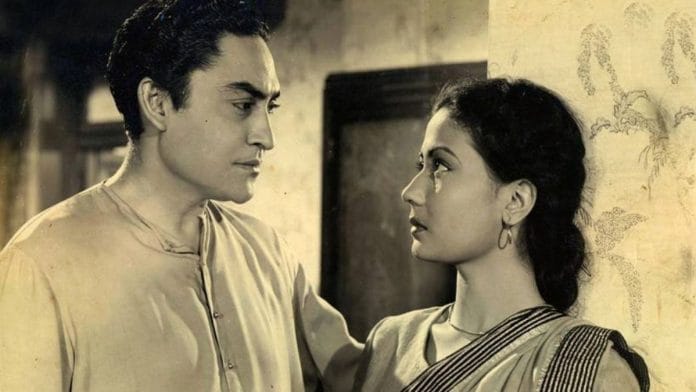
Shekhar Rai, played by Ashok Kumar, is the son of a landlord, while Lalita, played by Meena Kumari, is an orphan living with her uncle. Shekhar’s family is accustomed to Lalita walking in and out of Shekhar’s room since childhood. She tidies his writing desk and settles his wardrobe daily and they are comfortable in each other’s company. Still teenagers, both are unaware of their feelings for each other until a wedding in the neighbourhood triggers a dramatic moment.
It is the eve of Uthani Ekadashi and an innocent Lalita, wearing a flower garland, saunters into Shekhar’s study and flings another garland around him. It is the mahurat moment, and traditionally, they are a couple now! When the enormity of the moment is realised by both, Lalita identifies herself as parineeta, a married woman, while Shekhar is blissfully unaware of the implications. Balraj Sahni and Nargis are the ideal couple in 1958 Lajwanti, inspired by Ramayana. The Maryada Purshotam Sahni suspects Nargis, Sita, of foul play and sends her to exile. Nargis is never allowed to meet their baby; in fact, Baby Naaz ends up doing the shraad of her living mother.
Marital conflicts got more entangled and intense in the sixties as movies explored passion, adultery and initiation. In Chaudhvin ka Chand (1960), it is destiny playing a cruel game. Actor Rehman has seen a glimpse of Waheeda Rehman and is obsessed with the idea of marrying her. In the meantime, Rehman’s family has made a commitment to their relatives, so Rehman pleads with his friend Guru Dutt to honour the commitment and marry the girl of his parents’ choice. Guru Dutt agrees, but the bride turns out to be Waheeda Rehman. The lover, Rehman, is crestfallen and ends his life!
Chaudvin Ka Chand was a tragic tale of unrequited love, while Grahasti (1963) portrayed the protagonist, Ashok Kumar, leading separate lives with families and the extraordinary thing is that the climax justifies it. It was the remake of a popular South Indian film and a box-office success in both Tamil and Hindi versions. Rishte Naate (1965) was about choices. Nutan loves Raaj Kumar but cannot have him because he is married to Yamuna, so when Yamuna dies during childbirth, Nutan marries Raaj Kumar and assumes responsibility for the orphan child.
Interestingly, it was not always men who took the initiative in romance. Remember Rukmini penning a love letter to Lord Krishna, asking him to be her saviour; or in Govind Saraiya’s Saraswatichandra (1968), where a blossoming Nutan packs fragrant flowers in her letter to her suitor, ‘Phool tumhe bheja hai khat mein’ and the fiancé promptly arrives at her mansion to return the compliment with ‘Chandan sa badan’ on a moonlit night.
The seventies were a restless decade when the country was going through multiple crises. Filmmakers consciously projected stories of harmony in domestic lives to calm the audience. Two marriage movies where the mother of the couple played an important role were Abhinetri (1970), based on the life of Vikram-Mrinalini Sarabhai and Anil Ganguly’s Kora Kagaz (1974). In the former, Nirupa Roy, mother of Shashi Kapoor, senses trouble between her scientist son and dancer daughter-in-law and comes to live with them. Her presence diffuses the brewing tension between the couple, and love sparkles again. In Kora Kagaz, Jaya Bachchan’s bickering mother, superbly portrayed by Achala Sachdev, is over-interfering in her daughter’s marital life. As a result, Vijay Anand and Jaya Bachchan are separated and meet in the climax, both frail and aged, in a waiting room of a railway station.
The eighties did not permit parental intrusion and parallel cinema ushered in that change. Spearheaded by five-time-national-award-winning actor Shabana Azmi, the decade liberated the suffering wife from oppression—most memorably when Pooja refuses to take back her wayward husband (Kulbhushan Kharbanda) in Mahesh Bhatt’s pathbreaking Arth (1980). It was a decade in which Azmi voiced many concerns in marriage that were yet unexpressed in Indian society. She was willing to give a second chance to her husband (Marc Zuber) in Vinod Pande’s Yeh Nazdeekiyan (1982) and unapologetic about giving in to temptation in Ek Pal (1986), where she is attracted to Farooque Shaikh while married to Naseerudin Shah. Director Kalpana Lajmi made the film to emphasise equality in commitment without judgment and discrimination.
Also read: Raaj Kumar & Meena Kumari’s chemistry saves ‘Kaajal’
Then came the 90s
Change is unpredictable and seldom linear, and the best example of this is Rajshri Productions’ Hum AapKe Hain Koun (1994). While offbeat filmmakers were redefining gender gaze, director Sooraj Barjatya, inspired by his own family weddings, presented an extravaganza that changed the dynamics of entertainment forever. The film was an anatomy of the Indian wedding: the process, the celebrations, that propelled Madhuri Dixit to dizzying heights in her career.
A few years later, in 1999, Hum Saath Saath Hain, though not as big a hit as HAKHK, was a message in preservation of joint families. For almost a decade, mainstream cinema focused on marriages only for romance and music. Then came international filmmaker Mira Nair, who stunned all of us with her unforgettable Monsoon Wedding in 2001. Like the Rajshri Productions, this was also a story of a family wedding, but it included a dark secret brushed under the carpet for years. The film forced open festering wounds.
In 2006, Vivaah summed up Sooraj Barjatya’s trilogy on marriage. The film focused on an engaged couple preparing for their big day. The bride, played by Amrita Rao, is accumulating her school and college certificates, while the groom (Shahid Kapoor) is rearranging his room to include his partner and her paraphernalia. Creating space in his room and his heart.
The next decade served us a variety of marriages, some rocking comedies representing rural India, such as Tanu Weds Manu (2011). In Kangana Ranaut’s other film, Queen, the bridegroom calls off the wedding at the last moment. A pall of gloom falls over the bride’s family until the bride’s grandmother advises Kangana to go on a solo trip to London, and the experience transforms her.
In the last few years, India’s most imaginative filmmaker, Sanjay Leela Bhansali, has portrayed many seasons of marriage in his films. In Bajirao Mastani (2013), all the characters, Bajirao, Mastani, and Kashi Bai, express their perspectives on the same marriage. Bhansali’s Padmavat (2018) portrayed a palace of illusions, and the audience realised that the kings and the queens may live in magnificent mansions, but marriage makes them as fragile and insecure as you and me watching the film.
Bhawana Somaaya is a film critic and author. Views are personal
(Edited by Ratan Priya)