








Because of his policies, statements, and social media imagery, Assam Chief Minister Himanta Biswa Sarma has been attracting a lot of political attention. Let us examine his rise, and possibly his future, from a broader political perspective, aided by theory, comparison, history, and law.
Political ideologies tend to develop new faces; the vanguard can’t lead forever. As ambitious mid-level leaders begin to envision their futures, they consider how they might ascend to the top, especially if they believe the ideology they have embraced will remain in power for a long time. They draw attention by making statements or adopting policies that please the vanguard.
Self-regarding ambition and the desire for upward mobility are, thus, common features of political organisations. The process becomes quite intense when aspirational mid-level leaders realise they were not trained within the ideology’s core institutions. For the BJP, the RSS is the parent organisation. In pursuit of ambition, enterprising “outsiders” can easily become, as it were, more RSS than the RSS itself.
Different from Adityanath
For some time now, Yogi Adityanath, Chief Minister of Uttar Pradesh, has exemplified this logic. Adityanath did not emerge from the RSS. As a disciple of Mahant Avaidyanath, he was trained as a priest at the Gorakhnath Matth. He founded an organisation called the Hindu Yuva Vahini. His Hindu nationalism began with his math’s involvement in the Ayodhya Movement, not within the RSS. But his passionate advocacy of the Hindu community and his fierce critique of Muslims aligned closely with the ideological thrust of the RSS. In 2017, with the support of Prime Minister Narendra Modi, he became chief minister of India’s most populous state. His policies and statements in office, which have reinforced his Hindu nationalist credentials, have placed him among the most powerful leaders of the BJP despite his lack of roots in the RSS.
At one level, Himanta Biswa Sarma is traversing the same path. At another, his trajectory is even more complex and demanding. Adityanath may not have emerged from the RSS, but he was part of the Hindu Yuva Vahini and was groomed in a Hindu math. In contrast, Sarma spent many years in the Congress party in Assam. When he encountered obstacles to his rise to the highest echelons of power in the state, he switched parties. Adityanath moved from one Hindu organisation to another; Sarma shifted from a party long dependent on Muslim votes in Assam to one opposed to Muslims.
It is not often realised that the proportion of Muslims in Assam’s population has historically been second only to that of Jammu and Kashmir when it was a state. In absolute terms, Uttar Pradesh may have the largest number of Muslims. But as a proportion of the state population, Assam, West Bengal, and Kerala all exceed Uttar Pradesh.
A serious political implication follows. If elections are to be won while simultaneously satisfying the BJP’s ideological vanguard, a fiercely anti-Muslim stance can be viewed as political pragmatism. It is a manifestly clear sign of expediency, not necessarily proof of ideological rectitude. If Muslims constitute approximately a third of Assam’s population, and if few or none are likely to vote for the BJP, Sarma would need about 70 per cent of the Hindu vote, if not more. Under such circumstances, communal polarisation can be seen as an optimal electoral strategy.
Also Read: Borah vs Gogoi cracks open Assam Congress. What letter to high command tells about warring factions
Can Sarma be legally punished?
In light of this reasoning, let us consider some of the more recent episodes in Sarma’s politics of polarisation. He has said that he would like to shut down — forcibly, if necessary — as many madarsas as possible, so that Muslim youth do not become mullahs. He has also argued that if Rs 5 is the price of a rickshaw ride, Assamese passengers should pay Rs 4 if the driver is a miyan. He has used the term miyan at times to refer to illegal Bangladesh immigrants; at other times to Bangladeshi immigrants, both legal and illegal; and at still other times to Muslims in Assam, regardless of origin. There is no great principle involved here. Whatever promotes polarisation will be uttered.
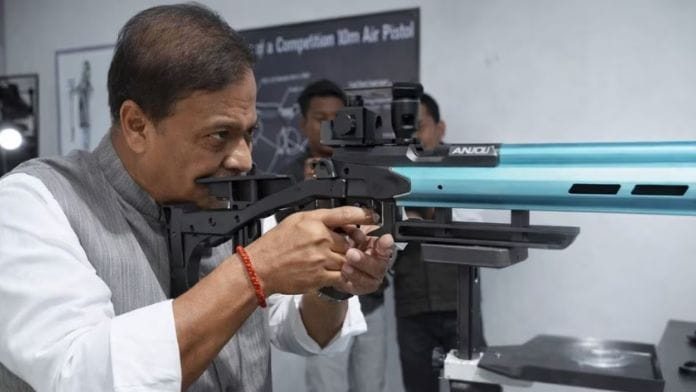
The most incendiary episode, watched extensively, was a social media video in which Sarma is seen holding a gun and aiming it at two Muslim men, one of whom is wearing a skullcap. The video was posted on X by Assam BJP and was later taken down.
Aiming at Hindu-Muslim polarisation, Sarma clearly has a political strategy that seeks to maximise the odds of winning. But an important legal question follows: do his statements, verbal or visual, violate the law, thereby exposing him to liability?
For perspective on this question, let us begin comparatively. In the United States, the First Amendment to the Constitution provides exceptionally strong protection for free speech. In 2015, during his first presidential campaign, Donald Trump said that “Mexicans were rapists and criminals.” More recently, an image circulated on his social media account depicting Barack and Michelle Obama as apes. These may have political consequences, negative or positive, but they are generally not legally punishable. The United States draws a distinction between “hate speech” and “hate crimes”. Only the latter are criminally prosecutable, and they are defined by acts of violence, not by speech alone.
In Western Europe, however, the situation is different. Britain’s Public Order Act (1986) makes words or behaviour intended to stir up racial hatred punishable. In France and Germany, too, freedom of expression is not an unqualified right; laws criminalising hate speech on the basis of race, ethnicity, or religion exist.
India’s constitutional framework leans more toward Europe than the United States. Article 19(1) guarantees freedom of speech and expression as a fundamental right, but Article 19(2) permits reasonable restrictions on grounds such as defamation, contempt of court, decency or morality. More important for our purposes here is First Constitutional Amendment, passed a little over a year after the Constitution came into effect, which expanded Article 19(2) to include additional grounds such as “public order” and “incitement to an offence.”
Whatever one may conclude about Sarma’s remarks against Muslims or his suggestion that people pay a miyan rickshaw driver less, the video in which he is seen holding a gun and aiming it at two Muslim men is clearly an “incitement to an offence”, and a potential threat to “public order”.
That is my assessment as a political analyst. Ultimately, however, what counts is the judgment of the courts. Will India’s judiciary see this as a criminal violation of constitutional law?
Ashutosh Varshney is Sol Goldman Professor of International Studies and the Social Sciences and Professor of Political Science at Brown University. Views are personal.
(Edited by Prashant Dixit)