





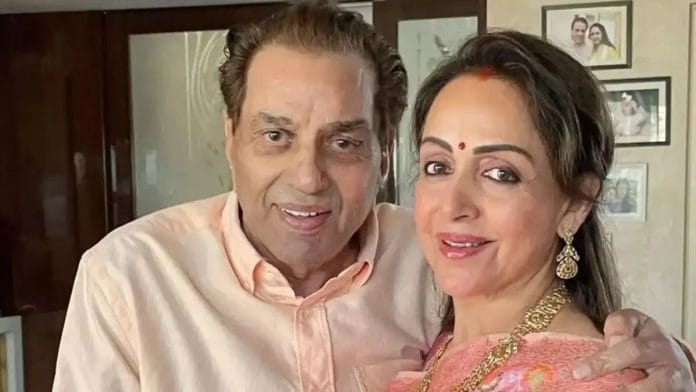



Hema Malini, parliamentarian, actor, dancer, and India’s eternal Dream Girl, lost Dharmendra, co-parliamentarian, poet and legendary star, her husband of 45 years. He was India’s “He Man”, adored by millions.
He died of age-related medical complications a few days short of his 90th birthday. The nation mourned. The mourning continues. Devastated fans are still posting loving tributes to the actor who radiated positivity and unalloyed goodness. Dharmendra is gone. Hema will grieve for her beloved till her last breath. And she will do so with her trademark dignity, head held high, back straight, shoulders aligned – a queen in mourning.
Public grieving comes in many avatars. Especially when the history of those grieving is unconventional. Dharmendra, in that sense, led a double life. He had his primary family, wife Prakash, and their four children. And then there was Hema and their two daughters. Time has obviously not healed the hurt caused to the primary family. Or so it appeared to outsiders watching Dharamji’s funeral play out. But that’s for the two families to reckon with.
Grieving with grace
The optics dictated the popular narrative, starting with the hasty funeral of a larger-than-life icon, to the various prayer meets, personal and public, organised by the Deols. It was Hema Malini’s quiet, silent, unbent presence within her own space, with her own family and close friends, that made the most poignant statement amid the noise.
Appropriating legacy under complex circumstances is a tight-rope act, especially for the people who lay sole claim to it. To the watching world, it can appear crude, rude, selfish, insensitive and driven by motives other than just logistical funeral arrangements. Put bluntly: Those who get control of the body first take full charge of all the formal ceremonies. That includes access to the patient while he /she is struggling for life in the hospital.
Who decides? Is the “other family” not entitled to spend the final moments with the person who has been an integral part of their lives for decades? What difference does deliberate exclusion make at such a delicate stage when it may be a matter of days, hours, minutes? What about the right to pay last respects? The person is dead and gone. But shouldn’t the living rise above themselves to forget the past and do the right thing?
Two grieving widows. One man. At least in death, cold-blooded math should be replaced by human sentiments. Doesn’t happen. Who knows what the legal implications can be later? Think of the visuals. What if the entire attention gets shifted to the “other woman” who broke up the close-knit family of the deceased? What if that widow is deemed the “real widow” and the nation’s sympathies shift to her?
Worse.
Legacy has many tentacles. The Will. Property. Investments. Rights. Who gets what? Advisors swiftly leap in to instruct the first family. “Keep it clinical. Keep it clean”. Nobody wants a repeat of the Sunjoy Kapur shenanigans that unfolded like a mess recently. Modern families generate modern conflicts that even the law is not equipped to handle. Nobody listens to the heart. There’s far too much at stake. The mind must win.
I watched Hema as she held her own during her prayer meet in Delhi. At one point, when she was close to losing her composure and breaking down on the podium, her daughter Esha reached out discreetly to hold her mother. Hema haughtily said, ‘’No, no!’’ and pushed her arm away. I loved Hema the most during that moment! That is the quintessential Hema – imperious, in control, and indomitable.
Her speech in Hindi was moving without being flowery. She said what she wanted to, shared only as much as she chose, let her eyes tear up but not spill over, and allowed her chin to quiver a few times as she spoke of her “Dharamji”. The emotions were reined in, but authenticity was PRESENT in every word. Her unalloyed love for the man who worshipped her, but never moved in, shone in her beautiful eyes as she thanked him for being in her life and showering love on their daughters – her world, her precious, compact family unit, fiercely guarded and deeply cherished.
There is much to learn from Hema. It couldn’t have been easy for either her or her daughters to be excluded from all the other ceremonies conducted on a grand five-star scale by the first family. Does it matter? The Dream Girl had lived her dream life with her Dream Man. That will always be her biggest reward.
The power of presence
Dhurandhar has just changed the language of desi big-ticket cinema with its audacity. Hamza (played by Ranveer Singh), the protagonist with the pale green eyes of a merciless killer, the mane of a lion, and the body of a well-fed cheetah, is given barely any dialogue. How ingenious is this move!
The strong, silent hero is a mere sidekick to a dreaded Karachi gangster. Hamza is the overlooked underdog who sees and hears everything. And waits! Aaaah…. The wait! Aditya Dhar understands wait. He wants viewers to beg. Well…I am begging. For more Ranveer. Just Ranveer. In the sequel. Forget the unwieldy storyline, which frequently lacks coherence. Just focus on performances. In a dream role that’s likely to become a game changer for Akshaye Khanna playing Rehman Dakait, he delivers big time, quivering chin, screwed up eyes, permanent scowl and all.
Technically, there is very little Dhurandhar and lots of Dakait in Dhar’s tour de force. Intentional and shrewd. But once Khanna’s viral Baloch dance was done (too short), I lost interest.
Did I find the film manipulative/propagandist/jingoistic? Frankly, I didn’t care. Every film in the world comes with an agenda—subliminal or otherwise. What difference does that make to cinema lovers? Take Schindler’s List (1993): is it neutral or objective? Take any film that delves into sensitive contemporary history and key political incidents – there is always a perspective. It is the filmmaker’s take. In Dhurandhar, did the Congress party sell India down the drain during the fake money scandal? Let’s ask P. Chidambaram.
Provide files and incontrovertible proof. Who looked the other way during the 2008 Mumbai attacks? Was it an intel failure or a conspiracy? Can anyone say for sure?
The biggest saving grace of Dhurandhar was its refusal to indulge in Hindu-Muslim religious bashing. Facts? Well, that depends on whose facts. True of any representation of history. And that exquisitely shot burial scene? Way too short, buddy.
But hello! The childish breaks (“chapters”) were intrusive. “Et tu, Brutus?” No, Aditya. No!
So guys, chill and watch the film—with an open mind, open heart. And definitely for the soundtrack, which is wild! Bodies get dismembered to techno bhangra beats – I love it! Rambha HO HO HO to you, too!
Also read: Lobbying for invites to hugs from Rekha—Diwali parties are Bollywood’s power games
How relevant are hazaar lit fests?
The lit fest season has barely kicked off, and I am already lit-fested out! Overdose, overkill, over the top. Sab Kuch. As a writer /performing flea (who does not charge fees), I am asking myself—what’s in it for me? No mazak, but the truth is, very little. Unless a writer is a natural performing flea like Shashi Tharoor – forget it! Tharoor is the ultimate Lit Fest babe magnet who not just sells zillions of his latest title, but is sexually preyed on by provocatively dressed younglings who breathe heavily and ask, “Mr. Tharoor, what are you writing next?’’ When all they want to know is, “Shashi, can I buy you a drink ?”
Lit Fest organisers, please take note: We don’t want canvas goodie bags stuffed with useless sponsor gifts, and boring motivational books we rudely leave behind. Ditto for hideously heavy mementos. Why pay extra baggage for that truly ugly thing?
Your intentions are noble and lofty, and inspiring. But at the end of an exhausting day and a tiring session, sponsored cheap wine and greasy snacks inside an arty Author’s Lounge, don’t quite cut it.
Am I sounding churlish? Of course! But let’s rejig the stale format, please. Even readers are bored.
Shobhaa De is an author, columnist, social commentator, and opinion-shaper. She has written 20 books. She tweets @DeShobhaa. Views are personal.
(Edited by Ratan Priya)
Beautifully written Shobha de on how beautifully n gracefully hema malini has handled this with utmost grace n dignity .she has shown the world what true love is .meanwhile the deol brothers have shown what they truly are …disrespectful n spineless..thanks for a wonderful writeup…and speaking the truth
Absolutely true. She maintained perfect dignity eventhough other side could have shown little bit compassion towards her at the last moments of Dharam ji.
This brought an old memory.
When the well known Actress Nadigaiyal Thilagam Savitri died after lot of suffering, Gemini’s wife asked him to bring her to their house and helped to do last rites in a much a dignified manner to the departed soul. They took care of their Children too.
I cannot avoid that comparision in this moment of Hema Madam’s loss.
May Dharam ji ‘s soul rest in peace
Om Shanthi