






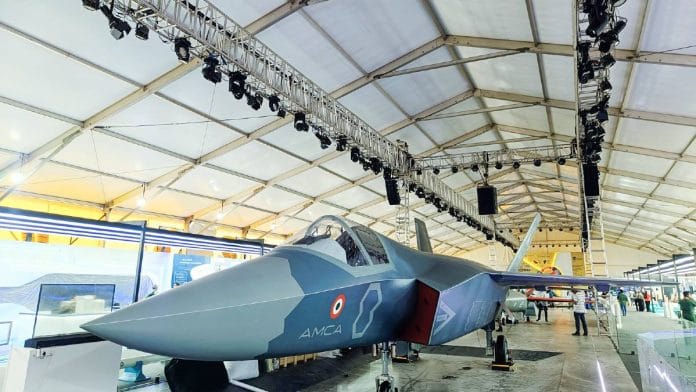



India’s Advanced Medium Combat Aircraft programme, valued at around ₹15,000 crore in its first phase, has taken an unexpected turn. Hindustan Aeronautics Limited, the country’s premier aerospace public sector undertaking, has not been included in the initial shortlist. Instead, private-sector firms such as Tata Advanced Systems Limited, Larsen & Toubro, and Bharat Forge Limited are being considered for the manufacturing role.
For the Defence Research and Development Organisation (DRDO) and its Aeronautical Development Agency (ADA), which has long partnered with Hindustan Aeronautics Limited (HAL), this marks a new era of collaboration with private industry.
The Advanced Medium Combat Aircraft (AMCA) project is not just another defence programme. It represents India’s ambition to field a fifth-generation stealth fighter, a leap in capability that places the country alongside advanced aerospace powers. The decision to involve private players at such a critical stage signals a deliberate policy shift—one that could redefine the contours of India’s defence manufacturing ecosystem.
HAL’s absence
HAL’s exclusion has raised eyebrows. With more than eight decades of experience, HAL has built fighters, helicopters, trainers, and support systems for all the branches of India’s armed forces. Its legacy includes the Tejas Light Combat Aircraft, Dhruv helicopters, and numerous licensed-production aircraft. By contrast, the shortlisted private firms have limited direct experience in fighter jet production. Yet, ADA will retain responsibility for design and development, leaving the private sector to focus on manufacturing and timely delivery.
This division of labour reflects a pragmatic approach. HAL’s order book is already overflowing, with commitments to deliver Tejas Mk1A fighters, helicopters, and other platforms. Critics argue that adding AMCA prototypes to HAL’s workload could risk further delays. By involving private firms, the government hopes to diversify capacity and inject efficiency into the system.
Having witnessed the transformation of the petrochemical sector, particularly the journey of Indian Petrochemicals Corporation Limited (IPCL), a blue-chip public sector undertaking (PSU), merged with Reliance Industries in 2007, I see parallels that may unfold in defence manufacturing. The private sector’s ability to deliver complex projects could well extend to aerospace, as HAL remains at the core of India’s aviation ecosystem today.
India’s private sector has repeatedly demonstrated its ability to execute large-scale, complex projects. From petrochemical complexes and refineries to metro rail systems and ports, companies like Tata, Larsen & Toubro (L&T), Adani, Reliance and others have demonstrated agility, financial strength, and managerial efficiency. Defence manufacturing, however, is a different challenge, fraught with technological complexity, long gestation periods, and dependence on global supply chains.
Still, these firms are not starting from scratch. Tata Advanced Systems Limited (TASL), for instance, is assembling Airbus C-295 transport aircraft in Vadodara, Gujarat, under a 56-aircraft deal with the Indian Air Force. Sixteen aircraft will be supplied from Spain, while 40 will be built in India. L&T has contributed to missile launchers, submarines, and naval systems. Bharat Forge has invested in artillery and armoured vehicle components. Together, they form part of a growing defence-industrial ecosystem that has matured over the past two decades.
Also read: 2026 defence budget is not good enough to achieve Viksit armed forces
Risks and opportunities
The AMCA programme is ambitious. Developing and producing a fifth-generation stealth fighter involves mastering design, advanced avionics, composite materials, and engine technology. India’s dependence on foreign suppliers for engines remains a critical vulnerability. HAL has faced delays in the past due to engine shortages, and private firms may encounter similar challenges. Success will depend on how effectively India manages international partnerships while building indigenous capability.
Yet, the opportunity is immense. If private firms succeed, India will have diversified its defence manufacturing base, reducing reliance on a single PSU. This could foster competition, innovation, and faster delivery cycles. It would also align with the government’s “Atmanirbhar Bharat” vision, encouraging private capital and talent to contribute to national security.
HAL’s absence from the first phase of AMCA marks a significant shift, but it does not necessarily signal a permanent exit. The company has provided the backbone of India’s aviation capability, and its institutional knowledge remains unmatched.
Criticism of HAL often centres on delays and quality concerns, yet many of these issues stem mostly from systemic challenges. Supply chain bottlenecks, engine shortages, and evolving user requirements have repeatedly complicated delivery schedules. At the same time, HAL’s traditional working environment is indeed marked by rigid processes and slower decision-making, hindering agility compared to private sector practices.
The Tejas Mk1A programme, for example, has faced setbacks largely due to inadequate supply of GE-404 engines, a factor outside HAL’s control. With enhanced manpower deployed in the right roles and with greater flexibility in its organisational approach, the company could strengthen both efficiency and delivery performance.
While HAL’s dominant position has sometimes been viewed as monopolistic, its infrastructure, skilled workforce, and experience in handling complex aerospace projects remain valuable assets. Importantly, HAL has indicated that it may participate in AMCA’s second phase, when full-scale production begins. With the program expected to involve around 120 aircraft and a total value exceeding ₹1.5 lakh crore, HAL’s expertise could still be called upon to ensure successful execution.
In this sense, HAL’s story with AMCA is not one of exclusion but of transition. The first phase may belong to private industry, but the later stages could well see HAL re-enter the picture, reinforcing its role as a trusted partner in India’s defence manufacturing journey. This uncertainty about HAL’s future role, however, has already begun to shape investor sentiment and public perception, setting the stage for sharp reactions in the market and among stakeholders.
Also read: Rafale dilemma sums up India’s defence paradox—security vs self-reliance
Looking ahead
The AMCA decision must be seen in the broader context of India’s defence industrial evolution. For decades, HAL and other PSUs dominated the sector, with private firms limited to supplying components. Over the past 20 years, policy reforms have encouraged private participation, joint ventures, and foreign collaboration. The C-295 programme, naval shipbuilding contracts, and artillery projects reflect this shift.
By involving private firms in AMCA, the government is accelerating this transition. The aim is not to sideline HAL but to create a more balanced ecosystem where multiple players contribute. This diversification could reduce risks, improve efficiency, and build resilience against supply chain disruptions.
Phase one of AMCA involves building five flying prototypes and one structural test specimen. The real business lies in later stages, with full-scale production and export potential. HAL may yet play a role, either through partnerships or by joining subsequent phases. For private firms, the challenge is to prove their capability in a domain long dominated by HAL.
The coming years will test India’s defence industry like never before. Success will depend on collaboration between DRDO, ADA, HAL, private firms, and international partners. If managed well, AMCA could become a symbol of India’s technological maturity and industrial strength.
India’s defence manufacturing is entering a transformative phase. HAL’s legacy remains vital, but private firms now have an opportunity to demonstrate their capabilities. The ultimate goal is clear—meeting national defence needs with reliable, indigenous solutions. If this transition strengthens the ecosystem, India will emerge stronger, more self-reliant, and better prepared for the challenges ahead.
Gopal Sutar is ex-spokesperson HAL and media analyst, SABIC/ARAMCO. Views are personal.
(Edited by Saptak Datta)