





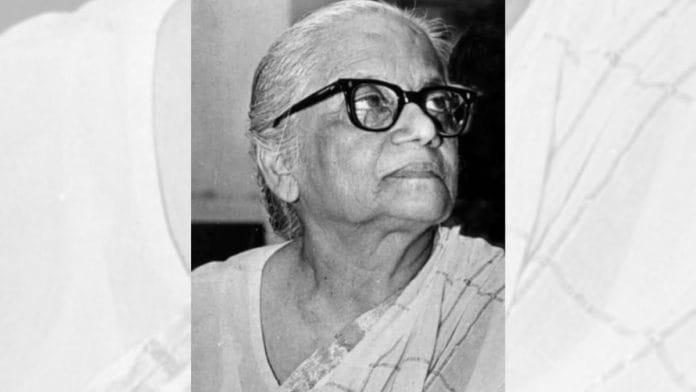

While welcoming the move to amend the Dowry Prohibition Bill and most of its amendments, I do record my protest against the way the [Rajiv Gandhi] government is introducing and passing it in such a hurry. Yesterday the government passed an important Bill, called the Suppression of Immoral Traffic in Women and Girls Bill, and today they want to pass this Bill. These are two most important bills affecting women and we should have been given time for proper study and for collecting opinion from the people outside, especially the women’s organisations, as we did before.
I don’t know what is the intention of the government to pass this important Bill in such a hurry. Do they want to appear as champions of the women’s cause after passing such a retrograde Muslim Women’s Bill or is it just a propaganda to show that they want to do some good for the women? Anyway, I still welcome this Bill and most of its amendments.
But, I would like to point out that some of the major recommendations of the Dowry Prohibition Joint Select Committee have still been left out. They have not been included here. The Dowry Prohibition Joint Select Committee, which included the present honourable Minister and myself also, took two years to study the matter and they made exhaustive recommendations, but still its major recommendations have been left out. The major women’s organisations, especially the All India Democratic Women’s Organisation, the National Federation of Women, All India Women’s Conference, all took interest. After consulting all of them, the Dowry Prohibition Joint Select Committee made some major recommendations. These major recommendations included the recommendations about the definition of the term ‘dowry’. It said dowry is anything that is given in consideration of the marriage or in connection with the marriage. The first recommendation says:
“The Committee have reluctantly arrived at the conclusion that ‘those who are’ should be omitted and without omitting them the provisions of the Act cannot be made to serve the purpose which they are intended to.”
(This was their first recommendation.)
The All India Democratic Women’s Organisation, after meeting Shri Rajiv Gandhi on the subject on 8th April 1985, sent an exhaustive letter to him in which they said:
“We feel that the Law Commission’s recommendations in regard to the 91st Report on the dowry deaths and Law Reports of 10th August 1983 in this regard should be, by and large, accepted.”
The definition of the dowry was:
“Dowry means money or any other thing estimable in terms of money demanded or taken from the wife or her parents or others on her behalf by the husband or his parents or his relatives or others on his behalf where such a demand is not referable to any legally recognised claim or is relatable to the wife having married into the husband’s family.”
That was the recommendation of the Law Commission. We also recommended the same definition.
The second recommendation was about the ceiling on both the presents given and the expenses incurred in relation to marriage.
The third recommendation was in regard to the punishment to the giver and taker of the dowry. It was recommended that both should not be equated. The taker should be punished more.
Then it was recommended that the annual review of the working of the Act should be done by the Central and State Governments.
Another major recommendation was in regard to equal property and inheritance right of women. Till today woman is not the joint owner of the property and in case of desertion, abandonment or separation she is just thrown out. So, it is necessary that amendments in relation to inheritance of property laws are also made.
We must remember that the dowry system is a deep-rooted social evil. In spite of the fact that we are passing more and more laws and amendments, obscenity against women and atrocities on women are increasing day by day. Why is it increasing even after four decades of independence? Sir, the economic policy of the government is throwing more and more women out of employment. Similarly, through the education policy of the government, the children of the masses are not getting opportunities of education.
So these women, when they are not having the chance of education and employment, have to depend economically on men. So economic independence is very essential for raising the status of women. If economic independence is not there, then the evil of dowry and the evil of prostitution cannot be eradicated. So long as their cultural level, educational level and economic independence are not improved, this evil of dowry system would continue. The marriage system in our country has become something commercial under the capitalistic and feudal system. So the marriages are linked up with commercial motives. So I say it is all related with the present economic, educational and cultural policies of the government.
The cultural standards of our young people are becoming more and more degrading. They are not learning to respect their mothers, sisters and wives. This is the way of life they are leading. So all these things are related. So it is of very little use to pass such important Bills though it is of some use. This Bill will not have any effect on the dowry system unless we go to the root cause and find out all these things. The evil of dowry cannot be completely eradicated unless the boys and girls are culturally advanced and are educated. The self-respect among boys and girls must be there to eradicate the evil of dowry.
So I say these marriages are related and fixed with commercial motives. I would like to say that equality between men and women is assured. But our Government of India is just compromising with the fundamentalists and communal forces and following the footsteps of the Britishers to divide and rule the people. They are dividing among the castes, communities and even among women. They are differentiating between Hindus, Muslims, Sikhs and others. Instead of following the policy of our Constitution to bring all the communities under the fold of Uniform Civil Code, they are just dividing the people like that. With the economic, educational, cultural, social and political policies of the government, the dowry system cannot be fully eradicated. Still I welcome the Bill through which the government seeks to do something. But I think it could have been improved further if it was done in a proper way and if time was given to the Members [of Parliament] to go through it and collect opinion from the housewives.
This is part of ThePrint’s Great Speeches series. It features speeches and debates that shaped modern India.
That is the conventional wisdom. Women should be educated, financially independent, free to take their decisions without family ( or even social ) pressure. 2. What is very troubling is how issues related to dowry are seen even amongst highly educated, affluent families, which really do not need this.