




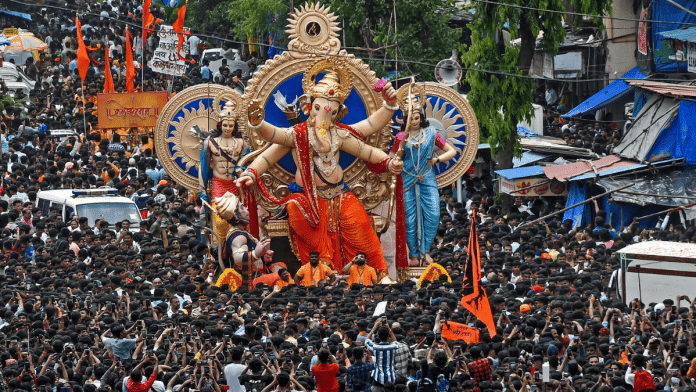

Ganeshotsav has evolved with changing times. It has taken on new meanings and grown with society, but devotion has always remained at the heart of it. What was once largely a private religious affair in the 1890s became a public celebration with participation across social classes. That transformation was led by Bal Gangadhar Tilak.
In 1893, he advocated for Ganesh Chaturthi celebrations in the public space to create an opportunity for people to come together, show their patriotism, promote nationalism, and fight colonialism. The change was evident on the streets of Poona in 1894, with large idols, decorated mandaps, processions, and public immersions.
The remarkable thing about this transformation was that it managed to bring different sections of society under one common cultural umbrella. Tilak understood that a festival could be more than a ritual; it could be a common public experience.
That sense of togetherness builds something deeper: social capital. In India, the Ganeshotsav festival provides an opportunity to demonstrate the values of collectivism that are so prevalent throughout Asian societies.
The ability to collect funds for a pandal, share prasad with their neighbours, organise cultural events, or volunteer at the time of the immersion of the idols all provide opportunities for people to come together and help one another.
Cultural soft power
This journey is also a subtle form of cultural soft power at play. A tradition that found a new public form in Maharashtra has travelled far beyond its place of origin, from Guwahati and Meghalaya in the northeast to Delhi, Kolkata, and Hyderabad, and then across the world.
In Assam, a 45-foot eco-friendly Ganpati in Fatasil Ambari signifies a celebration that has grown over the last two decades, reflecting how the festival is growing in scale and spirit. Ganesh Chaturthi was officially declared a festival holiday in Meghalaya, and the Ganesh Puja celebration in Kolkata increased from 350 in 2025 to more than 800 in 2026.
It has travelled beyond India to the Canada Cha Raja in Toronto, to public celebrations in Mauritius, and even to the Ganesh celebration among students at LSE. Having witnessed this spirit at LSE, it’s amazing how a tradition from Maharashtra can generate a similar sense of community thousands of miles away.
Eco-friendly Ganeshotsav
The next change in Ganeshotsav is already visible in the way we celebrate it. The Swachh Bharat Mission, launched on 2 October 2014, marked a national push towards cleanliness and behavioural change. Its focus has since extended to how we manage waste and public spaces and, importantly, to how we celebrate.
The 2026 Swachhata Hi Seva campaign includes Harit Parv, or clean and green festivities, as its focus, bringing the idea of sustainability directly into India’s festival celebrations.
Maharashtra is already seeing this shift on the ground. The Maharashtra Pollution Control Board has been promoting an eco-friendly Ganesh festival, while Thane has taken sustainability into schools and communities.
In 2025, around 1,385 students and 350 citizens participated in the Shadu clay idol-making workshop, with 25 tonnes of Shadu clay distributed free of cost. Artificial immersion facilities have also become part of festival arrangements.
The pandals themselves are taking this further. Lalbaugcha Raja’s “Prasad to Power” initiative is turning 8 to 10 tonnes of organic waste generated daily into a resource, with waste planned for biomethanation and renewable electricity generation.
The pandal has also shifted to sugarcane-bagasse plates and installed around 500 BLDC fans, which are energy-efficient. Raja Tejukayacha has also followed a paper-idol approach since 2019.
In September 2026, Maharashtra’s Honourable Governor distributed eco-friendly Ganesh murtis, and there was an eco-friendly Shadu idol at Maharashtra Lok Bhavan that was immersed in an artificial tank. The clay was then used as planting material for a neem sapling.
These examples show that sustainability is already becoming part of how Ganeshotsav is celebrated, from the idols we bring home to what happens after visarjan. The festival is growing in scale and is also becoming more conscious.
In Kalyan, we can see this change closer to home. For Ganesh Utsav 2026, building on past years’ initiatives, KDMC made arrangements for artificial immersion facilities at multiple locations. These were supported by safety and monitoring measures, including medical facilities, divers, life jackets, CCTV, drones, and LED towers.
The scale of the arrangements can be seen from the 1.5-day immersion period alone. During this period, around 16,666 idols were immersed across Kalyan-Dombivli, including 5,887 Shadu clay idols.
The management of Nirmalya is another meaningful part of this transition. Around 39.2 tonnes of flowers and other religious offerings collected during this period were transported for composting.
Also Read: BJP fumes over Vijay-themed Ganpati idols in Tamil Nadu, calls them insult to Hindu sentiment
Opportunity for community building
In addition to being a time of religious celebration, Ganeshotsav in Kalyan is also a time for the people. Over 900 free bus trips were provided throughout the Kalyan Lok Sabha constituency, which helped nearly 45,000 devotees get back to their hometowns in Maharashtra.
Thus, the festival became not only about worshipping God, but also an opportunity for community building, family gatherings, and returning to one’s roots.
For me, this is where the next chapter of Ganeshotsav lies. The spirit of seva that has always been at the heart of our festival is now finding new expression in cleaner and more responsible celebrations.
The Seva Sankalp Abhiyan, which is taking place throughout the nation right now, is an example of how “Seva” and “Jan Bhagidari” can work together.
Ganeshotsav has always changed with society, and today those changes are evident in the way we celebrate it. It, in a way, symbolises the strength and agility of our Hindu society and community at large.
Maybe this is the true spirit of Vighnaharta: not only to remove obstacles from our lives, but also to ensure that the celebrations do not create new obstacles for the generations that come after us.
Shrikant Shinde is a member of the Shiv Sena and Lok Sabha MP from Kalyan, Maharashtra. He tweets @DrSEShinde. Views are personal.