






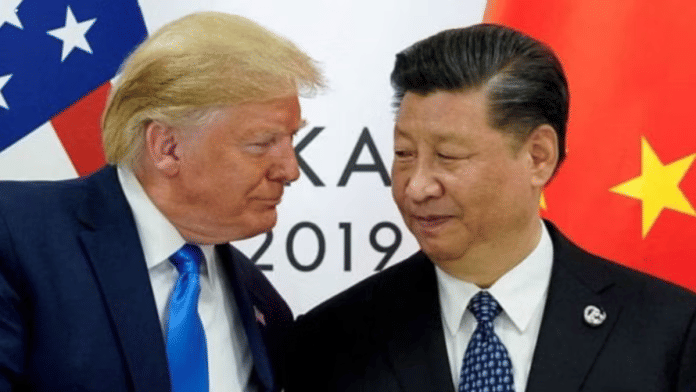



At the recent Geneva Conference on Disarmament, US Under Secretary of State Thomas DiNanno alleged that China had secretly conducted a nuclear test with a yield of “hundreds of tons” at Lop Nur using decoupling technology on 22 June 2020. Beijing rejected the claim outright, describing it as false, fictional, and a rumour. Yet the allegation sparked sustained debate across Chinese policy and online circles, where commentators largely dismissed the US narrative.
On Weibo, discussions under the hashtags ‘China honours its commitment to suspend nuclear tests’ and ‘Trump claims China secretly tested nuclear weapons’ gained traction. “Behind this accusation against China lies a shocking conspiracy. China must be wary of the outbreak of a world war,” wrote a user.
Timing and technical doubts
Within Chinese discourse, the allegation was quickly likened to a Hollywood-style plot twist: dramatic and attention-grabbing but unable to withstand scrutiny. Analysts highlighted the absence of seismic evidence for a nuclear explosion at Lop Nur and cited technical assessments that failed to substantiate the claim. The core question, they argued, was not whether a test had occurred, but why Washington chose to revive a six-year-old allegation now.
Commentators link the timing to multiple factors: the expiration of the New START Treaty, a recalibration of US strategy toward China, and India-China tensions following the 2020 Galwan Valley clash. The claim is interpreted as serving several strategic purposes. It amplifies the “China nuclear threat”, pressing Beijing into arms control negotiations despite its smaller arsenal, legitimises potential US nuclear testing, and shapes public opinion for a US-led restructuring of nuclear governance.
Many Chinese analysts argue that the accusation is an attempt to draw China into a “trilateral nuclear disarmament” framework, described by one commentator as “a carefully packaged shift of responsibility”. Another, referring to Donald Trump’s approach to China, wrote: “I want to pull you to the negotiating table, and I say you pose a ‘threat’ to the world, so you have to accept my terms. This is no longer a simple double standard; it is a ‘dynamic standard’ that changes in real time with my interests.”
Whether the US is accusing China of secret nuclear tests to justify its own nuclear activities is a frequent question online. “Obviously, it is the Trump administration that wants to conduct nuclear tests to expand and update the already huge US nuclear arsenal. They are desperately looking for reasons to do this,” wrote Hu Xijin, former editor-in-chief of the Global Times, in a long Weibo post.
Some analysts also highlighted India’s role. They noted that if a test had occurred in southern Xinjiang, the closest neighbour, India, would likely have detected it—yet no anomalies were reported. The claim only gained attention in India after the US publicised it. Chinese commentary interprets this as part of a broader US effort to draw India closer again as a counterbalance to China, potentially complicating the recently stabilising China-India relations.
“By arming India, the US wants to strengthen its confidence to confront China on border issues while weakening India’s traditional reliance on Russian weapons, tying it more firmly to the US strategic chessboard,” read a commentary on Baijiahao.
A Chinese commentator went on to argue that the US was pursuing an even more strategic move by bringing in a “helper” in the form of India. According to them, the US is sowing discord between India and China at low cost but with immediate effect. By signalling that China allegedly conducted a “secret test” shortly after the Galwan Valley clashes, the argument goes, Washington intends to imply that China has “ulterior motives”, linking nuclear activity to border tensions and deliberately stoking friction.
Also read: Don’t compare India-US trade agreement with UK, EU. It’s a deal with the only superpower
Strategic competition and the ‘China threat’
The US motive is central in Chinese analyses. The American allegation is seen to reflect a long-standing hegemonic logic, where Washington is constructing external threats to justify policy shifts and casting China in that role. Elevating China as a “nuclear threat” allows the US to gain leverage, dominate international discourse, and legitimise strategic initiatives, including potential nuclear testing.
A Baijiahao commentator described the approach as “a pathological psychology of the US”.
“Due to relative decline, it produces delusions of victimisation. They cannot accept that another country can possess even a comparable strategic deterrent. To maintain absolute hegemony, they fabricate lies and undermine global strategic stability,” read the post. Another commentator noted that the aim is to weaken the foundation of China’s nuclear deterrence.
Chinese analysts also emphasise nuclear asymmetry. China’s arsenal remains far smaller than that of the US and Russia. From this perspective, current arms competition is hardly driven by China’s posture, but more by the actions of established nuclear powers.
The episode underscores how nuclear issues remain an integral element of the enduring US-China rivalry. Allegations, signalling, and strategic messaging over nuclear capabilities operate alongside regional tensions and technological competition, forming part of a broader, multi-layered contest for influence.
Sana Hashmi, PhD, is a fellow at the Taiwan-Asia Exchange Foundation. She tweets @sanahashmi1. Views are personal.
(Edited by Prasanna Bachchhav)