






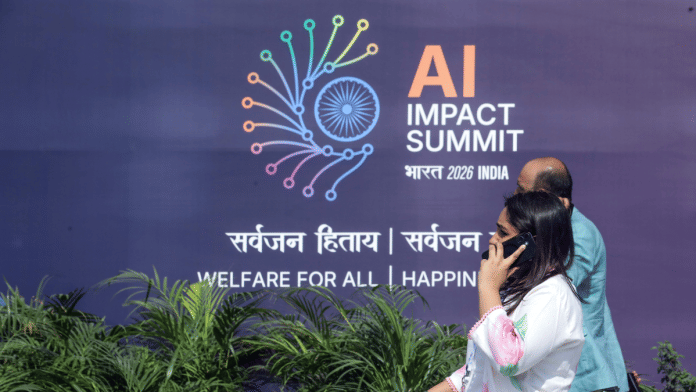



The Year of the Horse opened with political leaders and Silicon Valley executives descending on India for the AI Impact Summit. On the Chinese internet, the event sparked extensive discussion about India’s AI ambitions, its structural advantages, and its constraints.
One Baijiahao commentator described it as a “global tech party” and a “giant tech carnival,” capturing both the scale and spectacle of the summit.
A strategic bid in the global AI race
Within Chinese discourse, the summit is framed as a strategic move by India to stake a visible claim in the global AI race. Prime Minister Narendra Modi is portrayed as highlighting India’s technological talent and vast digital population. India’s efforts are likened to a sudden burst of speed in a race, aimed at gaining ground in the next phase of technological competition. Commentators suggest New Delhi is attempting to position itself as a third pole beyond the US–China rivalry. If India can leverage its data scale, talent pool, and cost advantages, it could emerge as a consequential actor in the global AI ecosystem.
India’s invitation to China drew particular attention. On Weibo, discussion circulated under the hashtag “India invites China to AI Impact Summit.” A commentator noted that even before the ink was dry on the US–India agreement, India had extended an invitation to China. Chinese observers interpret this as part of Modi’s balancing strategy: While deepening ties with the US, India seeks to preserve strategic autonomy through engagement with China. By involving China in a “Global South” AI governance initiative, India appears to keep its options open. China’s participation is widely seen as a positive signal for bilateral relations, and some Weibo posts suggest it demonstrates India’s determination to tap into opportunities offered by China, while avoiding overreliance on the West.
Lai Jiaqi, a reporter for Guancha, emphasised that India hopes to enhance its status and diplomatic influence by inviting China and the US, two AI powerhouses, to the summit. This move signals India’s ambition to integrate into the core of global AI governance and position itself as a neutral yet pivotal actor among major powers.
Also read: Vaishnaw apologises, but chaos spills over to Day 2 of AI Summit—long queues, abrupt end to sessions
Cautious appreciation, persistent critique
Alongside measured praise, scepticism runs consistently through Chinese discourse. Commentators argue that while the summit projected an image of international centrality, it was fundamentally strategic signalling. One Weibo post observed that the high-profile line-up created the impression that AI’s centre of gravity might be shifting towards South Asia. Yet, at a sensitive geopolitical moment, US tech firms are deepening engagement with India while scaling back in China.
A Baijiahao commentary situated the summit within Modi’s broader vision of positioning India as a “Global South leader,” transforming it into a manufacturing hub and cultivating favour with the US and Europe. Yet it stressed that India remains structurally distant from the second tier of global AI powers and lags behind Japan and South Korea in industrial chain development. With AI advancing at a pace measured in months, and with the US and China already consolidated, India’s margin for manoeuvre is narrow. Even articulating “Indian-style” AI governance would not automatically elevate India to peer status. While divergence between US closed-source and Chinese open-source models creates some diplomatic and regulatory space, India cannot compete on equal footing without a robust domestic ecosystem.
The commentary further suggested India may be leveraging the summit to attract reverse supply chain flows, particularly from China, generating economic gains while operating within architectures largely shaped by others. In this reading, India’s strategy is adaptive rather than transformative, catching up is possible, but without sufficient capital, infrastructure, and technological depth, it would be costly and complex.
From this perspective, the stakes for Modi’s government extend beyond optics. Organisational missteps and chaos of the first day at such a high-visibility event could weaken India’s claims of technological competence, even as global headlines project ascent. Another post distilled the structural challenge into three core deficits: Autonomy in computing power, access to high-quality data, and sustained depth in research and development.
On India’s shortcomings, Chen Xiaoyang, a correspondent for Guangming Daily, noted that by the end of 2025, the country had become a major destination for global AI investment, with leading firms announcing large-scale data centre, cloud, and AI projects. Yet behind this surge, structural challenges are evident. Regulatory frameworks remain underdeveloped, infrastructure faces energy and water constraints, semiconductor capabilities are limited, and converting India’s vast user base into sustainable revenue is difficult. India also contends with a critical shortage of high-end and interdisciplinary AI talent: Although it has a large engineering workforce, top researchers and experienced engineers are often absorbed by multinational R&D systems or work abroad, while advanced areas such as generative AI, chip architecture, and system-level optimisation demand expertise that cannot be rapidly scaled. These gaps, according to Chen, suggest that investment momentum alone may not suffice to establish long-term technological leadership.
At the same time, Chinese commentators acknowledge the political signalling embedded in the summit. By engaging China and other Global South actors, India asserts that the future of AI governance need not be defined exclusively by Western powers. Hosting the summit is interpreted as a statement about multipolarity and reforming global governance to reflect 21st century realities. Yet credibility will hinge on implementation. India’s AI regulatory framework is still evolving, and bridging the North–South divide requires overcoming intellectual property constraints, localisation costs, and talent shortages.
Who’s winning the AI race?
An AI race is under way, with the US and China in the lead and India attempting to close the gap. The AI Impact Summit has enabled India to carve out visible strategic space and assert relevance in global AI debates. In Chinese discourse, however, this is viewed more as positioning than breakthrough.
The commentary reflects a dual assessment, where a more competitive landscape that challenges Western dominance is welcomed, yet scepticism persists about India’s structural capacity to translate summit diplomacy into technological leadership. India is not yet seen by China as a peer competitor, but rather as an emerging variable in the US–China AI equation. Whether it can move from convening power to rule-shaping authority will depend on the extent to which summit deliberations are translated into tangible actions.
Sana Hashmi, PhD, is a fellow at the Taiwan Asia Exchange Foundation. She tweets @sanahashmi1. Views are personal.
(Edited by Theres Sudeep)
The Chinese views are guided by CCP’s assessment of the event. As such they’re based heavily on legacy geopolitical thinking of the Party and less on technological aspects. That’s why they have jumped the gun, focusing more on India’s constraints and not waiting for the entire event to finish and then report from the ground. So much for CCP’s bid to lead the Global South!