









The quiet release of the US National Security Strategy has triggered a wave of debate across the Chinese internet. The document is being framed as a fresh iteration of America First that steps back from Indo-Pacific security, alliance-building, and network-based approaches. In Chinese analysis, the NSS marks a broader recalibration of Washington’s global strategy, hinting at a shift in its approach to Russia and a reshaping of future military and diplomatic priorities.
On Weibo, discussion has coalesced under the hashtag “the US will not allow any country to become too powerful”, underscoring the extent to which the NSS is interpreted through the lens of US–China rivalry.
America First rhetoric
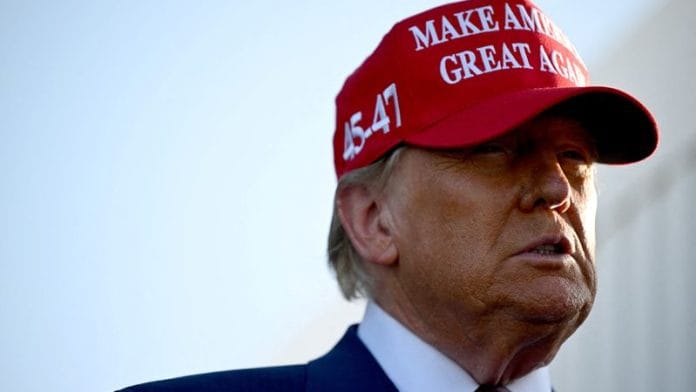
Diao Daming, professor at the School of International Studies at Renmin University, argued that the NSS continues Donald Trump’s long-standing America First framework, which places the maximisation of US interests at its centre.
Zhu Feng, dean of the School of International Studies at Nanjing University, echoes this assessment. He observed that the document aligns US security policy with domestic reform ambitions, reflecting Trump’s ultra-nationalist and business-focused orientation. For Zhu, this marks a return to an unambiguous prioritisation of American industrial and strategic advantage.
Recalibration of China policy
Chinese commentary has paid particular attention to the NSS mention of China. A widely shared Weibo post contrasts the Joe Biden administration’s emphasis on long-term rivalry with China with Trump’s framing of China as a ‘near-peer’ competitor. The post interpreted this shift, along with calls to rebalance economic ties, as a pragmatic effort to restore US economic independence.
Another analysis focused on the document’s use of “China” rather than “PRC”, reading it as a rare diplomatic acknowledgment of China’s near equal status. It argued that Washington’s move from “decoupling” and “de-risking” to language centred on “reciprocity” and “fairness” reflects neither concession nor goodwill, but rather recognition of the costs and limits of prolonged confrontation.
In this view, the US is moving toward more selective and targeted competition. At face value, as media commentator Niu Danqin noted, China appears to have been pushed to a secondary position in Washington’s hierarchy of threats, although this may not prove durable.
Several Chinese experts remain sceptical. Jin Canrong, professor and vice dean of the School of International Studies, Renmin University, maintained that despite speculation that China no longer singularly dominates Washington’s worldview, China will remain central to US strategic thinking.
Other commentaries adopt a sharper line. One argued that the NSS fully fuses economic security with national security, framing four decades of China–US trade as structurally imbalanced. This “economy is security” logic is seen as the organising principle of a more confrontational China policy. Rather than a course correction, it is viewed as a restructuring of US strategy, shifting emphasis from “competition” to “threat”. In this reading, the NSS functions as a blueprint for a more sweeping effort to contain China’s rise.
Another assessment drew a historical comparison, suggesting that the document is Trump’s corollary to the Monroe Doctrine, or as the media is calling it the ‘Donroe Doctrine’. A commentator argued, while the Monroe Doctrine targeted European influence in the Western Hemisphere, Trump’s version appears to be an attempt to constrain China’s economic and technological footprint in Latin America.
This signals an expectation that China–US competition will assume new and more complex forms.
Also read: What’s a National Security Strategy & why CDS Gen Chauhan feels India doesn’t need one on paper
Self-reliance for China
One Weibo user observed that many Chinese commentators view Washington’s description of China as a near-peer as a “two-faced and three-sided knife” or simply a delaying tactic.
The emphasis, the post argued, should remain on sustained economic development as the central task, extending outward into fields such as defence and technology.
Whether or not the US recognises China’s growing power is ultimately immaterial; as long as China’s national strength continues to rise, Washington will be compelled to acknowledge it. This is one of the objectives China seeks to achieve through long-term development, the post noted.
Zhang Jiadong, professor at the Center for American Studies, Fudan University, contended that the current US administration’s “tough plus cautious” combination on the Taiwan issue reflects an adjustment of strategic objectives designed to align with Washington’s own capabilities in a shifting international landscape. The US, he argued, disguises a defensive posture with intensified deterrence, and masks its power deficit and sense of isolation by rallying allies. In response, Zhang suggested, “China should reinforce strategic confidence, maintain long-term determination, deepen the construction of a ‘community with a shared future’ with neighbouring states, reduce external interference.”
Across these perspectives, one thread recurs: The more Trump leans toward isolationism, the more volatile the global order is likely to become. As summarised in a Weibo post, the US has not only abandoned its role as the “world policeman”, it has ushered in a far deeper level of global instability.
Chinese discourse points to the NSS as a reaffirmation of America First, hinting that recent US actions have intensified doubts about Washington’s reliability across Europe and Asia. Shifting commitments and domestic constraints further undermine confidence in the US’ ability to provide steady leadership. This environment is viewed as creating space for China to advance its strategic and developmental agenda, as an inward-looking and confrontational US leaves a vacuum in global and regional governance, even as the China-US rivalry continues.
Sana Hashmi, PhD, is a fellow at the Taiwan-Asia Exchange Foundation. She tweets @sanahashmi1. Views are personal.
(Edited by Theres Sudeep)